









22 June 2026 - 11:40am
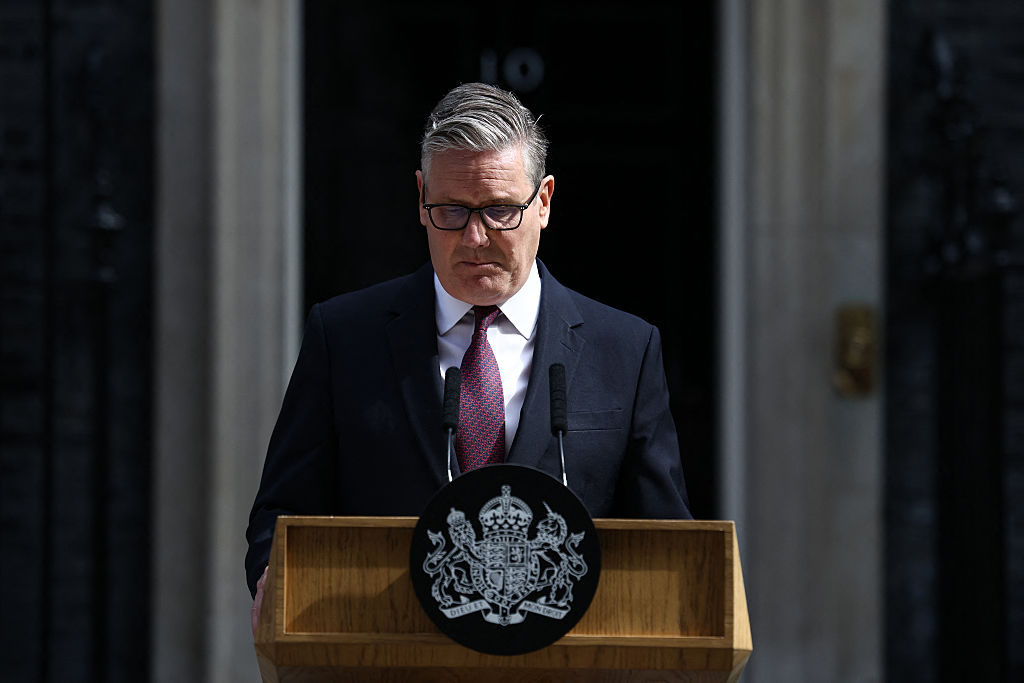
It was difficult, at a purely personal level, not to sympathise with Keir Starmer as he choked back tears at the end of his speech this morning, in which he announced his intention to resign from office. It is never a pretty sight to see a man struck down from the heights he once scaled, and no one should take any particular pleasure in the Prime Minister’s very public humiliation.
Yet his departure followed the pattern of his premiership. Until the very last moment, Starmer insisted that he would fight on. As late as Friday, he had vowed that he was “not going to walk away”. His media surrogates then spent the weekend repeating that line, only for him to do what everyone knew he was going to do and U-turn this morning.
If there is one thing Starmer liked to talk about, it was fighting. Whenever he encountered a crisis, he would give a speech and vow to fight. Last month, ahead of the Unite the Kingdom march, he proclaimed that “we’re in a fight for the soul of this country.” In February, after Scottish Labour leader Anas Sarwar called for him to go, the PM said: “I will never walk away from the people that I’m charged with fighting for.” At last year’s Labour Party conference, amid general unpopularity, he insisted: “I will fight with every breath I have.”
Then, having vowed to fight on, he would return to doing whatever he had been doing, having mistaken the act of talking about fighting for the activities associated with it. When a prime minister, in the full bloom of his power, engages in fighting talk, one cannot help but be impressed — at least the first time. But by the end of his time in office, his rhetoric had become a symbol of his impotence.
What did Starmer want to fight for, in any case? Assisted suicide? The Republic of Mauritius? Internet censorship? His causes and passions were as inexplicable as his political judgement. He spent his political capital on the most bizarre causes. But don’t worry: he will fight for you, or so he said.
This is not to say that Starmer was a pushover. He was perfectly capable of fighting, as long as it involved his internal party enemies. Jeremy Corbyn, Diane Abbott, and even relatively inoffensive figures such as Karl Turner were kicked out. Labour’s National Executive Committee was packed with yes-men. At last month’s local elections, almost 1,500 Labour councillors were lost to ensure that Andy Burnham’s trip to No. 10 would be delayed.
Starmer’s notions of personal responsibility extended only as far as the throwing distance between the person standing next to him and the nearest autobus. Sue Gray was handpicked, then forced out. Olly Robbins was sacked for appointing the man Starmer had personally chosen to send to Washington, D.C. Chris Wormald was personally chosen by the PM despite advice to the contrary, then sacked for… what exactly? Starmer’s inability to convince the country to stop hating him?
On that final point, it has become commonplace on the commentariat Left to express amazement at the degree to which Starmer is loathed across the United Kingdom. He is a good man, they say, and does not deserve the hatred, despite his flaws.
But what evidence do we have for Starmer’s status as a good man? The consideration with which he stabbed others? The high-mindedness with which he accepted free suits from Lord Alli? The ease with which he speaks of his siblings’ poverty in stump speeches while he himself is a multimillionaire?
The truth is that Starmer is neither a saint nor an evil man. He has his flaws, like everybody else. That, in and of itself, is not disqualifying, either for Downing Street or for anything else. But the gap between the Starmer who existed in his mind — competent, the saviour of his party and his country — and the real Starmer was large, and it kept growing. Voters could sense it, even if he and his media supporters could not. He covered up his glaring inadequacies through loud proclamations about his fighting spirit. The public, not as stupid as the pundits think they are, understood this, and treated him with the contempt that he richly deserved.
The tragedy of Starmer’s career is that it did not have to end like this. In the normal course of events, he would have made a good solicitor general in a lean year. But fate elevated him to the highest office that the son of a toolmaker could achieve, and then brought him crashing down.
