









2 Nov 2026 - 7:00am
Halloween seemingly came a day early this year for Poland’s populists — and for much of Europe’s Right as well.
After months of being stonewalled by Poland’s populist President Karol Nawrocki, who has refused to swear in any of his appointments to the country’s Constitutional Tribunal, pro-Europe Prime Minister Donald Tusk finally took the gloves off on Friday night. Several judges his government had appointed to the tribunal, who had been approved by parliament but never officially sworn in by Nawrocki, collectively suspended the court’s populist-backed president, triggering protests by supporters of the anti-Tusk opposition.
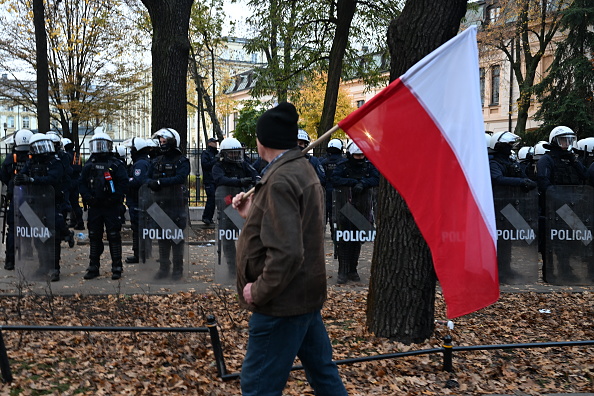
Riot police sealed off the court building, but were unable to stop Nawrocki himself from forcing his way through shortly after he cancelled a diplomatic trip and turned his plane around in midair to return to Warsaw amid the escalating crisis. Tusk, however, has refused to back down, stating in an evening address that “there can be no compromise” on reforming the long-politicised tribunal, claiming that Nawrocki and the opposition were acting out of “greed, stupidity or treason”.
The dramatic events in the Polish capital might seem at first like a strictly local affair. But while it is indeed the culmination of a decades-long domestic feud between the two leading hegemons of Polish politics, Tusk’s Civic Coalition (KO) and the Law and Justice Party (PiS) that backs Nawrocki, it has rung alarm bells across the European Right. Nigel Farage, Marine Le Pen, and Viktor Orbán all chimed in to condemn the actions of Tusk’s government. This is in large part because they see the showdown in Warsaw as a sign that Brussels and its allies across the continent are poised to bring the hammer down on them, and forcefully at that.
Since Friday’s events, the European Commission has essentially sided with Tusk, stating that Poland’s parliament, not Nawrocki, has the ultimate right to approve new judges for the tribunal. This has prompted an uproar from conservatives in the European Parliament. The battle lines appear set, then, for a new phase in the confrontation between the EU establishment and Right-leaning populists, not just in Poland but across the continent.
The impact of Tusk’s moves this weekend will of course be most immediate in Poland, where the affair has further inflamed a polarised voting public ahead of pivotal parliamentary elections next year. This polarisation has long sat at the very heart of modern Poland’s political travails, and is what made the Constitutional Tribunal so politically compromised in the first place.
Shortly after winning power in 2015, PiS argued that Poland’s judiciary had been inadequately cleansed of communist influence after 1989, and so appointed to the court judges who openly supported the party. Even after Tusk’s KO came to power in 2023 on promises of returning the rule of law to Poland, its efforts to reform the court were stymied by two successive PiS-backed presidents. This led to political gridlock and the emergence of two parallel judicial systems — one backed by the ruling government, and one backed by PiS and its opposition allies.
Regardless of Tusk’s intent, the optics of his move has opened a Pandora’s box that will give the fractured Polish Right ample motivation to mount a united front against KO in the 2027 elections. Already, former PM Mateusz Morawiecki has said the situation is a “powder keg” waiting to explode; and in the context of recent extremist plots to assassinate Tusk and members of his cabinet, such an explosion could prove very violent indeed.
As populists face setbacks across Europe, the unfolding drama in Poland may be exactly what they need to regain their momentum and, if necessary, justify strong-arm tactics of their own. But whatever happens next in Warsaw and other power centres in the EU, what’s clear is that a Rubicon has been crossed. The coming chaos in European politics will make the last decade look like child’s play.
 Michal_Kranz