









28 June 2026 - 1:00pm
“Is there a doctor here?”
“I am a doctor, what’s the matter?”
“This man’s having a cardiac arrest!”
“I am a doctor of philosophy.”
“Ah, then this man will die!”
“We’re all going to die…”
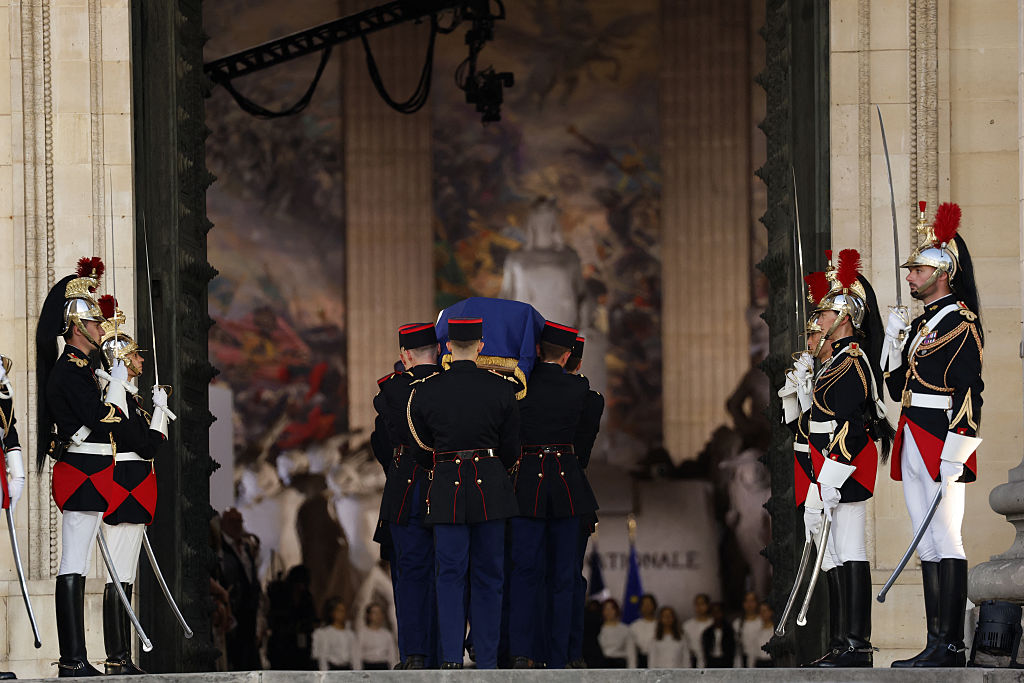
This favourite meme says something important about the touching seriousness with which the French treat philosophical matters. But so does the interment this week of the French academic and Resistance hero Marc Bloch in a solemn republican liturgy, conducted by President Emmanuel Macron himself, in the Panthéon in Paris. Surrounded by the tombs of Voltaire, Rousseau, Louis Braille and Marie Curie, symbolic caskets representing Bloch and his wife, Simonne — their bodies will remain in Le Bourg-d’Hem, where they were buried — were carried into the former church constructed on the orders of Louis XV. This duty was performed by soldiers wearing the sort of kepis and epaulettes that Bloch would have remembered from his service to the “steely, war-like France” for which “the French were required to die and mourn uncomplainingly”.
Panthéonisation is one of the highest civic honours that the French Republic can bestow, commemorating individuals judged to have made an exceptional contribution to the nation. The ceremony possessed that peculiarly French genius for solemnity: a country that abolished kings centuries ago nevertheless understands the value of ritual, provided the ritual is dedicated to the very French ideals of intellect and sacrifice. One could almost imagine Bloch himself observing proceedings with anthropological curiosity, taking notes, as the melancholic strains of Gabriel Fauré’s “Pavane” filled the great space beneath the dome, and Macron, the frustrated thespian, paid his tributes with typical suavité.
In laying Bloch to rest in the Panthéon, the Republic honours not only a patriot who died for his country, but a historian who taught it how to understand itself. For the French, the life of the mind is part of the nation’s inheritance, and its greatest thinkers — and those who lived up to its ideals — deserve a place alongside its greatest heroes.
Where the austerity of the Panthéon ceremony invited reflection upon the republican and democratic ideals of modern France, its legibility also highlighted the contrast with Britain’s own impenetrable state ceremonial. I have always been a fan of the Gilbert and Sullivan aesthetic of red tunics and horsehair wigs at state openings, and the King’s coronation was an immersive experience for anyone partial to Ruritanian splendour. But I imagine that much of the arcana involved in what has sometimes been referred to as “British Shinto” — special cushions, medieval cutlery and men in tights with titles like Silver Stick-in-Waiting and Rouge Croix Pursuivant — is utterly baffling to the wider public.
The British genius lies in performing these mysteries with such confidence that asking too many questions feels vaguely unpatriotic. And unlike the French devotion to Liberté, Égalité, Fraternité, we are more suspicious of abstract nouns, as recent attempts by our governments to define specific “British values” have shown.
But what the UK does miss is its own version of Panthéonisation for non-royals, where Britons could pay their respects with suitable gravitas. The closest analogue is Westminster Abbey, which houses the remains of figures ranging from Geoffrey Chaucer to Charles Darwin, yet the building’s function is primarily religious. Perhaps, in the age of Northern devolution, this charge could be best led locally; I have long dreamed of a Walhalla-style hall of fame on the banks of the Tyne, with marble statues of Northumbrian heroes such as George Stephenson, Grace Darling and Dan Burn.
After all, if France can elevate its philosophers to the Panthéon, the least we can do is give our own heroes somewhere more dignified than a roundabout. Britain has never lacked heroes, only the confidence to celebrate them with quite the same theatrical conviction as the French.
Dan Jackson is the author of the best-selling book The Northumbrians: The North East of England and its People. A New History, published by Hurst (2019)
 northumbriana