









25 September 2026 - 1:00pm
In 1961, the French academic René Girard outlined his theory of “mimetic desire”, arguing that human desire is fundamentally derivative. We want things because other people want them. Desire, in Girard’s formulation, emerges only once others have deemed an object worthwhile, valuable or beautiful.
The cosmetic surgery industry is a perfect example of the power of mimetic desire. Social media has revolutionised how beauty standards are created, so that we are now living through an era of the “copy-and-paste face”. Women, inundated by images of button-nosed, full-lipped, wide-eyed content creators, are driven by this “mimetic” desire and go to increasingly extreme lengths to achieve the same youthful “look”.
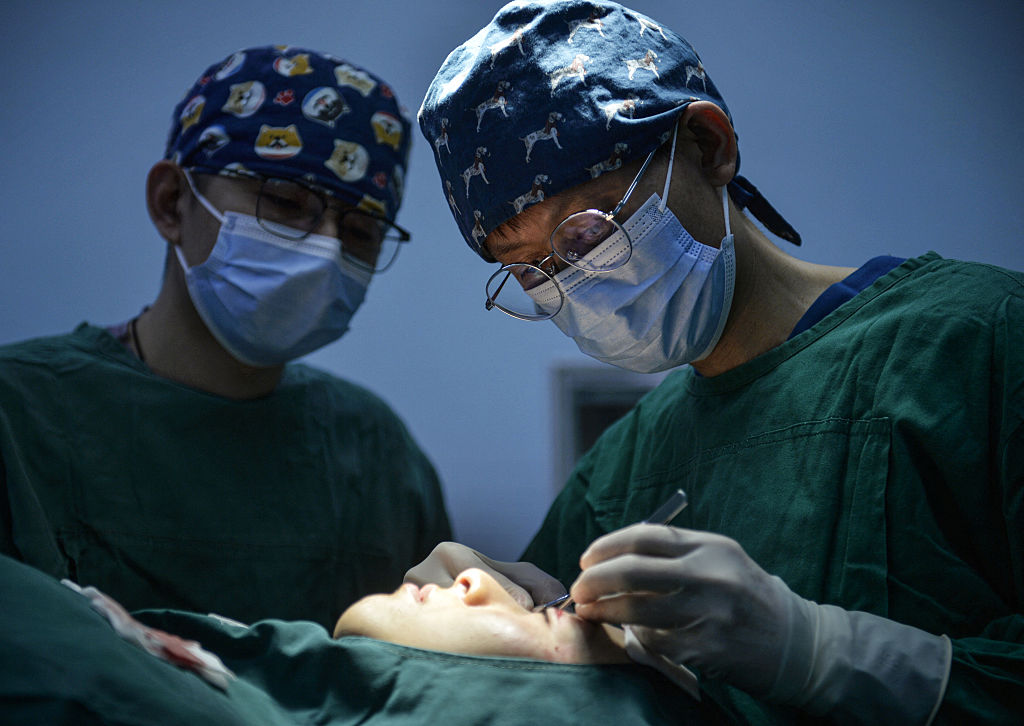
A report from the BBC this week detailed a rise in the problems that some women are experiencing after undergoing a blepharoplasty, a procedure that involves removing skin from just above the eyes. One woman who was interviewed told of how her eyelids split open and became infected after the procedure; another said she had too much skin taken off, risking permanent damage.
The rise of this treatment — sometimes referred to as “bleph” on social media — is a sign of a wider trend. Women no longer just have the option of boob jobs, tummy tucks or lip filler, but can choose from a whole menu of interventions: brachioplasty to remove “bingo wings”, Botox to make shoulders narrower, and labiaplasty for that porn-star look.
It’s clear that the pursuit of Kardashian curves and contoured cheekbones comes with medical risks: infection, pulmonary embolism, fat embolism, facial paralysis. Since 2019, at least 28 Britons have died from complications following cosmetic procedures carried out in Turkey. Even when performed by regulated doctors in the UK, successful procedures come with high rates of dissatisfaction and do little to improve self-esteem.
So why is cosmetic surgery accepted as just another form of “self-care”, rather than facing the unpalatable truth, which is that this is self-mutilation inflicted by the egregiously vain or the mentally unwell?
It’s because there is a degree to which we find the visual outcome palatable. It is easy to take pity on a TV personality such as Jessica Alves — the human Barbie doll — or model Pixee Fox, who had six ribs removed to achieve a tiny waist. Some have achieved cartoon character proportions, but still undergo entirely “unnatural” processes to achieve that “natural” look. Take Kris Jenner, who has normalised everything from ear-lobe reductions to routine use of fillers, and has now had two highly publicised facelifts. This means that twice she has voluntarily chosen, for no medical reason, to have her skin sawn off, her facial ligaments cut, her subcutaneous muscle trimmed away — and this is somehow “empowering”.
In saner times, influencers such as Clavicular, who smashes his jawline with a hammer to give himself a more chiselled look, or Amy Childs, who claims to have been “addicted” to surgery since the age of 18, would be referred to a psychiatrist rather than boosted on a public platform. Yet in 2026, everything about our shallow, self-absorbed culture has become inverted: freezing facial muscles or scooping out cheek fat is apparently not a form of self-harm but self-love.
The irony is that so many behaviours nowadays are pathologised as mental illness. And yet wanting to fundamentally change one’s appearance is not seen as one of them. As long as society indulges this delusion and blindly encourages people to “do what makes you happy”, young women will continue to travel abroad for dangerous procedures that will make them anything but.
