




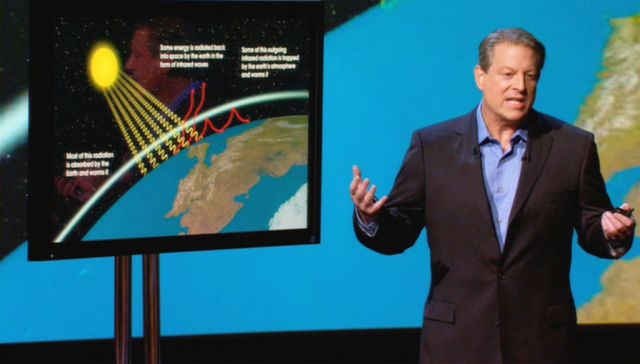
Al Gore delivers a presentation on climate change for his 2006 film, “An Inconvenient Truth.” Credit: Getty





It was just another day in school in the sweltering heat of suburban South Florida. Upon our return from afternoon recess, our fifth-grade teacher treated us to a documentary written and presented by former Vice President Al Gore. The hit documentary, An Inconvenient Truth, released exactly 20 years ago, made a marked impression on me and my classmates. Gore’s warnings of super-hurricanes and a submerged Floridian peninsula filled the classroom with alarm, especially in the wake of devastation from Hurricanes Wilma and Katrina.
In the two decades since the film’s release, Left-of-center politics has inculcated millions of young Americans — me included — in the belief that climate change poses an existential crisis. In the documentary, Gore himself used the false analogy of a slow-boiled frog to describe societal complacency in the face of supposedly impending doom. “It takes a sudden jolt sometimes before we become aware of a danger,” intoned Gore, “If it seems gradual, we are capable of not reacting.”
Over time, the routine abuse of this philosophy made me question core tenets of the climate movement, most notably the supposed threat of imminent apocalypse. In no uncertain terms, many of its followers adhere to a quasi-religious cult: climate fundamentalism. Like related iterations of cultural progressivism, climate fundamentalism distorts facts, disregards progress, and prescribes self-defeating policies in the service of deliberately nebulous and unrealistic goals.
Many of An Inconvenient Truth’s most alarmist claims turned out to be wildly inaccurate. In 2007, Britain’s High Court of Justice found nine scientific errors that would need to come accompanied with pertinent explanations from instructors should they wish to screen the film in schools. Twenty years on, the peaks of Kilimanjaro remain snowcapped, Glacier National Park features glaciers year round, and Florida’s coastline is largely unchanged. Even in the worst of cases, Gore’s prediction of a sunken Sunshine State would take more than a millennium to become reality.
To be sure, the film’s broad explanation of manmade climate change and associated negative consequences were mostly well substantiated. A historic heat wave in Europe has reportedly contributed to thousands of excess deaths since June; flooding in my native Florida and wildfires in California are both increasingly frequent and severe. The question to ask, however, is whether any of these phenomena — and climate change more generally — constitute a terminal risk to humanity.
Former President Joe Biden certainly thought so. In 2023, he stated: “the only existential threat humanity faces even more frightening than a nuclear war is global warming going above 1.5 degrees in the next 20 to 10 years.” The issue, of course, is that Biden’s assertion was patently incorrect. In human terms, climate change — unlike nuclear war — is a gradual process. Treating it otherwise is both counterproductive and obscures rational, commonsense measures that would otherwise mitigate negative consequences for the global poor and working classes. Expanding wind, solar, geothermal, and nuclear power can help limit warming in the long run.
Yet a 1.5-degree-centigrade increase in the Earth’s average temperature won’t extinguish humanity. Anyway, it’s a virtual certainty by 2040, barring an unlikely breakthrough in carbon capture technology. In turn, local, regional, and national governments will continue to funnel resources towards dams, levees, desalination plants, wildfire mitigation, tree cover, and air conditioning.
Much of the Middle East’s current population of more than 500 million would be unviable without current household rates of air conditioning (about 90% in Saudi Arabia, the United Arab Emirates, and Qatar) and existing desalination plants, some of which have been targeted in the region’s ongoing conflict. The obvious solution to saving lives from European heat waves is to emulate other high-latitude peers like Japan and South Korea and expand the continent’s meager AC coverage. Yet opposition to such proposals has come from none other than climate fundamentalists.
In Britain, the ostensibly populist Green Party opposes AC expansion on the grounds that cooler homes would produce more fossil fuel emissions. In France, Leftist standard-bearer Jean-Luc Mélenchon told Le Monde in June, “we must absolutely not install air conditioning everywhere; that would only make things worse.” Never mind the fact that only about 5% of France’s energy consumption consists of fossil fuels.
For those of us committed to a practical, state-led energy transition, France’s eminence in nuclear power stands as a model to follow. Between 1975 and 1990, when renewables were wildly unreliable and far from cost-effective, the country built more than 50 nuclear reactors, achieving near-total energy independence and creating more than 200,000 jobs to boot. But, for decades, climate fundamentalists were among the most rabid opponents of nuclear power on account of exaggerated environmental and societal risks from nuclear waste and potential accidents.
In Germany, the “climate-conscious” establishment Christian Democrats, Social Democrats, and, especially, the Greens completed a total liquidation of the country’s existing nuclear plants by 2023. In addition to deepening dependence on natural gas from Russia and the United States, the phase-out predictably boosted the use of coal, oil, and natural gas, which currently account for 60% of primary energy consumption. The same year, the celebrity degrowth quadrumvirate of Robert De Niro, Leonardo DiCaprio, Ralph Lauren, and RFK Jr. spearheaded a campaign that successfully closed New York’s Indian Point Power Plant. Just so, the state has since made up the energy shortfall with natural gas.
Climate fundamentalism’s self-destructiveness is by no means limited to developed countries. In Chile, efforts by then-President Gabriel Boric to promote lithium extraction were stalled by activists who accused the progressive leader of “greenwashing.” Aiming to avert a supposed “desertification” of Colombia, Leftist president Gustavo Petro halted all novel oil exploration, despite the fact that the country produces virtually no fossil-fuel emissions. Finally, in Brazil, foreign and domestic NGOs have sabotaged efforts to pave dirt roads in the Amazon on the grounds that better infrastructure will lead to increased deforestation. Never mind the fact that deforestation under President Lula Da Silva has fallen near an all-time low.
For all of its faults, An Inconvenient Truth committed a laudable if heretical act by the standards of modern climate fundamentalism: it acknowledged progress. In it, Gore celebrated collective action that reversed the hollowing of the ozone by phasing out harmful chemicals in aerosols. But when it comes to the ongoing energy transition away from fossil fuels, yet another tenet of climate fundamentalism is that any and all progress — however significant — must be played down, if not ignored outright.
In reality, much of the developed and even the developing world have made great strides since the premiere of An Inconvenient Truth. In Europe, total emissions have fallen in half since 2006. Despite Germany’s nuclear self-sabotage, non-fossil fuels currently account for roughly 70% of total energy production. And while much of the Continent’s total consumption is still reliant on fossil-fuel imports, reforestation — and, consequently, CO2 absorption — since 1990 has expanded forest cover to around 35% of Europe’s total land area.
In Latin America, CO2 emissions have remained stagnant since 2000, despite the fact that the region’s population has increased to 672 million in that period, up from 500 million. In the same period, deforestation in Brazil has fallen by over 80%. Even during the four-year period of state-sponsored land grabs and slash-and-burn agriculture of the Right-wing President Jair Bolsonaro, deforestation was still around half the rate prior to 2005.
Then there is China. Historic breakthroughs in renewables, electric vehicles, and nuclear power will see the Asian titan replace much of its still-coal-dependent grid within the coming decades. The Middle Kingdom’s overwhelming dominance in exporting both solar panels and EVs is likely to power an energy transition throughout much of the developing world.
Progress has even been made in gas-guzzling America, where CO2 emissions have fallen to 4.9 billion tonnes in 2024, down from 6.1 billion in 2007. And while renewables continue to make up a growing share of the country’s energy matrix, the reality is that the bulk of this decline is a result of the shale boom replacing coal with far cleaner natural gas. Make any of this known to climate fundamentalists, and they will instinctively counter that any and all anti-apocalyptic evidence is “denialist” and funded by the fossil-fuel lobby.
Put another way: the correct course, in the view of the climate fundamentalists, is to deny, delay, and roll back as many fossil fuels as possible regardless of the effect on the working class. Higher taxes on gas sales, restrictions on oil and gas production, and overreliance on renewables in Democratic states have led to exorbitant energy costs, even at times when gas prices nationally are low. Yet the fundamentalists won’t relent. Writing on X, as The Lever cofounder David Sirota described Biden’s reluctance to go beyond shutting down the Keystone XL Pipeline and the shale boom under Barack Obama as a “crime against humanity.” (This, even though the latter brought about 700,000 jobs and a decline in emissions.)
There is a better way for those of us interested both in pro-worker politics and a realistic energy transition.
Socialist mavericks like the Canadian journalist Leigh Phillips, Syracuse University professor Matt Huber, former German Left party MP Sahra Wagenknecht, and the now-defunct publication The Liberal Patriot have argued that concerns over climate change cannot come at the expense of workers and ordinary consumers. Putting pressure on working-class consumption only helps to elect the far Right.
Yet heterodox Leftists like Huber have been excoriated by fundamentalists for daring to question core tenets of the climate movement. Huber made the commonsense argument that Democrats would do better to restore much-needed credibility with non-college voters as opposed to virtue signaling over climate. Writing in The New York Times, he opined: “American voters broadly agree that climate change is a real concern and support addressing it, but they largely do not see it as a top priority. The Pew Research Center routinely asks Americans to rank their top concerns and climate change is consistently near the bottom.” That made Huber the hated “main character” in the progressive corners of social media for the better part of a week.
None of this is to exonerate the Right and, especially, the Republican Party for their fanatical opposition to renewables. In the same way that climate fundamentalists scoffed at Americans’ pain at the pump post-Covid, the Trump administration gutted much of the Biden administration’s subsidies for renewable energy amid spiraling energy prices from the AI boom. Then, in February, the White House launched the ongoing Iran War, causing oil prices to spike.
Democrats are right to point out that renewable tech in solar, wind, and battery storage is increasingly cost-competitive and viable for solving renewables’ short-term intermittency. At the same time, batteries remain impractical for mitigating long-term intermittency, meaning that fossil fuels and nuclear still have a role to play in maintaining stable and abundant energy — and employing millions of workers. Much to their credit, climate activists from across the political spectrum, including the fundamentalists of the 2010s like Greta Thunberg, have since warmed to nuclear power, which is currently experiencing a relative global renaissance.
Anthropogenic climate change is quite real and worthy of collective action. By all means, states should continue to drive innovation and investment in improvements to renewables and nuclear energy. Al Gore, then, sowed the seeds of an inconvenient and self-defeating cult. His fundamentalist successors would do well to reassess the myriad ways in which they’ve contributed to their own discredit.
