




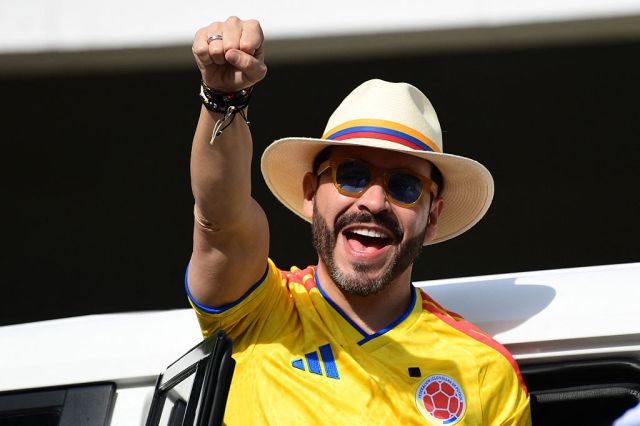
Abelardo de la Espriella promises law and order.





On Sunday, Colombians narrowly elected the Right-wing lawyer Abelardo de la Espriella to the presidency with 49.7% of the vote against ruling-party nominee Iván Cepeda’s 48.7%. Cepeda’s loss also heralds a sad conclusion to Colombia’s first Left-wing government under incumbent President Gustavo Petro. Amid an ongoing conservative wave in Latin America, de la Espriella’s victory is another win for the Trump administration and its “Donroe Doctrine.”
Above all, de la Espriella is more or less Colombia’s answer to Argentina’s Right-wing populist President Javier Milei: bombastic, cartoonishly subservient to US power, wont to break but not to build. His victory is a testament to Colombian progressives’ folly in adopting the climate, security, and identity politics of the Western Left.
Much like President Trump, de la Espriella fits the Right-wing archetype of the outsider businessman, complete with allegedly dubious deals and flamboyant self-promotion. In the Colombian’s case, the millions came from his legal firm and his extracurriculars include recording music videos and shamelessly promoting self-branded luxury goods on his eponymous podcast.
De la Espriella has been derided as el abogado de la mafia, “the mob’s attorney,” for representing clients like Colombian narco-paramilitary warlord Salvatore Mancuso and Colombia’s former President Álvaro Uribe (2002 – 2010). The most consequential is Uribe, who is alleged to have run death camps with Mancuso’s United Self Defense Forces of Colombia, racking up thousands of civilian casualties while conducting war against FARC, the Left-wing guerillas-cum-drug dealers. De la Espriella previously made the unrealistic promise to nominate Uribe as his vice president. For his part Mancuso, who served time in the United States for drug trafficking, claimed in 2025 that he and de la Espriella were childhood friends.
As an attorney, de la Espriella also represented Colombian-Venezuelan businessman Alex Saab between 2014 and 2019, long after the latter’s ties to the former Venezuelan dictator Nicolás Maduro were well known. On May 19, Saab was extradited to the United States for allegedly laundering $350 million via American banks for the Maduro regime. Days later, the Colombian journalist Daniel Coronell published documents showing that de la Espriella received almost $400,000 in illicit funds from Saab’s companies.
In his own words, de la Espriella’s international role models are Trump, Argentina’s Javier Milei, and El Salvador’s Nayib Bukele. From Bukele, de la Espriella has borrowed his appearance — the two men look remarkably similar — and his hard-line security policies. But by far, his greatest influence is Milei, who anthropomorphizes himself as a lion in accordance with libertarian social Darwinism. In the same vein, de la Espriella styles himself El Tigre, often engaging in song and dance with AI-generated felines at his rallies.
Like Milei, de la Espriella professed elite libertarian views before launching his presidential bid. Up until recently, his market fundamentalism came paired with vocal support for euthanasia, abortion, and adoption by same sex couples. The issue, of course, is that this combination of progressive social views and market worship is repellent to the working class. De la Espriella now claims that he evolved on these issues, exalting the traditional family and calling abortion “an abomination.”
More dubious still is his conversion from godless globalist to a Catholic patriot. In 2017, de la Espriella stated in an interview that he denied the existence of anything that reason can’t explain. When asked why he married his wife through the Catholic Church, he replied, “We all commit foolishness and stupidities for love.” In the same vein, the millionaire attorney is a tri-citizen of Colombia, Italy, and the United States, and lived abroad in Florence and Miami for at least a decade prior to his campaign.
Recognizing these vulnerabilities, de la Espriella now claims that he found God in 2020 following his aunt’s death from Covid, though pre-campaign evidence of his religiosity is scant. Now, the president-elect champions Christian nationalism and has adopted the slogan Firme por la patria — “firm for the fatherland.”
In practice, this firmness seems to involve a great deal of deference to Washington — or rather, southern Florida’s Trump World. This month, de la Espriella stated that he voted for Trump and is a registered Republican in the United States. He has also celebrated the White House’s extrajudicial killings of alleged “narco-terrorists” near Colombian waters, though none of the victims have been proven to have engaged in drug trafficking. Undaunted, de la Espriella has gone so far as to say that he would welcome US strikes inside Colombia.
Much of this explains why de la Espriella’s victory was so slim. Petro, moreover, will leave office as the most popular Colombian leader since Uribe. After spending much of his term mired in telenovela-esque scandal and identitarian excesses, Petro engineered a stunning turnaround that saw his approval ratings recover to nearly 50%.
In 2024, the administration passed a pension reform expanding coverage for almost 14 million Colombians, including some 3 million seniors living in extreme poverty. Petro also restituted around 1 million out of a total of 3 million hectares for victims displaced by guerrilla conflict. Jhon, an ex-soldier and displaced person from rural Tolima, told me that his hometown had since flourished thanks to government investment, including improved infrastructure and rural health care. “People are growing coffee and bananas again,” he said.
The Petro administration also passed a historic labor reform, reducing the workweek to 42 hours and restoring workers’ rights and benefits that were previously cut by Uribe. Workers now receive overtime worth an additional 35% of wages after 7 p.m., as opposed to 9 p.m. previously, in addition to 90% overtime on weekends and holidays in 2026, set to rise to 100% next year. Additionally, the government has raised the minimum wage around 40% in real terms since 2022, including an unprecedented 23% hike for 2026. Contrary to scaremongering about job losses and “Venezuelization,” poverty and unemployment have fallen to record lows.
So why, then, did so many Colombians vote for a politician who can only be described as a MAGA-Miami asset?
The answer is that Petro’s pro-worker turn proved too little, too late. In recent years, much of the Latin-American Left has taken to the activist-academic progressivism of the Western Left, which largely appeals only to credentialed cosmopolitans. Cepeda’s margins with working-class Colombians fell decisively relative to Petro in 2022. Supporters will inevitably fixate on de la Espriella’s surge among fickle, middle-class voters, but this ignores serious failings of policy by the Leftist establishment.
Colombia produces virtually no fossil-fuel emissions, yet Petro halted all novel oil exploration under the pretense that humanity has 12 years to avoid extinction from climate change. Around half of government revenue derives from the sale of petroleum, most of which comes from the state firm Ecopetrol. Yet Petro resolved to destroy Ecopetrol, whose revenue collapsed by more than half during his term. Up until 2025, Colombia was wracked with stagflation — low growth, high inflation — a predictable consequence of the government’s energy sabotage.
Catastrophically, Cepeda’s campaign remained committed to the outgoing president’s climate fundamentalism, despite a spiraling energy crisis. In a show of sheer stupidity, Petro and Cepeda put Ecopetrol’s union in the impossible position of choosing between labor rights and the promise of renewed exploration under de la Espriella. To his credit, the president-elect has committed to a commonsense, all-of-the-above strategy that includes fracking (which Petro has described — try not to roll your eyes — as a “crime against humanity”).
Security was also a top concern among Colombians. When it came to tackling common crime, particularly in urban areas, Petro has embraced “criminal-justice reform” of the kind that has hobbled cities run by Democrats the world over. His government attempted — and thankfully failed — to reduce prison sentences for crimes like murder. He also condemned building prisons for fear of perpetuating “mass incarceration.”
Asked by a youth influencer about how he would respond to someone breaking into his own home, Petro waxed philosophical on criminals as victims of society. In contrast, de la Espriella has promised to build mega-prisons modeled on Bukele’s in El Salvador.
Dealing with the militarized cartels, guerrillas, and Right-wing paramilitaries that dominate parts of the Colombian countryside is a different matter, however. Petro’s record on this front, while poor, is roughly comparable to that of his post-Uribe predecessors. Since 2022, Colombia’s high national homicide rate, about 25 per 100,000, has remained stable. While cocaine production has soared to a record high, critics omit that production has risen consistently since 2012. Accordingly, Petro has seized record amounts of the drug.
In contrast, Petro’s “Total Peace” initiative — negotiating peace deals or terms of surrender with multiple armed groups simultaneously — has created more problems. In May, infighting within a FARC splinter group led to nearly 50 dead in the Colombian Amazon. The competing factions were allegedly torn between guerrillas interested in negotiating with Petro and others keen on exploiting illicit economies.
Norberto, a schoolteacher and de la Espriella supporter, told me he wasn’t opposed in principle to talks with armed groups but felt that Petro lacked an iron fist and follow-through during negotiations. Indeed, the architect of Total Peace was none other than Cepeda, Petro’s heir and would-be successor, who doggedly refused to explain what, if any, changes he would make to the policy as president. Then again, de la Espriella’s promises of mass bombings, perhaps conducted by Washington, are unlikely to meaningfully improve security in the countryside; Petro’s predecessor, Iván Duque, tried a similar strategy with mixed results.
More broadly, the problem with the president-elect’s promise to imitate Bukele on law and order, is that Colombian courts, unlike their Salvadoran counterparts, are unlikely to tolerate an indefinite suspension of due process. Even then, the example of Noboa’s Ecuador shows that autocratic methods may still prove insufficient against militarized cartels as opposed to simple street gangs; de la Espriella himself has noted that Colombia’s drone-specialized armed groups are far better-equipped than El Salvador’s street gangs.
Colombians have taken a gamble on de la Espriella. Yet — as with Petro — they are likely to be disappointed. Indeed, it is likely that Colombia will descend into mass unrest by year’s end. Like his Right-wing peers elsewhere in the region, the president-elect is enamored with Milei’s “chainsaw austerity,” which he aims to enact via a Trumpian executive decree. Promises to privatize all state companies and slash 40% of public employees are certain to deliver mass protests identical to those in Argentina, Bolivia, Ecuador, and Chile.
The saddest part about the president-elect’s market fundamentalism is that — unlike with the cartoonishly mismanaged Argentina — there simply is no case for mass cuts in Colombia. The Andean nation’s debt-to-GDP is just 60%, compared to Argentina’s whopping more than 150% in 2023. Colombia’s deficit is admittedly high at more than 6%, yet critics neglect that mass cuts would kill economic growth, thereby increasing total debt. Much like Petro’s dogmatic capture on climate change, de la Espriella is equally captured by a fanatical hatred of public services; ironically, the bulk of Colombian public employees form part of the country’s desperately needed armed forces.
There is a painful lesson here for the Latin-American Left. Mexico’s Morena under Presidents AMLO and Claudia Sheinbaum remains the only ruling party Left-of-center in the region to have won re-election since 2020. Sheinbaum, a climate scientist, has championed the state oil firm Pemex and even pushed to expand fracking in tandem with renewables. And contrary to her image as a progressive heroine, the Mexican president and her hard-line security minister, Omar García Harfuch, have tripled Mexico’s incarceration rate, leading to a historic reduction in homicides. Wage hikes have likewise been steeper in Mexico.
Until Left and Right can get it into their heads that voters despise their respective groupthink — on climate change, crime, market fundamentalism, and worship of foreign interests — they will continue to alternate power in the most destructive manner possible. It remains to be seen whether de la Espriella and the current crop of Right-wingers in the Americas stave off a bloodbath in the next wave of elections.
