




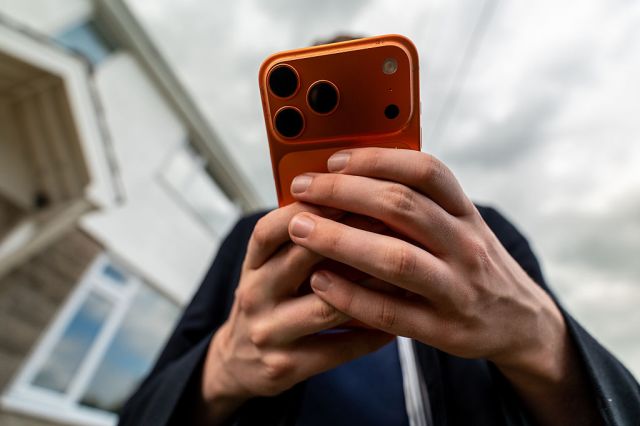
Real-world spaces are closing rapidly as people stay home with their phones. Credit: Getty





“It’s really bad for you … we know better than to drink all night.” “I just like to go home after class, relax, maybe go on Twitch or Stream.” “Cost of living, man, I have to go out and grind.” These are some of the reasons given by students at my local university, when asked why they no longer frequent the campus pub, which used to close at 1 a.m. and now has its last call around 7:30 p.m. But the real reason was apparent; as soon as they stopped speaking, they turned their heads back down to their phones and went on their solitary way, apparently without the least interest or curiosity in each other. One young woman opened up a bit more: “it’s an anxiety thing. … We don’t really like to talk to strangers.”
With every new innovation, the digital universe continues its conquest of the social world, assimilating everything from high politics to the most personal and intimate aspects of our lives. And there is one consequence that seems to correlate perfectly with this trend: the steady contraction of the real world itself. The relationship between the stagnation of our natural and built environments and the growth of the “bits economy” has been noted before. But what we are now only beginning to understand in depth is how decades of offloading our daily interactions to online spaces has made a desert out of the in-person environments where human beings congregated and conducted the customs, norms, and rituals of shared existence.
The term “third space” was coined by sociologist Ray Oldenburg to refer to these sites where people meet to socialize beyond where they live and work. Such places have been in decline for years before Covid, work-from-home, and delivery apps supercharged the trend. Now, food inflation is accelerating the pace of collapse and changing generational preferences around diet and drink are entrenching it.
The statistics confirm a bleak outlook for the service industry: “nearly 40% of Americans are dining out less frequently,” reports YouGov, while Gallup finds that “the percentage of US adults who say they consume alcohol has fallen to 54%, the lowest by one percentage point in Gallup’s nearly 90-year trend.” Momofuku chef David Chang calls the situation an “existential threat” to his profession. Fast-food chains like Subway and Wendy’s are closing hundreds of locations, and mid-tier and mom-and-pop restaurants are vanishing even faster. One may celebrate the broad turn away from intoxication and greasy food, but people, especially the young, aren’t replacing the bars and diners of old, and are instead forgoing the prosocial dimensions of classic third spaces. Putting on an old episode of Cheers, “where everyone knows your name,” or Friends, with its Central Perk coffeehouse, feels like watching footage from a lost civilization.
Another set of figures completes the picture: crashing global fertility can be attributed to the introduction of smartphones in 2007, according to a new University of Cincinnati study. Time-use data shows that smartphones “halved face-to-face socialization” from 12 to six hours or fewer a week, with the result being that young adults fail to meet and hook up, never starting on the path to reproduction that once began at a bar, cafe or equivalent place for social interactions. What this suggests is that beneath the impacts of exogenous shocks like the pandemic or affordability crises, the antisocial pull is endogenous to the smartphone era. The hollowing out of third spaces, as it turns out, presages nothing less than the extinction of the species.
And thus, what passes for the “new normal” is, in fact, a mass screen-induced distortion of our basic human nature. The only alternative is to actively resist and fight back. But how can people be persuaded to do something? Just as Rachel Carson kickstarted the modern environmental movement with her haunting prediction of a “silent spring,” where birdsong ceased due to the mass die-off of birds from the (hitherto uncontroversial) use of toxic pesticides, so too should the public today be galvanized out of apathy by the image — already a stark reality — of a “silent society” characterized by a social die-off. For the silent society is one drained of organic life and human voices, populated by successive, shrinking generations of dead-eyed youths who no longer know how (nor even desire) to talk to each other, foster friendships, seek partners, or build families and communities beyond what exists as simulation on screens. It is, above all, silent quite literally because the everyday sounds of conversation, laughter, argument, romance, and spontaneity have been snuffed out and surrendered to total digital intermediation.
Of course, the firms of the attention economy have no problem with the silent society and are, in fact, responsible for it — the industry is built on encouraging addiction to its products. A world where people can’t communicate except through phones and AI assistants is one where the rule of the algorithm is absolute. When Mark Zuckerberg hinted at a future where personalized AI (to be made by Meta) fills the friendship gap, he is not previewing a distant dystopia but describing the trajectory we are already on.
Pushback is gaining momentum, but where the interests that prop up the attention economy are concentrated and overrepresented, the rebellion against it is diffuse. There have been promising but limited victories: high school cell phone bans; porn-gating legislation; sporadic subcultures by youths themselves to drop their phones and “touch the grass.” What has been missing so far is a unified countermovement and restoration of the vibrant third-space ecosystems that existed before the silent society. As Financial Times reporter John Burn-Murdoch asked in a recent interview with UnHerd, “If [youths are] not going to be spending two hours a day on TikTok, what are we going to provide in place of that?”
The answer must come in the form of a vision to transcend the silent society and a push to build a coalition of countervailing interests to bring it about. The policy components to fill in such a vision are already hiding in plain sight. The idea of a “digital sabbath” has been floating around for some time. The old sabbaths were enforced by society to uphold the biblical command of rest and worship, and even as late as the mid-20th century, “blue laws” limited business hours and television broadcasts on Sundays.
A new digital sabbath would have to go beyond being a personal wellness quirk and operate at the level of public policy, as a state-mandated two-day-long shutdown of all non-essential attention-economy applications. People would still be able to call or text, but feeds would be frozen. This would not be “censorship” as the law suspends the medium itself rather than any particular message within it; gaming and streaming servers could be curtailed. And yes, there will be outrage and meltdowns as digital addicts undergo withdrawal symptoms, but we’ve reached a point where the liberal axiom of absolute, unfettered personal choice can no longer be endlessly justified.
A second step provides positive alternatives for people to turn to once their social media goes offline. In this scenario, the attention economy would still function five days a week and that activity would, at least for a time, still be lucrative; Big Tech would still rake in billions as it does now. But in this case, it would be taxed a certain percentage of its general income in a country: call it the “Social Reparations Tax,” premised on the idea that the attention-economy firms are directly liable for the social catastrophe wrought by the smartphone age. They should be made to pay for the costs of societal repair. This would come in the form of “third-space coupons” (or 3SCs) funded by the reparations tax, which would be distributed in the mail to ordinary citizens, but especially to the 16- to 34-year-old demographic, and which may be redeemed at any local establishment. In effect, it is a massive wealth transfer from the distraction merchants to the proprietors of displaced third spaces.
But that’s beyond the pale — and has never been done! Yes, the specific redistribution mechanism is genuinely novel but the notion that governments might step in to prop up a struggling service sector is hardly untested. At the height of the pandemic, the British economy undertook an experiment known as “Eat Out to Help Out,” where the government subsidized meals and drinks. The difference would be that the 3SC system would have a stable funding pool, and it proposes to institutionalize over a period of years what has only been tried as a provisional measure. The second- and third-order effects of such a break with the status quo are worth mapping out.
The learning curve for a cohort deprived of regular social contact would be steep as youths strive to rebuild interpersonal skills and habits. It would become an “Addison and Steele” moment, echoing the 18th century, when the arts of conversation and social grace were cultivated by a newly enlightened Europe — a whole new paradigm of sociability would have to be consciously constructed as if from scratch. 3SCs would radically raise demand for food and beverages, as well as in-person leisure services, and create new markets; non-alcoholic alternatives like milk bars could become popular once more.
And just as important, within a few years, the attention economy could itself begin to be crowded out by the revived analogue economy, which would no longer have to be subsidized as much, as demand stabilizes and food production gradually returns to equilibrium, easing inflation. In this case, attention-economy firms would have to find a business model that is more socially productive, perhaps diverting their AI compute power toward rebuilding our material, industrial capacities rather than virtual content; this would amount to a winding down of the attention economy and its replacement with something new.
There is then the question of who or what coalition is supposed to drive such a revolutionary shift? In past essays, I’ve mapped out a stratum of local entrepreneurs known as “the gentry.” Among these are the franchisees, restauranteurs, agribusinesses, brewers, and recreation industry professionals who as a class played an essential but overlooked role in seeding the contemporary rise of populism in America. (Their ranks include Andrew Puzder, Dick Yuengling, Marjorie Taylor Green, and Lauren Boebert.) There are equivalents elsewhere, such as the British publican, the French boulangère, the Japanese teishu — precisely the local elites who’ve been battered by the rise of the silent society and whose fortunes would recover under this scheme. What they lack is a proper “class consciousness,” but an effort to raise them up as the vanguards of a prosocial, pro-human renaissance would align them with the very same youths who will fill the revitalized third spaces and — hopefully — revive family formation and social cohesion.
Finally, just as the attention economy took root with the help of leaders motivated by a quasi-religious ideology centered on the supplanting of humans with godlike technologies, this countermovement too should have its own vision of the divine. It could hold that what makes us human is holy, and that our social capacities are a sacred trust, meant to help us find happiness in each other’s presence and, ultimately, to “be fruitful and multiply.”
 1TrueCuencoism