




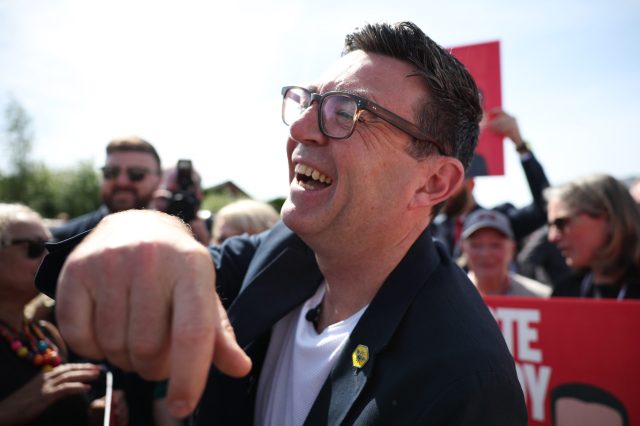
A Westminster creature through and through. (Ryan Jenkinson/Getty)





In his 2004 song “Irish Blood, English Heart“, the Manchester-Irish songsmith Morrissey proclaimed he was “dreaming of a time when/ To be English is not to be baneful / To be standing by the flag not feeling shameful” and “The English are sick to death of Labour and Tories.” It is a mark of Britain’s transformation since then that these sentiments, quixotic and cancellable two decades ago, now represent the driving force of national politics. To escape the harsh winds swirling around them, Westminster’s ruling party has been forced to huddle in fear around the saviour figure of Andy Burnham, the least hated candidate they can find, as the only force standing between them and electoral destruction. Like it or not, we live in Morrissey’s England now.
Yet in this battle between the two visions of the nation, it’s ironic that Burnham himself holds the rare distinction of having been directly scolded by his musical hero. The would-be prime minister, who once rather Pooterishly wrote that while “not in tune with his views now, I can’t deny how important Morrissey was to me”, faced the singer’s wrath for imprecisely characterising the 2017 Manchester bomber as merely “an extremist”.
The Manchester Arena bomb, for Morrissey “England’s 9/11”, and the subject of his unreleased song “Bonfire of Teenagers” — in which “the silly people sing: ‘Don’t Look Back in Anger’… I can assure you I will look back in anger ’till the day I die” — came only two weeks into Burnham’s tenure as mayor of Greater Manchester, in what already feels like a different country. Were it to happen today, it is hard to imagine a restive public responding as warmly as it then did to the comforting platitudes of swaying “togetherness” rolled out by Burnham. In his 2024 political manifesto of no-nonsense Northernness, Head North, co-written with Liverpool mayor Steve Rotherham (whose own daughter was at the concert), Burnham discusses the atrocity more or less like an unfathomable act of God. Particular censure is reserved for the slow response of the emergency services, presented as yet another failure of Westminster state capacity.
That the bomber’s very presence in this country — as a member of a family granted asylum precisely due to their involvement in jihadist opposition to Gaddafi; who was himself returned to Britain from Libya by the Royal Navy while an object of interest to MI5 for his jihadist activity; and who paid for his bomb’s components with taxpayer-funded benefits doled out to his mother — of course represents an infinitely greater state failure. None of this figures in Burnham’s manifesto. Yet it is precisely this grievance — against the strange and cruel punishments that the British state, through a perverted sense of benevolence, wreaks against its own people — that has underwritten Reform’s rise and Labour’s catastrophic fall. Only in his 2025 postscript does Burnham note that, “One of the features of the age in which we live is its extreme volatility… The appalling murder of three young girls in Southport was sickeningly exploited and, for several days after, Britain felt like a country we have not known before… it feels as though we are approaching a political reckoning.” If the numbers are right, Burnham will soon find himself ruling this strange and unknown country. Yet uneasy lies the head that wears the Northern crown: according to the polls, if he enters power at all, it will only be because the threat from Reform, in this once dependable Labour heartland, has been dissipated by the electorate’s unexpectedly strong interest in the more radical Restore party.
Burnham himself warns of the “risk” that “a progressive government could serve only one term and be replaced in 2029 by the most right-wing one Britain has ever seen”, presenting his Northern manifesto as “the Left’s only viable answer to the radical Right.” Is Burnham’s localised success replicable nationwide? As others have noted in their dissections of Burnham’s self-proclaimed “Manchesterism”, presiding over a booming and dynamic citystate is not quite the same as being the cause of its success. That the Northwest, with its Irish links so lauded by Burnham, has become the epicentre of violent revolt against the asylum system and its unintended consequences, first in Knowsley in 2023 and then after the Southport murders, suggests other narratives are possible.
Yet Burnham’s contributions to Head North are more interesting than the Westminster discourse, focused on the economics of Burnhamism, would so far imply. Buried in the text is a one-line summation of the Nairn-Anderson thesis, in which the root of British decline, and latterly its political dysfunction, is traced to the Westminster state’s anomalous failure, when compared with peer nations, to have undergone a successful bourgeois revolution.
“Britain,” Burnham declares, “unlike other countries, has never had a moment of modern nation-building. Our system of governance has slowly evolved from the feudal state, the remnants of which are still clearly visible in Parliament today.” The result, Burnham writes, is that “Britain is one of the most politically centralised and economically unbalanced countries in the developed world.” Rather over-egging Manchester’s distance from the capital — we are led to imagine him like Robert Bruce sheltering from the rain in his cave, ruminating on London’s iniquities — Burnham declares that only in his Northern exile did he reach the conclusion that “the Westminster system was our problem and, in its current form, could never be our solution”.
While Farage and his Right-wing challenger Rupert Lowe echo, in southern English accents and perhaps unconsciously, the discourse of Britain’s peripheral nationalists, Burnham’s critique of the failing Westminster state is more startlingly explicit. The Celtic comparisons are fully intended: his “experiences outside of Westminster”, he tells us, have inspired “a much better understanding of the feeling long building in Northern Ireland, Wales and Scotland”. He rails against an “establishment prepared to play public opinion against parts of the North of England, Northern Ireland, Wales or Scotland whenever it has suited them”. He claims that “they do it because they fear nothing more than the regions and nations uniting in common cause against a system that doesn’t have their interests at heart”. The Hillsborough disaster is repeatedly likened, rather dubiously, to Bloody Sunday. Northern Ireland “has big similarities to the North West of England,” Burnham asserts, without informing the curious reader what these similarities might be.
Yet Burnhamism, in its constitutional sense, represents something that does not meaningfully exist in Northern Ireland: he is an Irish Catholic Unionist, a Home Ruler through and through. This Redmondite quality comes through most clearly in his 2025 interview with Tom McTague. Proud of his great-grandfather’s self-sacrifice in the First World War, “it is Burnham’s Irish roots that help explain his British identity,” we are told, fuelling “his insistence that he is British first rather than English”. Bearer of an identity more commonly found among non-white minorities and Ulster Protestants than Labour’s defected voter base, now merrily flagging their neighbourhoods with St George’s Crosses, “Being British rather than English”, Burnham tells McTague, “allows him to keep all the ‘layers’ of his identity intact: British first, north-west second, Liverpool third, and English fourth.” Or English last, Morrissey might archly note.
For having outlined the similarities between the North — and for Northern England, Burnham only ever really means the urban Northwest — and the Celtic nations, Burnham suddenly tacks in a different direction: insisting that “unlike some in those places, we would never advocate for the break-up of the UK”. He thus utilises the Nairn-Anderson thesis for novel Unionist purposes, using it to save what its originators believed could not be saved. The answer to Britain’s many problems, he argues, is a further round of devolution, breaking up England into powerful city-regions with their own hinterlands, each comparable in size to the Celtic nations. Scotland, Wales and Northern Ireland, in turn, are to be encouraged to devolve more power away from their parliaments towards their towns and cities, which, “collaborating” across the UK’s internal borders in a hazy fashion, would weaken the “inevitably tense and political” relationships between their national governments and Westminster. For all that Tony Blair’s latest intervention in national politics is read as an assault on Burnhamism, Burnham’s own constitutional experimentation is a turbo-charged Blairism, both completing New Labour’s unfinished revolution and, Burnham believes, ameliorating the centrifugal pressures it introduced.
But it is here that we see Burnham’s characteristically Labourite weak point, his absence of national feeling except towards the very Westminster state he claims to oppose. Burnham’s assertion on the outdatedness of nationalism is not borne out by political events, as the May elections showed. The very building block of electorally ascendent Scottish, Welsh and Irish nationalism is their sense of national sentiment and the sense of political destiny it leads towards, a destiny its adherents believe to be frustrated by Westminster rule. Rather than cooperating with a Burnham government, won over by his misty-eyed Celtic reveries and performative distaste for the capital from which he must rule, Burnham’s proposed strengthening of Unionism through devolution would present peripheral nationalists with a mortal threat. Why would they give up their hard-won power to serve explicitly Unionist ends? Why would they abandon their political projects at the behest of Westminster’s latest (and surely short-lived) ruler, thrust to power only as a result of crisis and desperation in the political centre?
And what is true of the Celtic nations is also true of England. Burnham’s analysis of the urban Northwest as the artificially suppressed engine of British modernity, laid low by the rentier capitalism of Southeast England and a creaking and antiquated Westminster state, equally overlaps with that of Tom Hazeldine in his excellent 2020 book The Northern Question. Its history punctuated by occasional rebellions, its dialects divergent from the state’s prestige form, its governance marginal to distant London, Northern England in many ways presents an analogue to the Celtic nations. Yet it never developed its own comparable nationalism. The reason, Hazeldine never quite clarifies, is surely that the inhabitants of Northern England are, politically, English before they are Northern. As such, Northern English dissatisfaction has always expressed itself in trying to reform Westminster rather than seceding from it: and for all that he claims to be Northern first and English second, this is also Burnham’s chosen path.
Yet to save the United Kingdom, Burnham must carve up England, an instinctively conservative country, into a collection of urban metropoles whose cosmopolitan voters will outweigh their suburban and rural hinterlands in the exercise of power. Why would Reform, with its keen if unspoken appreciation of the demographic limits of its appeal, agree to such gerrymandering? Perhaps the march of history compels us, Burnham muses: “If the nineteenth century was the century of empire, and the twentieth was the century of the nation state, the new thinking was that the twenty-first would be led by a network of cities around the world,” he declares, revealing himself as less a daring avatar of national rebirth than as a provincial Sadiq Khan.
We can, no doubt, expect all manner of constitutional novelties from a future Burnham premiership. In its terminal throes, Labour is making the explicit choice to replace a leader who believes the Westminster state still fundamentally functions with one who demands “nothing less than a complete rewiring of Britain”: even Labour now accepts that Britain needs reform. Yet beyond England — for Burnham merely an unappealing menu option between dynamic city-states, the wider Union and an even greater European union still — none of the dominant peripheral nationalist parties have anything to gain from Burnham’s vision of “the regions and nations uniting in common cause”: unless it is to accrue more power, to be utilised in the service of secession. A Westminster creature through and through, to save the Labour project it is England Burnham must dismantle, whose own brewing bourgeois revolution he feels history commands him to suppress. If Northern England is now the engine of the nation’s politics, its voters’ ever more determinedly-expressed wishes present far more of a threat to Burnhamism than an endorsement.
Nevertheless, there is something, and potentially something of great power, to be found in appealing to shared conceptions of British identity beyond the reach or confines of the Westminster system. Yet attempting to do so from Whitehall, exerting power through the same system he condemns, will prove as challenging for Burnham as it later will for Farage. Once ensconced in Downing Street, he will no longer be the King in the North, but just another Labour prime minister, trying and failing to manipulate the broken levers of the state. More likely, the English revolt will soon do for Burnham as it already has for Starmer. Even so, Burnham is significant as a waypoint on the road we are condemned to travel: it is a marker of our political moment that to rule from Westminster, our next prime minister must claim to despise it.
