




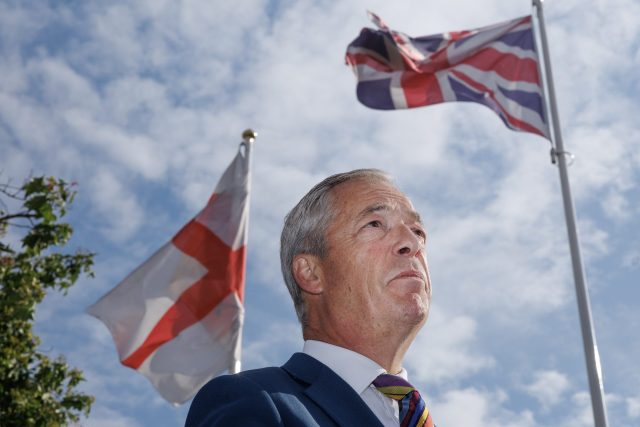
Nigel Farage outside Havering Town Hall. (Dan Kitwood/Getty)





In 1990, shortly before the collapse of Yugoslavia, the Serb cartoonist “Corax” drew an image that summed up the prevailing mood. A man sits in his house at night, watching the television news. Above him, a missile is just about to drop through his roof. On the screen, he is watching the same image we see: the same house, the same missile. As one anthropologist interpreting the image for a post-war readership explains, “The paradox is made up of two apparent contradictions. The falling bomb is dynamic, the man is static. Nothing can stop the bomb from reaching its target; nothing can prevent the destruction of the house representing the common Yugoslav state and the death of the man representing the shared Yugoslav identity.” The inescapable nature of fate is thus emphasized. Apparently, the only option is to do nothing and wait for events to unfold.”
One need not share the apocalyptic visions of Britain’s near future animating much of the Right to see a similar, dreamlike paralysis in the face of our own national disintegration. The facts, when outlined, are bleak. Elected on a mandate of renewing Britain, Keir Starmer is now the least popular prime minister in British history, whose party’s landslide victory may yet prove terminal. If we assume that Starmer’s time in office is now drawing to a close, then it is his fate for his premiership to have been bookended by being heckled by angry crowds at the scene of two stabbings: the first in Southport, the second in Golders Green. That footage from North London revealed the Union Flag fluttering from lampposts, a now England-wide dynamic which only took effect after Southport and the ethnic riots which followed, shows how quickly we have stumbled into creating a simulacrum of the Shankill Road even among loyal and placid suburban British Jews. Neither of these two attacks were Starmer’s specific fault; his fate is just to embody the modern Westminster state, loathed by its people.
Seemingly cursed from the start, it is hard not to feel some grudging sympathy for Two-Year Kier. True, he is unsuited both ideologically and temperamentally to keeping a fractious country together. But who else could do any better? Every news story, every headline, looks like an extract from some future documentary recounting the disintegration of a state. Just weeks before the elections, Starmer’s St George’s Day video message once again possessed all the attributes of a late-stage imperial bureaucrat trying to dampen an ethnic revolt outside the capital. And rightly so: the political salience of St George’s Day, which is entirely new, is the symbolic rupture between the English people and their form of government that Westminster represents.
That rupture, indeed, is closer to the resurgent Celtic nationalisms than it is their antithesis, and is best understood as part of the same process that has led the governments of all three devolved nations to be led by parties eager to terminate the Union. On the other pole of national politics, the Greens, by virtue of their support for Irish, Scottish and Welsh nationalism, are functionally Westminster’s only political faction committed to the logic of an independent English state: in technical terms they are therefore more of an English nationalist party than Reform, the ambivalent flagbearers of Unionism, whose support base nevertheless rests upon English dissatisfaction with Westminster. The logic of party political fragmentation is also one of national dissolution, consciously intended or otherwise.
The two legacy parties of British mass democracy, meanwhile, have shrunk to regional London parties of the Westminster statelet. Losing their leafy shires to the Liberal Democrats, and the suburbs to Reform, the Conservatives are now the party of Metroland Hindus, socially conservative West Africans and Clapham Yimbys. No longer a national mass party, Labour has become a London-based workers union for those who actually run the Westminster state — the civil servants, lawyers and thinktankers who now make up Labour’s voting base — and the social housing tenants to whom they distribute their patronage, or at least those who have not yet been seduced by their own ethnic parties, whether openly, as in Tower Hamlets, or under the Green mantle, as in Waltham Forest. Politically, it is the British state’s seat of government that has now become the periphery, buffeted by events it can no longer control.
And in turn, further than London than they have seemed for centuries, it is on the peripheries that the twilight of Westminsterism is now most highly evolved, and the country’s future determined. Northern Ireland, waiting for its devolved elections next year, remains, as it has been since its abortive birth, a thing apart, incomprehensible to British observers, and viewed with a mix of horror and disdain by political elites in the Republic. Indeed, the anxiety within Ireland’s coalition government that Farage will “bounce Ireland into a referendum it is not ready for” reads more like fear of a border poll succeeding than of it failing. Yet the exultant glee expressed by Sinn Féin at the election results in Scotland and Wales, which show, as my own abstentionist MP claims, that “people are looking beyond Westminster towards a brighter, more positive future, free from the shackles of the British government”, is difficult to dispute.
The SNP’s victory in Scotland, despite all its internal feuding and record of incompetent governance, once again demonstrates the existence of a hardcore voting bloc for independence above all other factors, even if it is outweighed by a slim unionist majority, divided, as in Northern Ireland, between opposing factions. In Wales, initially ambivalent about devolution, Plaid Cymru, seeking independence, is now the party of government, yet with only a slim lead over Reform, which has now taken on the responsibility of defending the Union.
Yet the headline take — that both countries now share pro-independence administrations — obscures the more meaningful political reality that, just like Northern Ireland, Scotland and Wales are now more or less evenly divided between those wanting to preserve our shared state and those wishing to dismantle it. With no immediate route to independence for either, the likelier outcome than near-term secession for is therefore a repeat of the dysfunctional deadlock of Stormont, with the concrete work of governance taking a backseat to the symbolic politics of national identity. Political paralysis, and the radicalization of the voter base into two binary and directly opposing conceptions of national identity, now appears unavoidable. The hopes of Celtic nationalists rest on framing a now probable Reform government as an English nationalist party, the Westminster state assuming its final, most reductive, and cartoonish form.
Yet Reform’s hopes, in both Scotland and Wales, must be that the accelerating immigration into both Wales and Scotland — immigration supported by Plaid and the SNP respectively — eventually inspire defections among Celtic nationalists of the ethnic rather than civic variety, with the novel and rapid peripheral adoption of England’s demographic churn eventually producing an equivalent political response. Indeed, 12% of Reform’s vote share in Scotland is now assessed to have come from defecting SNP voters. Yet the tussle between Unionism and nationalism works in precisely the opposite way in Northern Ireland, where the mass immigration lauded by Sinn Féin has the effect of strengthening the Unionist vote, by importing people with no particular emotional bond to Irish nationalism, who are in many cases wards of the Westminster state, dispatched to Ulster by the spreadsheets of Whitehall bureaucrats rather than any personal choice. The same two poles — the traditional nationalisms of the British state and the new ones created by mass immigration — are in interplay across the Kingdom, with long term effects difficult to predict: other than bitter and dysfunctional polarization and the counterintuitive ambiguities inherent to nationalism, far beyond the apparent synchrony of yesterday’s results.
With Reform, a personalist movement led by a figure ambivalent about the Union, now adopting the mantle of Unionism in Wales and Scotland, it is ironic that its own pitch to English voters is not so different to that pronounced by Sinn Féin’s South Down MP Chris Hazzard: that “Westminster does not serve our people.” Rare is the English voter who would now disagree. The zeal with which Reform’s new English voter base has taken to flagging its own ethnic enclaves is an outward manifestation of the collapse of post-industrial England’s Labour coalition into opposing ethnic blocs. As the pollster Luke Tryl observes: “We are seeing some of the most fragmented results in councils that combine a white working class vote with a large ethnic minority population.” The political polarization reshaping British politics is simply the reflection of an already-existing social polarization decades of willed Westminster blindness failed to prevent and which it is now too late to undo.
In England, Reform’s success in Bradford, Birmingham, Greater Manchester, just as much as the rise of the South Asian Muslim identitarian candidates — or where electoral demography requires it, the Greens as a temporary substitute — reflects this binary process of self-sorting into ethnic factions. The belated protestations of horror from liberal pundits amazed at the inevitable consequences of their worldview have come too late to arrest this dynamic. The Greens, for now, may be a beneficiary, though the party’s coalition of radicalized young women; geriatric millennials seeking yet another lifeboat from the wreckage of the Corbyn project; and Muslim identitarians is hardly more stable than the Labour bricolage whose rubble it picks over.
Yet something similar could be said of Reform, whose working-class and petit bourgeois coalition is deeply divided on economic questions, papered over by a shared, and newly assertive identity. There is no logical reason, other than the total unqualified success of a future Reform government, for the same structural forces demolishing the 20th-century parties not to do the same to Reform in turn. England’s genuine ethnonationalist contingent, currently celebrating as online outriders Rupert Lowe’s success in his Great Yarmouth fiefdom, is more likely to find the failure of a Farage government a profitable hunting ground than any immediate attempt to supplant Reform as the dominant party of the Right. Whether there will be a Britain left for them to restore is quite another question.
For there is, in all that Reform’s path to government seems inevitable, no real certainty in Britain’s future politics other than extreme volatility. Reform’s vote share has decreased from its greatest highs: unless the party fully cannibalizes the Conservatives, or enters coalition with them, it is not on course for a stable majority. There is just as much a likelihood of a coalition of England’s Left parties, propped up by peripheral nationalists, as there is of Farage entering Downing Street, in doing so accelerating the dynamics of disintegration and dysfunction on which Reform relies. Should Reform achieve power, it is highly likely to find its program frustrated by the functionaries of the Westminster state, heightening the already mutinous mood of provincial England. The dysfunction of the Westminster state accelerates its disintegration into identitarian voting blocs, and the state’s disintegration in turn accelerates its political dysfunction: and all the while, the country gets poorer, angrier and worse governed. There is more to Ulsterization than just flags on lampposts.
Let us look at the problem objectively, from first principles. In every country in the United Kingdom, the winning message from last week’s elections has been that Westminster, as it currently exists, simply does not work. In the peripheral nations, the electorally dominant solution is to break away and start again. In England, it is to gamble on Reform as the last chance of resolving this mess. The world that Starmer entered power to preserve, of optimistic, 1990s cosmopolitan liberalism, is already gone forever: his political failure, rather than deriving from his personal flaws, was to attempt to rule a country that no longer exists. Yet in attempting to mend and preserve a Westminster state whose very failure is propelling him to power, it is hard for even the most sympathetic observer to see Farage — a far more polarizing figure than Starmer — working the same raw material into something more stable.
The state may not break apart, then, but it will continue to hollow out, as its constituent peoples old and new continue to sort themselves into smaller political units, focused on ever-narrower and more bitterly opposing ends. The process now underway, which Starmer’s doomed two years in government has radically accelerated, is still very far from assuming its final form. Indeed, Farage is just as likely to prove a catalyst of disintegration as a nation-builder. Some unhappy marriages fall apart; others stagger on, in hope that things might change, or fear of the alternative. The difference between the two outcomes is as often a matter of chance, and circumstance, as willed choice. Westminster is no more in control of how things end than any individual voter. Like the cartoon Yugoslav, all we can do is continue, motionless, to watch the headlines scroll, and wait for events to unfold as they will.
