









1 October 2026 - 6:00pm
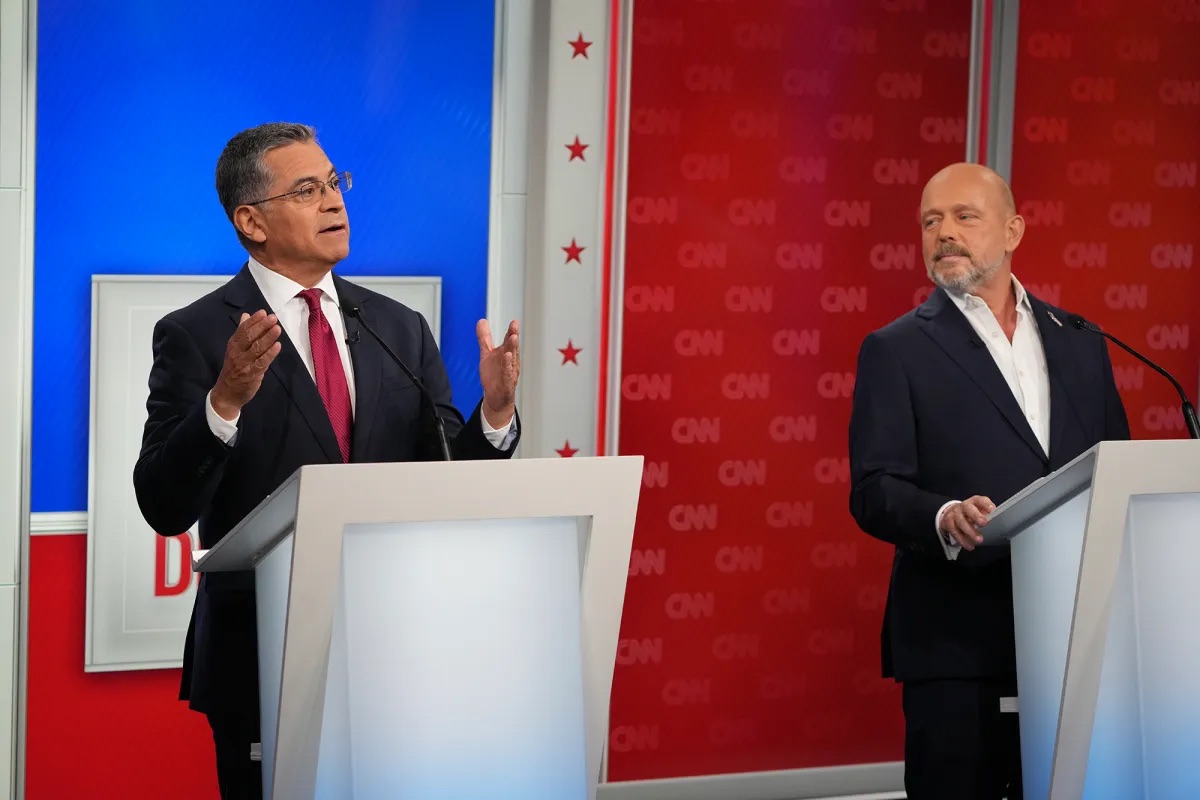
The Lincoln-Douglas debates, this was not. For an hour, the men vying to become California’s governor attacked each other in a contest whose outcome had already been decided. It had all the drama, therefore, of a Supreme Soviet where elections were conducted without choice.
Nothing in the debate was going to do enough to change a state that Democrats typically win by 10 to 20 points. But if we were to grade the debaters’ performances, Republican candidate Steve Hilton was clearly the winner. He was the sharper debater as Democrat Xavier Becerra struggled to hold his own. For example, when Hilton pressed Becerra on his record as Joe Biden’s health secretary, the Democrat struggled to mount a convincing defence.
On other issues, Becerra was no better. In fact, his response to nearly everything, including the demise of Hollywood, was to blame Trump. Given the extreme hostility of Californians to the President, it was probably a wise, if fundamentally dishonest, strategy.
Of course, Left-wing papers such as the Los Angeles Times saw Becerra as “the blowout winner”, while the Right embraced Hilton’s performance. The one truly non-partisan source, CalMatters, captured it best: “little was learned in governors’ debate.”
In the end, the die is cast. Hilton will now go onto a career as a conservative media gadfly while Becerra, with a wide lead, will sail smoothly towards Sacramento.
This is not good news for Californians. Becerra has had a long political career, but he has never quite acquired the stature one might expect from someone who has risen as far as he has. I first interviewed him during his initial run for Congress in 1992, hoping to be impressed. Three decades later, I am still waiting.
Those of us with longer memories should also remember that signs of California’s decline emerged well before Trump, and certainly before his chaotic second term. The state’s growing class divide — between extraordinary concentrations of wealth and the nation’s highest cost-adjusted poverty rate — was already evident more than a decade ago. Under prolonged Democratic control, those problems have hardly disappeared.
Clearly, California needs a new direction. But none of this will change, even if by some miracle Hilton wins. With huge Democratic majorities in both houses of the state legislature, and a highly progressive judiciary, even a skilled executive would have trouble making a difference, particularly against someone with limited managerial experience.
The best-case scenario, sadly, is that Becerra has inherited some of Gavin Newsom’s political instincts. California increasingly appears to have two competing Democratic factions: an establishment wing and a more Left-wing, DSA-aligned one. Becerra seems likely to remain firmly in the establishment camp, judging by the support he has received from Silicon Valley companies, including Anthropic, as well as public-employee unions.
Without Newsom’s political dexterity, Becerra may struggle to manage the Left-wing faction within his own party. That tension could come to a head over Becerra’s opposition to the proposed wealth tax, Proposition 40, which has strong backing from the party’s Left. The bigger question, then, is whether Becerra can keep that insurgent faction in the legislature onside while maintaining his position as an establishment Democrat.
Conservatives can celebrate Hilton’s performance all they like. But his success on the debate stage is, ultimately, an empty victory. It will remain so until Californians decide they are ready to “try something different”. Sadly, that moment does not appear to have arrived yet.
Joel Kotkin is a Presidential Fellow in Urban Futures at Chapman University and a Senior Research Fellow at the Civitas Institute, the University of Texas at Austin.
 joelkotkin