









21 Nov 2026 - 5:00pm
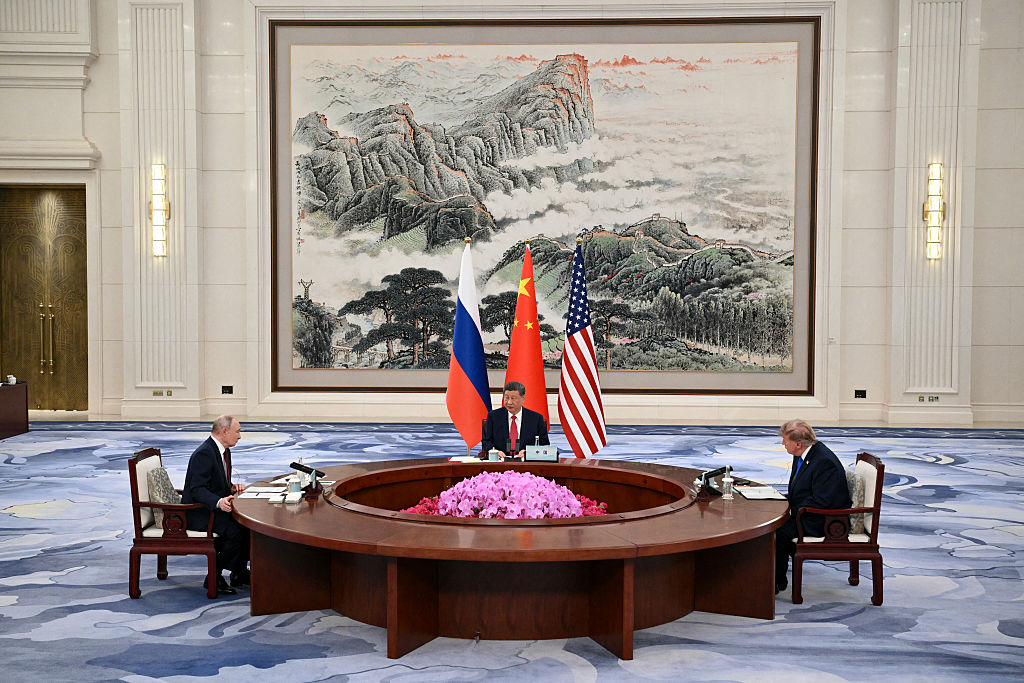
The White House’s official X account has spent the past few days amplifying Chinese propaganda about a Beijing-led world order. There has been no hack, however. Through sheer obliviousness, Donald Trump became an prop in Xi’s spectacle of Chinese power at this week’s Asia-Pacific Economic Cooperation (Apec) summit in Shenzhen. The White House has simply been faithfully posting the footage. “What a job you’ve done,” Trump told Xi Jinping, committing one protocol faux pas after another while posing for photographs that made him look increasingly diminished.
Xi chose to gather 20 leaders from around the Pacific Rim in Shenzhen for a reason. The city, barely more than a fishing town until the early Eighties, has since become one of the great industrial and technological powerhouses of the world economy. It is a living symbol of China’s economic transformation.
By bringing Trump and Vladimir Putin together for a trilateral meeting in the heart of Shenzhen, Xi was making a further point about hierarchy. This was the high table for other leaders to admire from a distance. As host of both the outer and inner circles, Xi was the central figure: the geopolitical convener of a new, Beijing-led world order. The image was of Chinese leadership, flanked by a pliant Russia and no longer meaningfully contested by America.
But this was not simply about optics. This was, in truth, a summit without the West. Japan, an American ally feted by Joe Biden at a White House state dinner barely two years ago for strengthening defence ties against China, was publicly snubbed by Xi. Its leader was received by a junior official and denied a bilateral meeting with the Chinese President. American support was conspicuously absent, even as Trump boasted that his Big Three meeting was “bigger than Yalta”.
Meanwhile, Beijing rolled out the red carpet for two other American allies, Canada and Australia. These nations celebrated the distance they had travelled since relations sank to their lowest point under Biden with pork deals and ceremonial welcomes. The Democratic president’s administration had worked to bring both countries into a more united coalition against Chinese influence.
What a contrast with the first Apec leaders’ summit, held in Seattle in 1993 and hosted by Bill Clinton. If ever there was a symbol of the unipolar moment, that was it. Back then, Chinese leader Jiang Zemin, still creeping back onto the world stage from the Tiananmen massacre, was grateful to even be invited. After the summit, at which Clinton boasted that he had brought together countries accounting for half the world’s economic output, he told reporters he had pressed Jiang on China’s treatment of political prisoners. That is now diplomatic history.
The sight of Trump in Shenzhen, agreeing with authoritarian superpowers to put pressure on the ICC and greeting Putin as “my friend”, could hardly make clearer how much the balance of power has shifted since that first Apec summit. This week offered a glimpse of what comes after the Free World, when the high table is no longer convened by a transatlantic coalition of democracies but increasingly by Beijing.
