







 Prefer us on Google

24 August 2026 - 6:00pm
It reads like a scene out of a Philip Roth novel, about a battle between Left-wing professors at a small liberal-arts college. Last week, the Guardian published a joint letter addressed to “Iran’s political prisoners” and signed by a Who’s Who of the academic Left: Judith Butler, Angela Davis, Bill Ayers, and Bernardine Dohrn, among others. The signatories — including, for some reason, the convicted Philadelphia cop killer and self-described “political prisoner” Mumia Abu Jamal — lamented domestic repression in the Islamic Republic, even as they decried the US-Israeli war against Iran.
The letter referred to an Islamic Republic which, “from its inception, enforced absolute social and political control based on an exclusionary ideology”. The signatories pointed to a “system that claims to counter imperial power while using its very logic of domination and systems of carcerality, torture and execution”, and suggested that Iran embodies a “hollow anti-imperialism”.
Then, over the weekend, came the backlash from different factions of the Left: the letter, as the London-based Marxist writer Carlos Martinez charged, is part of a “genre that has preceded and accompanied every single regime-change war”. In reality, “progressive and anti-war forces have a duty to support Iran against war, sanctions, regime-change plots, and destabilization.” The Indian-born, Latin American-based Marxist historian Vijay Prashad, meanwhile, described the letter as a “scandal” and claimed that Abu Jamal hadn’t, in fact, lent his name to it.
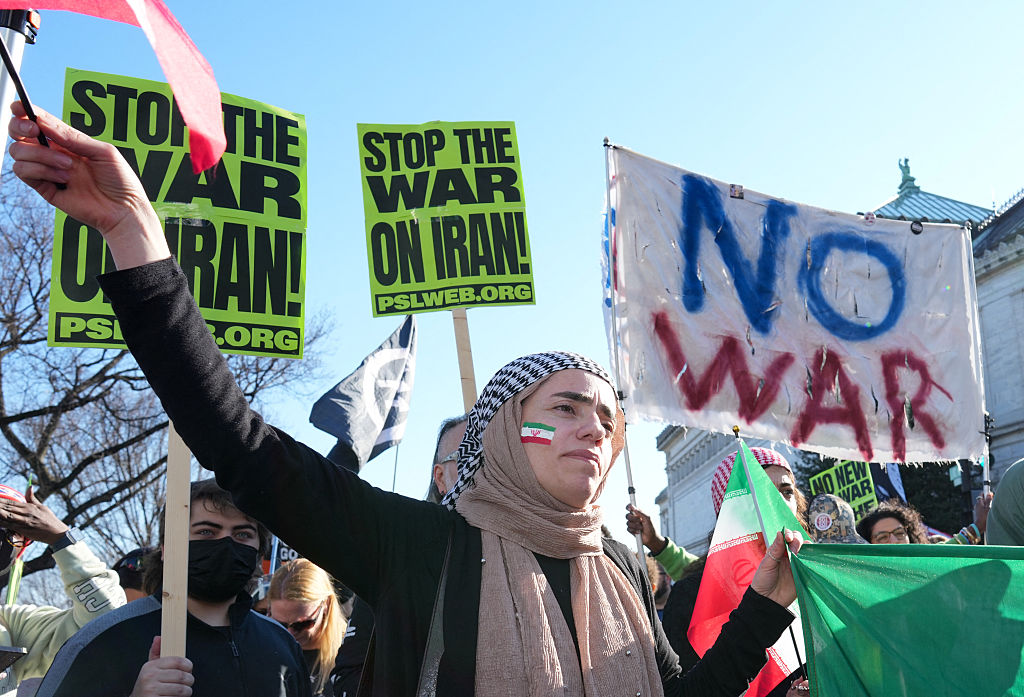
This is mostly a tempest in a teapot — forgettable save for what it reveals about the failure of the anti-war Left since the mass mobilisations it achieved against the 2003 Iraq War: the underlying cause of stopping the war with Iran is overwhelmingly popular. Unlike the post-9/11 interventions in Afghanistan and Iraq, Donald Trump’s Iran war didn’t even enjoy majority support when he first launched it, and has been haemorrhaging favourability ever since.
Yet by turning it into a transnational struggle against “systems of carcerality” and the “logic of domination”, Leftists lose normie audiences in the West who’d otherwise agree that stupid wars of choice are stupid. They somehow manage to turn a kitchen-table issue into a niche interest implicating prison abolition and other toxic causes that even progressives in the Democratic Party won’t touch.
The original letter, for example, rightly decries Iran’s authoritarian system — and in the next breath suggests that the democratic West is no better. “We see the same logic of domination,” it reads, “in the ICE detention centers, where the US government imprisons our people in the pursuit of a political agenda of racist exclusion or detains our political activists.”
Really, there is no equivalence. ICE’s internal enforcement of US immigration law has taken some troubling turns under Trump, but the agency still operates within a constitutional, democratic system. Indeed, ICE has already encountered plenty of resistance from the courts and the grassroots — and, soon, Congress, if polls are correct about a Democratic tide. The Islamic Republic, meanwhile, brutally suppresses independent labour activists, systematically tortures and executes dissidents, and discriminates against religious minorities and women.
The letter’s critics on the harder-Left are still more misguided. If opposing the war means pretending the Islamic Republic is beyond criticism because of a shared doctrine of “anti-imperialism”, then the anti-war cause will continue to languish, despite popular sentiment. The same criticism, by the way, can be lodged against the admirers of Communist Cuba among the leadership of the Democratic Socialists of America. The US and the West desperately need an anti-war Left that is normal and patriotic, that speaks an ordinary, decent moral language, and that isn’t beholden to weird boutique agendas. The Guardian letter dispute is a sign that the present crop of progressives isn’t able to offer any of these things.
Sohrab Ahmari is the US editor of UnHerd. His next book, on The Triumph of Normal, is forthcoming from HarperCollins.
 SohrabAhmari