









8 April 2026 - 7:30pm
Donald Trump’s “fragile truce” with Iran may stop the war, but it will not stop some Christian conservatives from reevaluating their support for him. So direct was Trump’s threat to wipe out an “entire civilization” that it forced a deep reckoning with the reality of American foreign policy, most clearly demonstrated by Tucker Carlson on one of the top podcasts in the country. More seeds of doubt are being planted for harvest down the road.
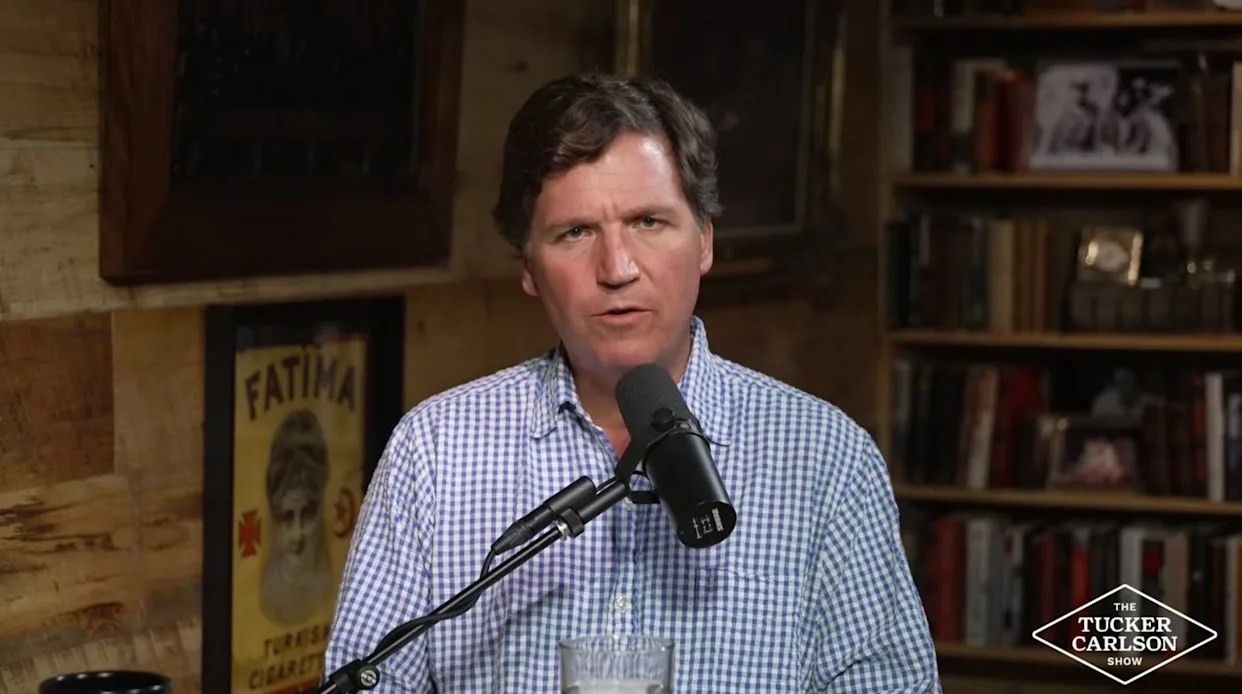
On Monday, Carlson released a monologue in response to Trump’s “open-the-fuckin-strait” Easter message to Iran. He slammed Trump for mocking Islam and posting the f-word on Easter morning. More importantly, Carlson asserted that Trump was threatening “to destroy civilian infrastructure in another country, which is to say, to commit a war crime, a moral crime, against the people of the country whose welfare, by the way, was one of the reasons we supposedly went into this war in the first place.” This was echoed by former congresswoman Marjorie Taylor Greene and MAGA Catholic influencer Carrie Prejean Boller, who called on “every single Christian to RESIGN IMMEDIATELY from this administration.”
Carlson’s explicitly Christian denouncement of Trump is a blow to the foundation that held up American conservatism since the end of the Second World War. And it arguably cuts even deeper than that, asking in plain language for the Christian West to reevaluate our most basic political assumptions in a nuclearised world.
Since 1945, the centre of American politics — including both Democrats and Republicans — insisted everyone was either with us or against, at home and abroad. This mindset is understandable, having taken root in a world freshly scarred by nuclear weapons and gripped by global paranoia. It was often in tension, though, with the very agreements reached after the Second World War to protect civilians and human rights — which, as Tom Holland argued in his book Dominion, came from a Christian foundation.
In other words, the political and moral frameworks the West built after the Second World War were largely rooted in Christian universalist values, emphasising moral duty, human rights, and the protection of civilians. What Carlson sees in Trump, however, is a break from these pretences: instead of acting according to moral or ethical principles inherited from that tradition, Trump prioritises raw power and self-interest. In this way, Carlson is echoing a prediction made by Friedrich Nietzsche before the 20th century’s catastrophes: once the moral veneers of Christian universalism are stripped away, politics becomes a contest of strength rather than conscience.
Christian nations and leaders were easily persuaded to fight total war once nuclear destruction became a reality, making this both a pretext and a genuine value system. The West, sometimes openly and sometimes covertly, bent post-Second World War rules to shield its own civilians from complete annihilation. Proxy wars in regions like Latin America and Iran were justified on these grounds: Soviet expansion implied a heightened risk of total destruction, so supporting the Contras’ actions was framed not merely as tolerable but as essential in the name of freedom. This rationale made more sense before the USSR’s collapse, but it has often served — and still serves — as a cover for business and strategic interests. That is what Carlson is really challenging, and he does so neither from the perspective of Liberation Theology nor from the anti-imperial Left.
Carlson’s argument is that he’s only anti-American to the extent America abandons Christian principles. Christian conservatives who listen to him are now confronting this question more directly than they have in nearly eight decades.
