









22 September 2026 - 10:00am
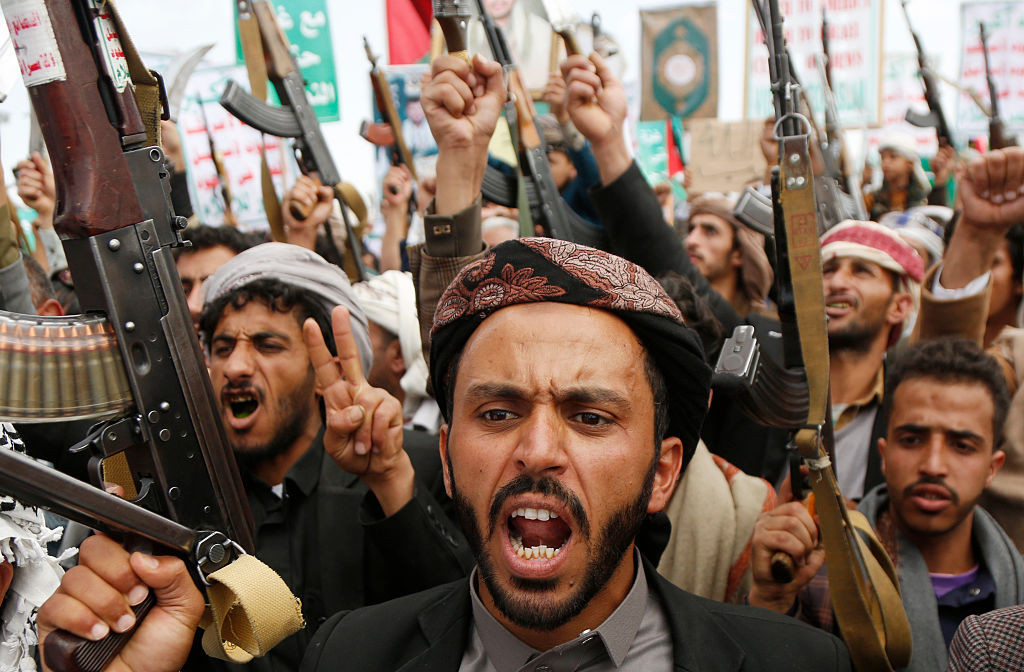
Earlier this month, Iran-backed Houthi rebels in Yemen routed pro-government forces in a lightning offensive that caught Saudi Arabia and the United States by surprise. The small island of Perim and the port city of Mokha are now under Houthi control, giving the group an advantageous position over the Red Sea and the Bab al-Mandab Strait. The Saudis have used Bab al-Mandab to export crude oil to global markets without having to traverse the Strait of Hormuz that is still blocked by the Islamic Revolutionary Guard Corps (IRGC). Then, over the weekend, the Houthis reportedly targeted the Saudi capital of Riyadh in a series of missile strikes.
Last night, the British Government announced it would provide military support for Saudi Arabia in response to the attacks. But as Prime Minister Andy Burnham meets Donald Trump in New York later today, the US President has so far avoided getting involved. On Sunday, the New York Times reported, US bombers were fully loaded and prepared to strike Houthi targets, only for Trump to change his mind at the last minute and pull back from an attack.
The Saudis will undoubtedly view this news with disappointment, if not contempt. With Iran and its proxies now effectively controlling two of the Middle East’s most important energy chokepoints — and with Iranian-sponsored Iraqi militias damaging the oil-rich monarchy’s key East-West pipeline earlier in the month — Saudi Crown Prince Mohammed bin Salman is scrambling for a way to escape a vise that is becoming ever tighter. But as much as Trump’s overall policy in the Middle East has been botched by his unnecessary war with Iran, he’s right to think twice before launching another war against the Houthis.
Firstly, though nobody would dispute the US military’s capacity to blow things up in Yemen, the Pentagon can’t afford to be reckless with its munitions anymore. Notwithstanding Defense Secretary Pete Hegseth’s assertions to the contrary, the nearly seven-month conflict with Iran has drained the department’s stockpiles to such an extent that its leadership is forced to scrounge around for precision munitions and air-defence platforms from other combatant commands. One estimate finds that the US has used up nearly 80% of its Terminal High Altitude Area Defense (THAAD) interceptors, while its arsenal of Patriots is depleted too. These numbers will inevitably get worse if Washington embarks on another air campaign.
Secondly, it’s worth remembering that Trump already went to war with the Houthis once, and the result could be charitably described as unimpressive. Between March and May last year, he ordered a comprehensive bombing campaign in Yemen to compel the militia to stop firing at civilian ships in the Red Sea. The US military dropped over $1 billion in munitions to strike more than 1,000 targets, including drone manufacturing facilities, missile batteries, command-and-control and individual Houthi commanders.
But despite those losses, the Houthis dug in and continued sending cruise missiles and drones towards vessels. Ultimately, Trump got tired of the engagement, cut a deal, and declared mission accomplished. To dive right back into a similar situation a year and a half later, expecting a better outcome would be the definition of insanity.
Finally, air campaigns only work if there are viable ground forces which can take advantage of them. That’s not the case in Yemen, where the anti-Houthi grouping is less a coherent coalition and more a constellation of separate factions with different interests and agendas. The National Resistance Forces are led by a nephew of the former Yemeni dictator Ali Abdullah Saleh, who was ousted during the Arab Spring and eventually killed by the Houthis five years later. Others are jihadists, or at the very least sympathisers of the very Sunni fundamentalism the United States has fought against since 9/11.
None of these armed formations, either separately or even together, have proven they can get their act together and reclaim territory from the Houthis, who have now ruled most of Yemen’s population for more than a decade and demonstrated their capacity to outlast their rivals. Yemen is a morass, pure and simple. One can’t blame Trump for avoiding it.
Daniel R. DePetris is a fellow at Defense Priorities and a syndicated foreign affairs columnist for the Chicago Tribune.
 DanDePetris