









1 May 2026 - 1:30pm
The outrage arrived before the film did. Within 24 hours of the trailer’s release last December, the new adaptation of Animal Farm had attracted a barrage of criticism, much of it from people who were already certain they knew exactly what was wrong with the film. Conservative commentators lined up to declare that director Andy Serkis had betrayed George Orwell’s legacy by attacking free markets instead of totalitarianism.
“Hollywood takes Orwell’s anti-communist masterpiece — makes it anti-capitalist and woke instead,” wrote podcaster Mario Nawful. Commentator Tim Pool refused to run ads promoting the film, calling it “shockingly offensive as it is pro communism and anti-capitalism … a critique of capitalism from beginning to end and even has pro-leftist terrorism elements”.
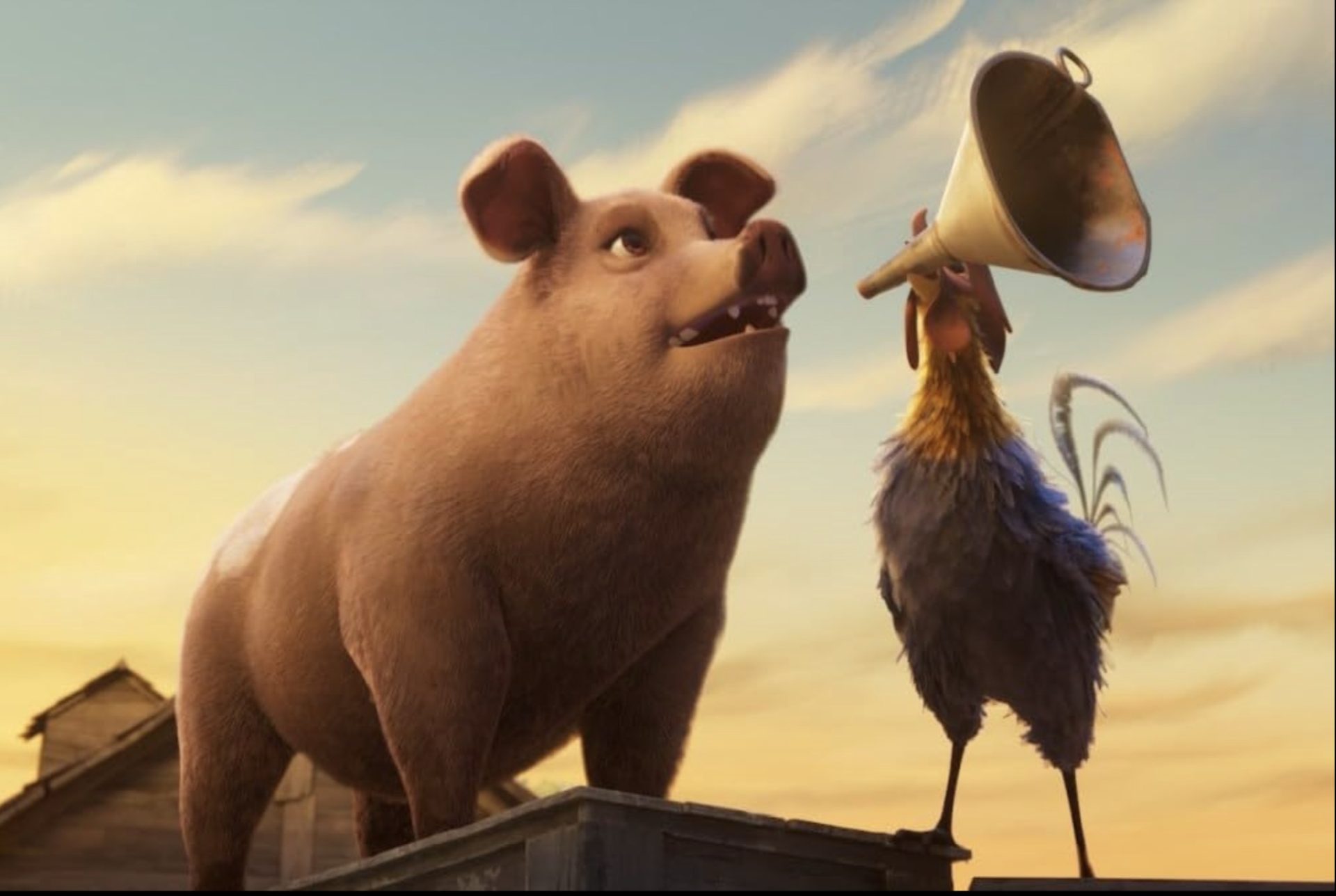
The verdict was in: this was Leftist Hollywood eating from the slop bucket once again. Yet, if one watches the film, that reading turns out to be almost entirely wrong. Sure, Orwell might be “rolling in his grave” after watching the 2026 version of his political allegory, but that’s mostly because it’s been diminished by fart jokes, a distractingly bad soundtrack, and other trappings of contemporary kids’ movies. It’s not a great watch, but it’s not an anti-American watch either.
The new animated film’s central conflict is the animals’ fight to save their farm, and Serkis’s version keeps the bones of Orwell’s fable but changes the meat on them. The animals still rise up against human exploitation, and the pigs still learn to speak the language of liberation while hoarding power for themselves. But this time, they also have to save their farm from corporate exploitation, represented by a new human antagonist, a tech CEO-style businesswoman seeking to seize control for profit. She tries to grab the farm by seducing the pigs with the promise of power, celebrity, and cheap consumer goods, and the rest of the animals with free food.
But this doesn’t mean the movie has a radical, or even anti-capitalist message. What Serkis has made is something closer to a defence of ethical markets than a critique of markets as a whole. In the film’s middle act, the animals start a farmers’ market, and it’s a massive success. They make enough to pay their rent to the banker, who is portrayed as basically fair — unlike Farmer Jones, who lost his farm to foreclosure, probably due to alcoholism-induced laziness and mismanagement. Producer Jonathan Cavendish has pointed this out with some exasperation. “There’s a huge triumph of capitalism centrally in the story,” he told journalists last week.
Similarly, Animal Farm’s villains aren’t traders or shopkeepers but instead monopolists and consolidators, the kind who look at a thriving farmers’ market and see a licensing opportunity, who convert a commons into a brand and a brand into a monopoly and then enshittify the product. This is not a rejection of capitalism so much as a critique of its worst distortions.
If anything, Animal Farm is quietly conservative in the older, less partisan sense of the word. It suggests that big business corrupts, that localism and fair dealing are virtues, and that a system’s legitimacy depends on the moral code of the people running it. Indeed, Orwell was never the patron saint of laissez-faire markets. He was a democratic socialist who hated any system that lied about what it was: Soviet communism, British imperialism, or the slow colonisation of working-class life by bureaucratic bloat. Orwell’s pigs were specifically Stalinists, authoritarians who happened to be operating inside a revolutionary idiom.
There’s also the small matter of the present tense. We live under what Mark Fisher dubbed capitalist realism: the condition in which it’s easier to imagine the end of the world than the end of capitalism. Communism, as a mass revolutionary threat to the West, is not really the menace it was a century ago. What we have instead are various forms of state-managed capitalism and national markets with party-states attached to them, including China. Warning a multiplex audience about the dangers of imminent collectivist revolution is like staging a morality play about the perils of commuting via horseback.
Ultimately, this version of Animal Farm argues against what happens when a system stops working for most people and becomes a racket. In that sense, the film’s most “conservative” instinct is also its most universal one: a belief that no structure, however well designed, can survive the loss of basic moral habits. When a pundit claims that warning about oligarchs is a betrayal of Orwell, what they’re really telling you is which side of the trough they’re on.
