









15 March 2026 - 4:00pm
President Trump faces a major challenge. Having started a war of choice against Iran, he must now grapple with the country’s refusal to surrender. Ayatollah Mojtaba Khamenei’s regime has suffered major damage to key infrastructure, but it hasn’t fallen, and the regime appears resolute. Now, Iran may hold the battlefield advantage due to its successful shutdown of the Strait of Hormuz.
Opening the Strait of Hormuz is a task far easier said than done, and America’s next steps will be incredibly risky. Trump’s current Hormuz reopening strategy is centred on escalating air strikes against Iranian missile and drone forces around the strait. Meanwhile, the US is bolstering its own armed drone patrols over the area. These drones can loiter above Iranian targets, waiting for them to emerge.
Iran’s geography is also a major complicating factor. The areas bordering the approaches to Hormuz are mountainous terrain in which Iranian missile trucks can hide, quickly appear to shoot their missiles, then return to hiding. But the sophistication of Iran’s military technology plays a role, too. Tehran’s missiles use heat-seeking targeting systems that complicate jamming efforts and do not require manual operators to fix exact target coordinates at launch. The speed of these missiles and their short distance to targets make interception extremely difficult.
This is where the problem lies for Trump. Until the US can effectively eliminate and drive back Iranian forces from the coast, warships will be ineffective in a naval escort effort.
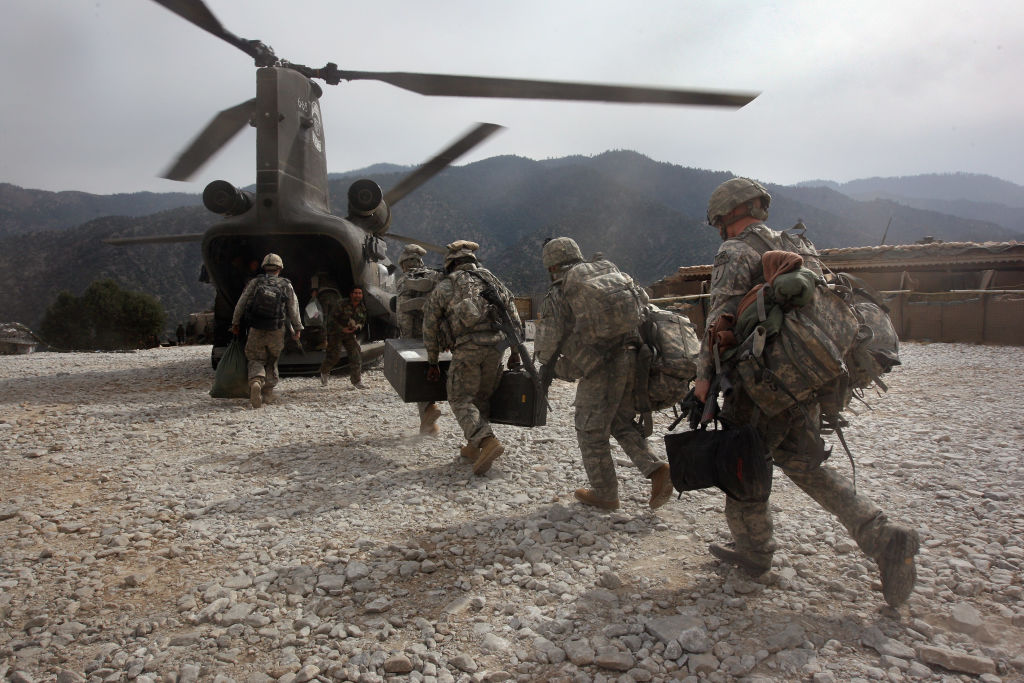
Recognising this challenge, Trump has now ordered the deployment of a Marine expeditionary unit based in Japan. It will arrive in the Persian Gulf in the next 10 to 14 days, carrying approximately 800 combat infantry personnel and supporting aviation, artillery and armoured forces. Additional Marine units are being deployed from the US. These actions strongly indicate that the Pentagon is preparing to conduct amphibious assaults on the Persian Gulf islands of Kharg and Qeshm. Seizing those islands would both deny Iran its own energy export economy and complicate Iran’s ability to target vessels. These amphibious assaults would also involve bloody boots on the ground fighting, inevitable American casualties, and heavy uncertainty of political outcome.
While Iran might seek a mutually acceptable ceasefire if Kharg and/or Qeshm were seized, it might alternatively harden in resolve. Equally, economic chaos might also implode the country into civil war or state failure, which may be in Israel’s interest, but it would not be in America’s. The US, after all, would bear responsibility for avoiding a humanitarian catastrophe among Iran’s population of 93 million. Trump would have to expend heavy resources to salvage another Middle Eastern mess of its making. Iran knows this and is banking on Trump blinking amid his Hormuz pressure campaign.
The President thus has a big choice to make. He could offer Iran a favourable ceasefire that might see it end its Hormuz operations. But that action would suggest to Iran and other US adversaries like China that the easy way to deal with Trump is to identify and hammer his economic pressure points. Such a course of action might only invite increased military challenges against US interests in the future. Yet, if Trump decides to take bolder military action to reopen the strait, his central foreign policy narrative of avoiding foreign wars may collapse even if such action succeeds.
