









30 August 2026 - 1:00pm
This week a major new initiative was launched to save Europe from economic ruin. It is called the Rhine Group — and it might just be the most significant challenge to the EU status quo since Brexit.
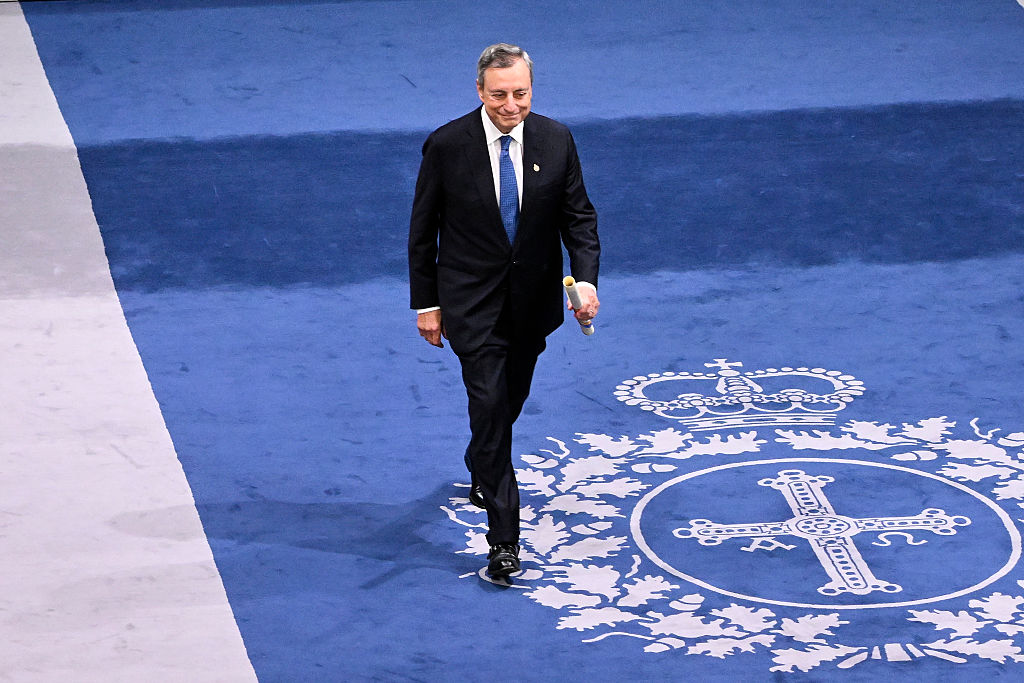
Its co-founders are Mario Draghi — former Italian PM, former president of the European Central Bank and the man who saved the single currency; and Patrick Collison — an Irish citizen, but, as CEO of Stripe, a titan of Silicon Valley.
Draghi and Collison are joined by a glittering line-up of financiers, industrialists, academics and other senior figures — very much part of the Euro-establishment, but of the opinion that if Europe doesn’t lift itself out of its economic and political torpor, it is heading for disaster. Their mission is to wake Europe from its slumbers, and press for the reforms that would allow the EU in particular to meet the existential threat of Chinese competition, Russian aggression and American disengagement.
They emphasise their general point with the killer fact that, of the world’s 50 biggest tech companies, only four are European. “If [Europe’s] stagnation continues,” they write, “the continent will progressively lose the ability to fund the core obligations of a modern state: defence, public healthcare, pensions, education, climate investments and safety nets for those who lose their jobs.”
Those obligations are multiplying, especially in regard to defence. This week, Armenia announced its intention to apply for membership of the European Union. Among other consequences, this would give the EU a border with Iran. Of course, with countries such as Albania, Moldova and Ukraine ahead in the queue, it will be years (probably decades) before the Armenians get a look-in. But its stated ambition does underline the EU’s growing role as a shield against Russian hegemony.
Realistically, that’s a role it is unsuited to play. The EU has no armed forces, no collective nuclear deterrent and scant ability to make security decisions independently of its member states — some of which are officially neutral or even pally with Putin. Furthermore, there’s a growing possibility that the most militarily powerful member state — France — will be under the control of Marine Le Pen by this time next year.
Of course, the EU does have a much greater ability to coordinate and direct economic policy across the continent. But that being the case, where’s the necessary reform? Mario Draghi set out what needs to be done in his 2024 EU-commissioned report. But since then progress has been glacial. Key recommendations — for instance, joint borrowing to fund investment and a rethink of the EU’s hyper-bureaucratic AI Act — have been strangled at birth.
What Draghi and his colleagues can’t bring themselves to accept is that the European Union (as we know it) is structurally incapable of radical change. A fully sovereign country like the UK could elect a new government committed to root-and-branch reform, but the EU is governed by a permanent coalition of centre-right, centrist and centre-left politicians — the latter of whom are dedicated to the idea of progress through regulation and judicial activism.
So what is it in Draghi’s experience of the EU that makes him think that things could ever be any different? Well, perhaps it’s his leading role in the Eurozone crisis — during which democratic norms were effectively suspended. This allowed the European Central Bank to impose a policy of extreme austerity on countries like Ireland, Spain and Portugal. An especially brutal example was made of Greece — despite its Left-wing government.
It’s therefore possible that a future crisis — for instance, a Europe-wide jump in the cost of servicing public debt or a major attack by a hostile foreign power — could once again force the politicians to submit to the technocrats.
For that reason, I’d recommend we pay close attention to the work of the Rhine Group. This might not just be the output of an elite talking shop, but the embryonic programme of an EU emergency government.
Peter Franklin is Associate Editor of UnHerd. He was previously a policy advisor and speechwriter on environmental and social issues.
 peterfranklin_