









9 May 2026 - 8:00am
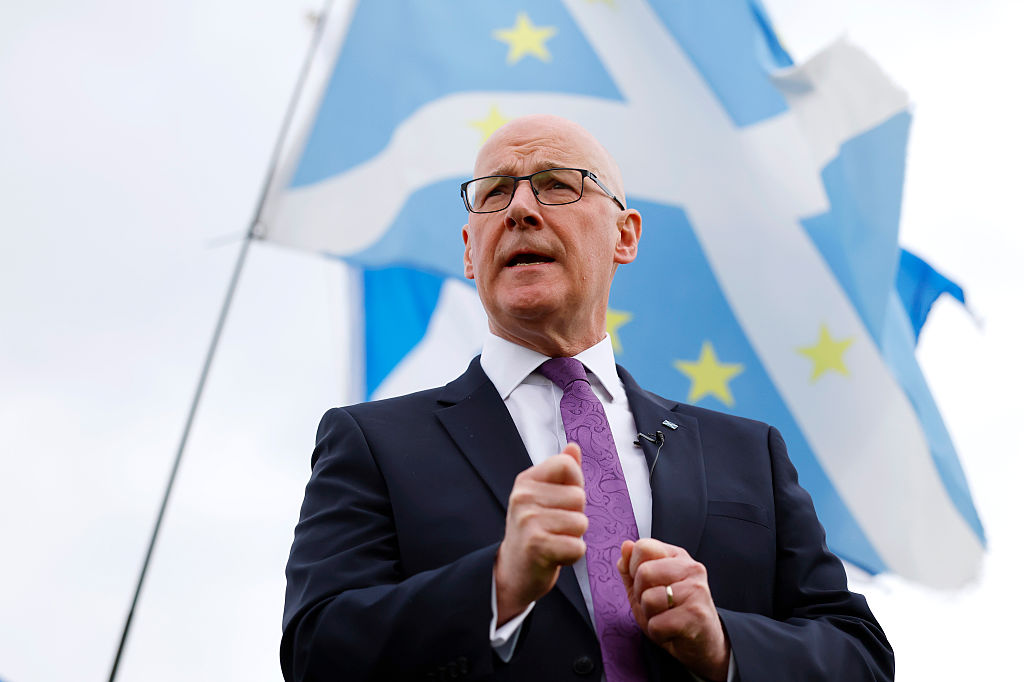
Last month, First Minister John Swinney declared that if the Scottish National Party won an overall majority in the Holyrood elections, this would constitute a mandate for an independence referendum. Yesterday the SNP won 58 seats, seven short of an absolute majority.
Swinney’s target was always a long shot, given the additional member system of proportional representation under which the Scottish Parliament is elected. Nonetheless, his party has just won its fifth consecutive Holyrood election victory and will dominate the next half-decade of Scottish politics, even though its share of the vote fell by over a fifth. By the time of the next Holyrood vote, the nationalists will have been in power for a quarter of a century.
Scottish Labour leader Anas Sarwar, meanwhile, suffered a dismal result. Less than two years ago he was measuring the curtains in Bute House, as Labour appeared on course to replace the SNP in government. It was not to be. A disconsolate Sarwar conceded defeat before lunchtime on Friday after only seven seats had been declared. After he began his campaign by boldly calling for the resignation of Labour leader Keir Starmer, Sarwar’s own political future must now be in doubt.
It has not been an entirely great day, either, for the new kids on the Holyrood block, Reform UK. The party’s Scottish leader, Malcolm Offord, had hoped to secure at least a couple of the 73 constituency seats in the Scottish Parliament. He has not won any of them, and came third in his own constituency fight in Inverclyde. However, Reform still managed 17 regional seats, which is itself a historic achievement given Nigel Farage was a political pariah in Scotland only a few years ago. The Conservative vote collapsed, as supporters flocked instead to Reform. Indeed, almost a third of Tory candidates lost their deposits.
The other big story in this election has been the rise of the Scottish Green Party, which has won its first ever constituency seats in Scotland, capturing Nicola Sturgeon’s old seat in Glasgow Southside and replacing SNP cabinet minister Angus Robertson in Edinburgh Central. The party ended yesterday evening on 15 seats.
One key question now is whether Swinney, deprived of an absolute majority, will seek another coalition arrangement with the Greens, or whether he will try to continue, as he has for the last two years, as the head of a minority government. The last “coalition of chaos”, as it came to be known, with the Greens ended in acrimony two years ago when Swinney’s predecessor as first minister, Humza Yousaf, unceremoniously ejected Green ministers Patrick Harvie and Lorna Slater from their posts. The new Scottish Green Party leaders, Ross Greer and Gillian Mackay, have made positive noises about a renewed arrangement, but there may still be bad blood between their respective party memberships.
For his part, the Scottish Liberal Democrats’ leader Alex Cole-Hamilton said during the campaign that he would resign rather than support an SNP government, and the Union might outwardly appear to be on safer ground after yesterday’s results. It will be relatively easy for the UK Government to reject calls for another independence referendum, considering Swinney’s previous comments about a mandate depending on his party winning a majority.
At the same time, the First Minister’s ambitions are expanding beyond the Scottish Parliament. Now that the SNP’s nationalist sister party Plaid Cymru has ended Labour’s quarter-century of dominance in the Welsh Senedd, and with a nationalist Sinn Féin First Minister in Northern Ireland, Swinney is hoping that an alliance of the “Celtic Arc” will force Westminster to concede not just a border poll in Northern Ireland but also another Scottish independence referendum.
There is no constitutional reason for the UK Government to recognise this putative alliance. But the old Unionist parties, Labour and the Conservatives, have been decisively rejected by voters in the nations and regions. Perhaps the most significant takeaway from the Scottish results is that the United Kingdom is not as united as it was on Friday morning.
Iain Macwhirter was political commentator for The Herald between 1999 and 2022, and is the author of Disunited Kingdom: How Westminster Won a Referendum But Lost Scotland. He was Rector of the University of Edinburgh from 2009-12.
 iainmacwhirter