









30 March 2026 - 10:50am
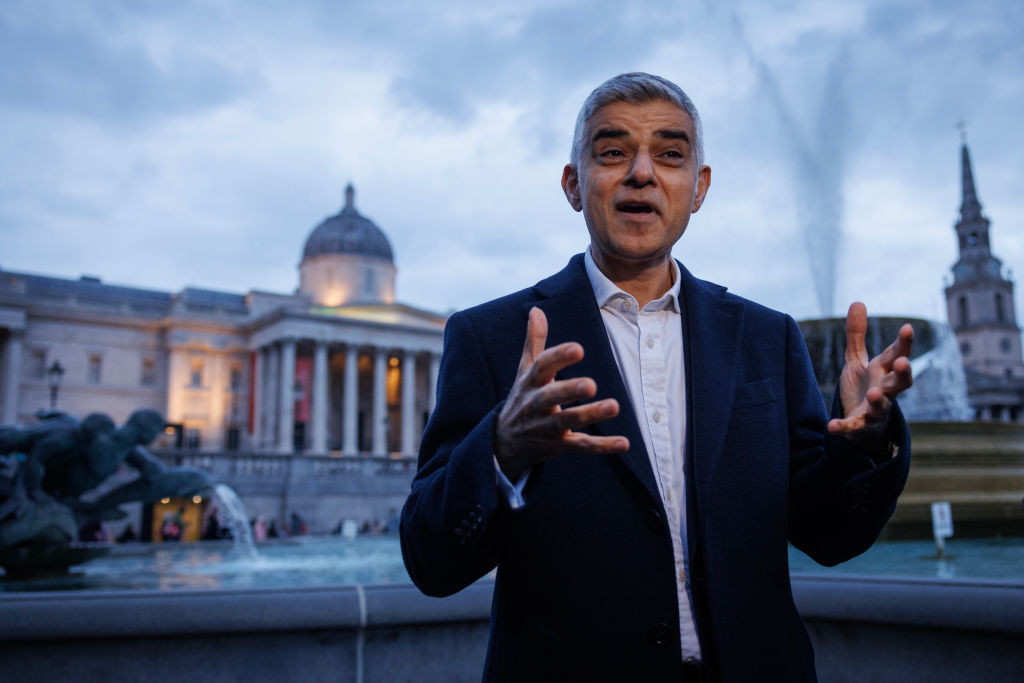
Yesterday, Labour’s official X account opted to mark the beginning of Holy Week with a weirdly liturgically tone-deaf post, wishing the public “Happy Palm Sunday from all of us at the Labour Party.” Then Sadiq Khan, the Mayor of London, posted to mark the Holy Week procession across Trafalgar Square to St Martin-in-the-Fields.
Though Khan did not reference it explicitly, the Palm Sunday procession came in the wake of an internet bunfight over a public Muslim prayer celebration which also took place in Trafalgar Square this month, and in which Khan participated. That event prompted a critical post from Nick Timothy MP, who called it “an act of domination” and demanded that public Muslim worship not happen again in Britain.
Timothy’s post caused a furore, including demands from some MPs that he be censured under Labour’s new “Islamophobia” definition, and even a call by Keir Starmer for Kemi Badenoch to sack him as shadow justice secretary. In this context, Khan’s acknowledgement of the Palm Sunday procession — and likely also Labour’s X post to mark the day — should be interpreted as an intervention in this debate on the side of equal freedom of worship for all in Britain, including Muslims.
Journalist Oli Dugmore made the same point more directly, copying Timothy’s complaint about Muslim worship but substituting in the Palm Sunday procession photo. Why, we are presumably to wonder, should a Christian procession get to do this but not a Muslim one? Yet the answer to this is straightforward: Anglican Christianity is England’s established Church. Our King is its head, and its bishops sit in the House of Lords. There is no tradition in Britain of freedom of worship.
Indeed, it was this lack of freedom of worship which prompted the Puritans to depart for the New World in the 17th century, and later to write freedom of worship into America’s constitution. Meanwhile, England passed the Test Acts, banning faithful Catholics from public office. Until 1791 Catholics in England had to hold Mass in secret, and even afterwards were forbidden from worshipping in the open air.
Though the Test Acts were repealed in 1828, Britain is so far from being constitutionally secular and liberal that Tony Blair only converted to Catholicism after leaving Downing Street. Were a royal heir apparent to convert to Catholicism, it would cause a constitutional crisis. It’s hard to think of a clearer example of one faith being institutionally privileged. And contra the insidious equalising-down implied by Khan’s “ecumenical” celebration of the Palm Sunday procession, the logic of an established state faith should in fact mean Anglican public religious displays are permitted by default, and others only by express permission.
Dugmore knows this perfectly well. He has since posted to the effect that the Church of England should not play any role in governance. But the freedom of worship principle that both he and Khan have chosen to pretend is already the default is an American norm, not an English one. Those who imply covertly (like Khan) or overtly (like Dugmore) that Anglican public worship should be tolerated as, at best, one instance of a smorgasbord of interchangeable “faiths” are asserting something radically disruptive to Britain’s actual constitution.
The only reason all of this is not more obvious is that senior clergy in the modern Church of England seem, on the whole, uncomfortable with their own constitutional primacy. Many seem to spend as much time genuflecting to religious pluralism as performing their historic role upholding England’s established faith in the public square.
In turn, a cynic might suggest that whatever Britain’s state faith is de jure, the behaviour of our bishops affirms that they are more aligned with Khan and Dugmore on Britain’s de facto state faith than with Nick Timothy. That, whatever role Timothy may think England’s established church should play, in practice its bishops view their role as sustaining a tolerant public square able to hold all competing faiths in a kind of mild, smooth emulsion, like confessional mayonnaise.
With this in mind, we might further wonder whether Dugmore should be careful what he wishes for when he longs for their disestablishment. Anglicanism’s current crop of mild-mannered, pluralistic primates are not an obstacle to British secular liberalism, but a keystone of its survival. The most likely outcome of displacing them from their constitutionally privileged position would not be entrenching religious pluralism in Britain, but signalling the beginning of its demise.
