









23 October 2026 - 7:00am
As oil money began to flow towards HM Treasury — and domestic crises mounted amid the discontent of the Seventies — then Labour PM Jim Callaghan described the North Sea as “God’s gift” to the British economy. Alas, the gift wasn’t generous enough to prevent his landslide defeat to Margaret Thatcher in 1979. But in that pre-ecologically conscious era, before concern over climate change had become a pillar of mainstream political debate, there was a consensus that ran through Left and Right: the discovery of oil and gas fields was a boon.
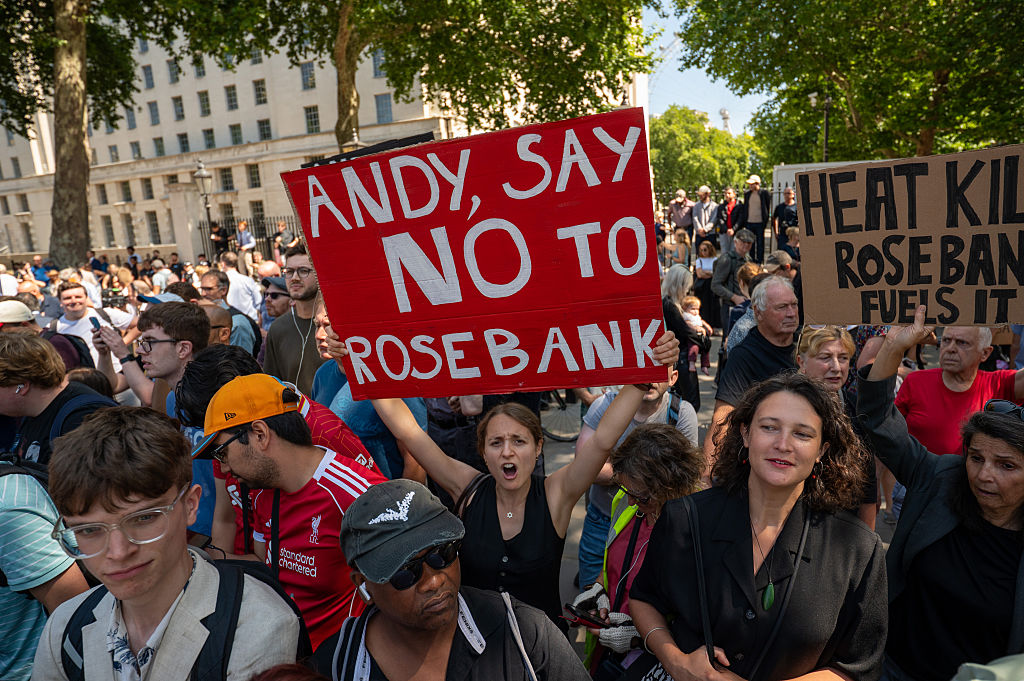
Opinions today have diverged sharply. Miatta Fahnbulleh, Britain’s Energy Secretary, has strongly intimated that while gas production at Jackdaw met the standards required for the government’s approval, further drilling at the Rosebank oilfield will likely be blocked. While Jackdaw, she says, is “a gasfield that caters for the domestic market”, Rosebank is “an oilfield that is mainly for export”.
The Conservative Party spent years in government implementing the Climate Change Act, investing heavily in renewables and constraining the actions of future governments by enshrining net zero targets into law. But they have since become more circumspect. Kemi Badenoch has called for new licenses to be issued without delay (presumably by repealing legislation she happily voted for in government), while Reform’s energy policy is best summarised as “drill, baby, drill”.
Meanwhile, Andy Burnham’s government looks to be adopting a middle-ground fudge — “yes” to expanding existing domestic gas supplies, “no” to extending oil fields, particularly if the latter are primarily geared towards providing for foreign buyers. All the while funnelling more revenues from the North Sea into renewables. This kind of in-out, eco-pragmatist fence-sitting will alienate both the Green-curious and the pro-drilling lobby. It is designed to placate the wishes of both the climate-minded (for whom Fahnbulleh is the cabinet mascot) and the more fiscally focused in the Treasury.
But Fahnbulleh’s reasoning for a possible rejection of Rosebank — that its output would mainly feed exports — is a confusing one given it comes from a government presiding over a persistent current account deficit. The UK is importing much more than it exports, and it is relying on foreign finance to plug the gap. Indeed, the UK’s poor productive record and over-consumption leave it in what the New Economics Foundation — Fahnbulleh’s former think tank — once described as an “economic deadlock”, with “mutual reinforcement” between “demand for finance” and “demand for imports”.
Even if Rosebank’s oil bounty was preordained by God to be sold abroad, then the benefits for Britain’s trade deficit, tax revenues, and jobs created, would be enough to persuade a smarter government — truly committed to the buzzwords of economic resilience and “securonomics” — that domestic production should be maximised.
While the Energy Minister seems concerned only with allowing domestic production for domestic consumption, a more traditionally dirigiste social democrat would be exploring options for export controls, state participation in production, or domestic purchasing agreements alongside the remaining local refineries, rather than halting extraction entirely.
Given the fact that even the most optimistic scenarios for the energy transition accept that we will depend on oil and gas well beyond 2050, then surely sourcing these essential products closer to home should enthuse ministers, like Fahnbulleh, who have bemoaned an “uncritical embrace of globalisation”. This too would bring the project into line with the Prime Minister’s own vision: “It just doesn’t make sense”, he told his social media following this week, “only to import oil and gas from abroad when we could be considering the responsible use of our own resources here at home”.
And yet, as ever, it points to a confusion in ideas about what Labour stands for: governing in the national interest, and by extension in the interest of British workers; or governing for some overarching and abstract concept of the endangered Earth or amorphous global citizenry. It looks like the government will now answer that with: neither, apparently.
Jonny Ball is a Contributing Editor at UnHerd. He formerly wrote under the name Despotic Inroad.
 DespoticInroad