







 Prefer us on Google

21 June 2026 - 8:00am
Central London
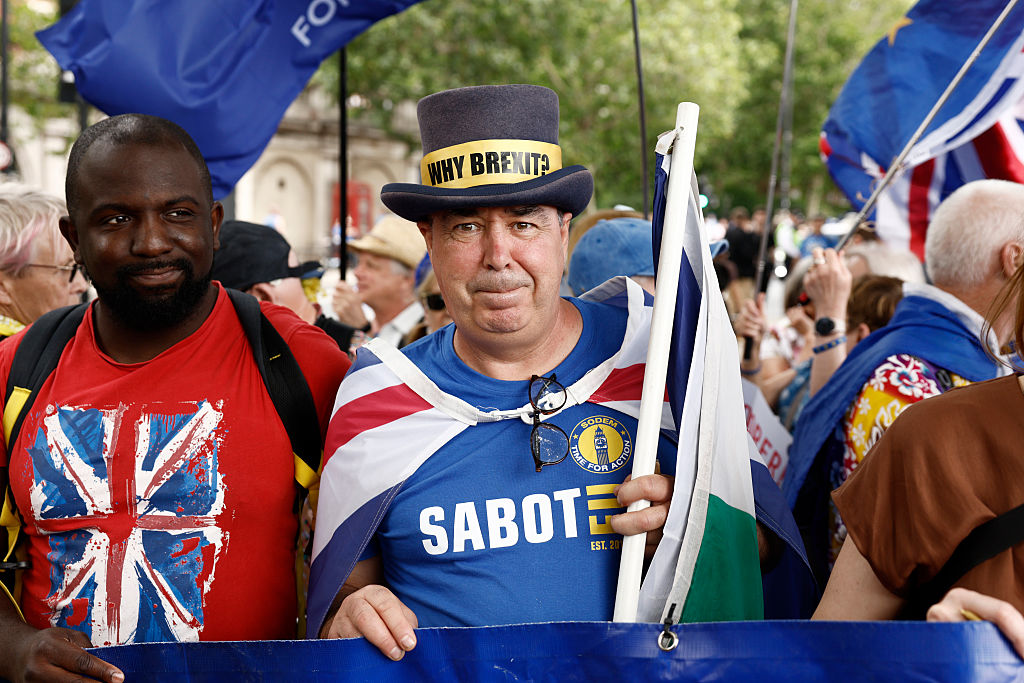
For some four, heat-exhausted hours on Saturday, one thousand people stood in Parliament Square and dreamed of Europe. It had been 10 long years since the Brexit vote, since they woke one morning to find they were no longer Europeans, but now the prospect of rejoining felt inevitable.
A statistic that had appeared in the Financial Times earlier this week gave them hope: 2.6 million Leave voters were dead, meaning that, had the vote happened today, it would have turned out quite differently. A placard insisted that “nobody born this century voted to leave.” “The problem with older people,” said one attendee, “is their nostalgia.” He was 65 years old and so, it seemed, was everyone else at the National Rejoin March, the latest iteration of the People’s Vote campaign. I saw only four people who were plausibly younger than 20, all of whom had megaphones or speaking slots thrust upon them.
The march had started at Temple Station. From there, it had been led by a troupe of blue-haired dancers waving EU flags and chanting: “You can shove Brexit up your arse.” The occasional passer-by or cabbie heckled them.
By the time they’d reached Parliament, it was so hot that the only smell was Nivea sun cream, the only sound the crunching of water bottles. One by one, the ageing crowd collapsed onto the lawn, or fainted into ambulances, or else retreated into the shade. A woman fanned herself with a copy of The New World bearing the headline “A History of Brexit in 256 Disasters”.
In hindsight, Brexit was easily explained: a few dishonesties about the NHS and an imminent Turkish invasion had swung it. Whatever anger there was in the country had been whipped up by lying Tories or Nigel Farage. It felt significant that no one cared that one of the most alienating consequences of Brexit had been the “Boriswave”. Someone wore a T-shirt that read: “Who will sell us coffee now?” They seemed to think that a return to Europe would mean more immigration, rather than less. I wondered how they’d feel about an EU in which Giorgia Meloni has increasing influence, in which Jordan Bardella and the AfD are knocking at the door. They responded with either silence or assertions that Europe is liberal and could only ever be so.
The show was delayed. A woman appeared onstage to announce that they were having technical issues. I spotted the veteran anti-Brexit campaigner Steve Bray wandering around nervously and looking for an amplifier, shouting: “Gareth! Gareth! Has anyone seen Gareth?” A video appeared onscreen: a purported history of Britain’s relationship to the EU, bafflingly limited to clips of Barack Obama, Ronald Reagan and Charlie Chaplin. Over in the shade, old men sidled up beside me and told me that I really ought to know about Russia and Cambridge Analytica and Tory plots.
Once the tribunes of the People’s Vote campaign dispersed into the podcast-sphere and a few stillborn parties (who now remembers True & Fair?), all that was left were a few diehard campaigners and the occasional fossil. The headline speaker was former Labour leader Neil Kinnock, who spoke of the “unmitigated” failure of Brexit. He also said that “there are no islands in this world, least of all ours.” He gestured to the “youngsters”, who — now in their mid-60s — smiled gormlessly back at him.
Femi Oluwole, a People’s Vote campaigner, followed shortly after. He had recently visited Brussels and met the EU’s Brexit spokesperson, who had told him that “it’s time to make Nigel Farage pay.” Terry Reintke, an MEP with the German Greens, said much the same. There is a liberal Europe waiting with open arms, and all we need to do is hurtle towards it. She threatened that, if we’re not quick enough, the 28th European “star” will go to Montenegro. The crowd groaned. They wanted it for themselves.
But no one, really, wanted to talk about Europe. All the issues they blamed on Brexit were alarmingly present in Europe itself — sectarian tension, cost-of-living pressures, the rise of the hard Right. If only Britain could return to the EU, then it could take back control — of its faltering economy, its wayward electorate — and the course of history would be corrected. Britain, once again, would be at the centre of a liberal Europe.
