









13 April 2026 - 7:00am
Hungary’s election climaxed in spectacular fashion on Sunday evening, as Péter Magyar’s Tisza party scored a crushing victory over Viktor Orbán’s Fidesz, putting an end to 16 years of rule by one of Europe’s most polarising leaders.
The scale of the Tisza victory, amid astonishingly high voter turnout of almost 80%, was quickly apparent. Orbán phoned Magyar to concede defeat just two and a half hours after polls had closed. Speaking to supporters, the outgoing Prime Minister promised that Fidesz would “never, ever give up” and would continue to “serve our country, the Hungarian nation, even from opposition”.
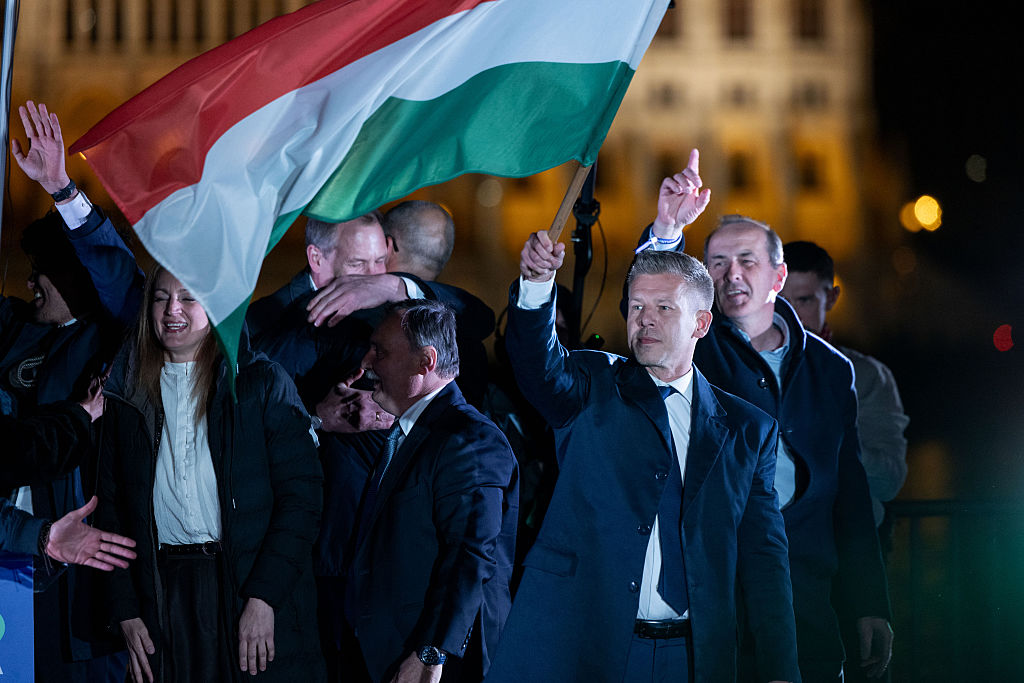
With Tisza on course to claim a remarkable 138 seats in the new parliament against Fidesz’s meagre 55, Magyar’s victory speech on the banks of the Danube proclaimed the dawn of a new era. “Together, we have replaced the Orbán regime, liberated Hungary, and taken back our homeland,” he said, describing the bitter election as a David and Goliath struggle in which “love finally prevailed.” Although “the state party deployed its entire apparatus” in “lies and hatred”, he added, “today, the truth triumphed over lies.”
Magyar recognises that there will be a prolonged struggle to dismantle the network of Orbán allies who dominate Hungarian public life. With this in mind, he called on the country’s Fidesz-aligned President Tamás Sulyok to invite him to form a government and then immediately resign from office “with as much dignity as he has left”. Magyar also encouraged the president of the supreme court and various other senior public office holders to resign, in order to facilitate “the independence of the institutions that ensure democracy” so that “Hungary will once again be a strong ally in the European Union and Nato.”
A two-thirds “supermajority”, providing the parliamentary strength needed to amend the nation’s constitution, was seen as a key, if unlikely, condition allowing Magyar to force through such sweeping changes and override the expected blocking tactics of Orbán’s political allies. Now, that supermajority has been achieved. Ironically, the disproportionate share of seats to votes — Tisza is set to have over two-thirds of seats in the new parliament from 53.5% of the total vote — is a direct consequence of the “winner takes all” electoral system refined by Fidesz to make Orbán electorally invincible.
This supermajority, and the constitutional power it brings, will cause particular alarm among members of the Orbán system. Magyar’s aim to dismantle that system and prosecute its leading figures dovetails with his promised bid to secure the release of around €18 billion in EU funds withheld for claimed rule-of-law and corruption concerns. The incoming leader has long held that negotiations in Brussels over the release of those funds will be his main priority on assuming office.
Magyar’s campaign has otherwise focused on domestic issues such as the cost of living, in contrast to Orbán’s strong focus on geopolitics and foreign policy. A paradox of Magyar’s campaign has been that, while he portrays the Fidesz regime — of which he was himself previously a member — as irredeemably evil, he does not openly plan significant changes to Hungary’s stance on the key policies for which Orbán has been criticised abroad. Those include a rejection of mass migration, a strongly conservative approach to LGBT issues, and military support for Ukraine (although Volodymyr Zelensky will heave a sigh of relief at the removal of the chief obstacle to EU aid for Ukraine).
Instead, Magyar wants to focus his energies on purging Fidesz allies from positions of power and reshaping Hungarian public life. Orbán will strain every sinew from the opposition benches to hold his carefully constructed power apparatus in place, yet questions will be asked about his own political future. The aura of invincibility which has sustained him as a standard-bearer for the global populist Right, and as the irreplaceable Godfather-figure of Hungarian public life, is shattered.
Orbán has been in opposition before, but never as the representative of a model of government that has been so emphatically rejected at the ballot box. Anti-populist forces the world over will now proclaim, with glee, that his remarkable, controversial model has finally failed, once and for all.