









15 April 2026 - 10:00am
Richard Dawkins has a question for us. It’s so big that it renders most of our present concerns puny by comparison. “Neanderthal genome is largely known,” he posted on Sunday. “If it becomes possible to reconstruct a live Neanderthal person, what, in your opinion, would be the pros and cons? I’m genuinely interested in canvassing opinions for and against.”
The strongest case against the de-extinction of the Neanderthals is that their existence would blow apart our ethical frameworks by blurring the line between human and non-human. But before unpacking that objection, is this a scenario that is likely to arise in the foreseeable future — or something we can leave the 22nd century to worry about? Well, the enabling technology might be closer than we think.
Last year, a biotech company called Colossal Biosciences claimed to have brought back the dire wolf, a species that’s been extinct for 10,000 years. Other experts have disputed the claim, arguing that the resurrected dire wolves were just genetically modified grey wolves, a modern-day species that’s still very much with us. Nevertheless, the experiment hints at the most plausible pathway by which science might reverse the extinction of the Neanderthal. We would begin with a human cell and edit it, gene by gene, until it more closely resembled Homo neanderthalensis than Homo sapiens. That would be an extraordinarily complex undertaking, but so too, once, was sequencing the human genome.
As with that earlier breakthrough, advances in AI could dramatically accelerate progress. Once a viable Neanderthal-like cell had been reconstructed, existing cloning and implantation techniques, similar to those already used in cloning pet dogs, could in principle bring a Neanderthal child to term.
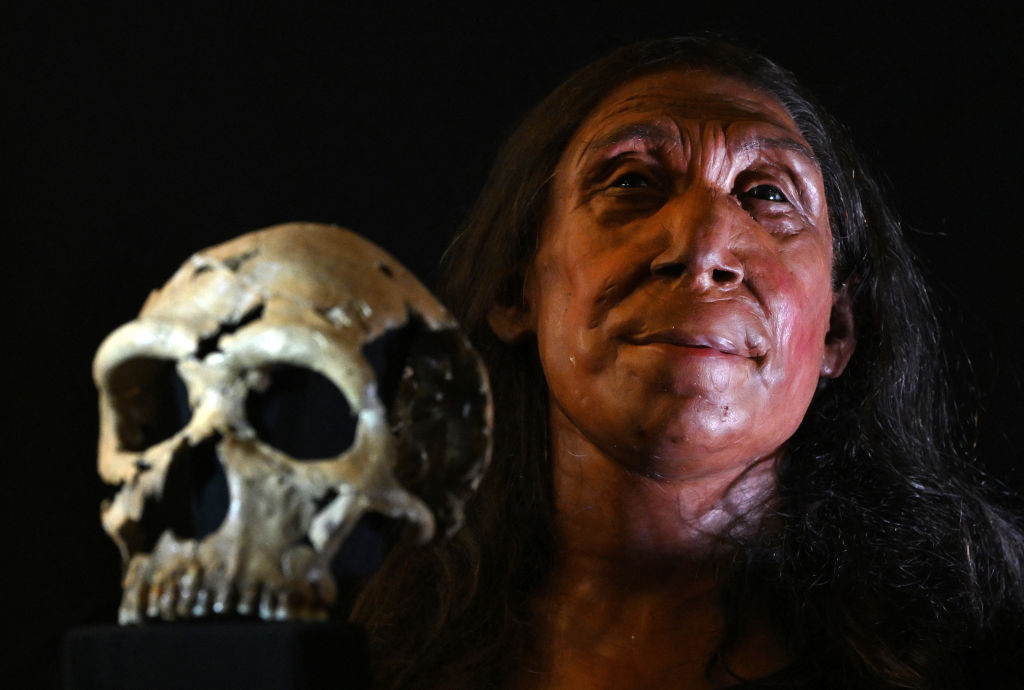
Never mind Jurassic Park, this would be the ultimate prize in de-extinction. That’s because, as Dawkins acknowledges, Neanderthals are people — they are not our brutish ape-man predecessors, but a sibling species to humanity. For the first time in our history, though not our prehistory, not all persons in this world would be human. In that respect — and assuming that the Neanderthal extinction 40,000 years ago was our fault — we might even view their de-extinction as making amends.
And yet the personhood of Neanderthals presents a set of problems that we wouldn’t have with, say, bringing back the dodo. It would mean experimenting on people — not only the resurrected Neanderthals but also the human surrogate mothers who, in the absence of artificial wombs or animal surrogates, would be required to give birth to the first of the new generation.
If that isn’t enough to raise every red flag in our ethical armoury, then think about the fate of the Neanderthal children as they grow to adulthood. By what criteria would we extend human rights to a non-human species? Our traditional understanding of personhood, based on belief in the soul, has been replaced by biological criteria. Humans have human rights because they are human; animals do not because they are non-human.
Throughout history, attempts have been made to designate oppressed groups as sub-human, not least to justify the institution of slavery. These have ultimately failed, but the return of the Neanderthals would create a fuzzy third category of being: not animal but also not quite human. Consider the issue of genetic modification. While we engineer animal and plant species to serve agricultural and other economic purposes, manipulating the human genome is banned by agreements such as the Oviedo Convention. Apart from the special case of medical treatment, we have decided to protect the genetic fate of future generations from those who’d seek to pre-determine it.
And that is the fundamental problem with bringing back the Neanderthals. By the very fact of their de-extinction, they’d exist as a class of instrumentalised persons — the objects of others. Time, then, to close this loophole before it has a chance to open.
Peter Franklin is Associate Editor of UnHerd. He was previously a policy advisor and speechwriter on environmental and social issues.
 peterfranklin_