







 Prefer us on Google

26 September 2026 - 4:00pm
Benjamin Netanyahu, judging by his address to the General Assembly of the United Nations in New York earlier this week, is not happy with Britain. Although he hasn’t formally lent his support to Javier Milei’s claims to the Falklands, the other round of Britain-bashing this Assembly season, others in his government have gleefully taken the opportunity. Echoing JD Vance, the Israeli Prime Minister has previously joked that Britain will be the “first Islamic republic to get a nuclear weapon”, apparently forgetting about the Islamic Republic of Pakistan. He is indignant that Keir Starmer followed through on his manifesto promise to recognise Palestinian statehood, and that Ed Miliband, now Foreign Secretary, has imposed sanctions on the West Bank.
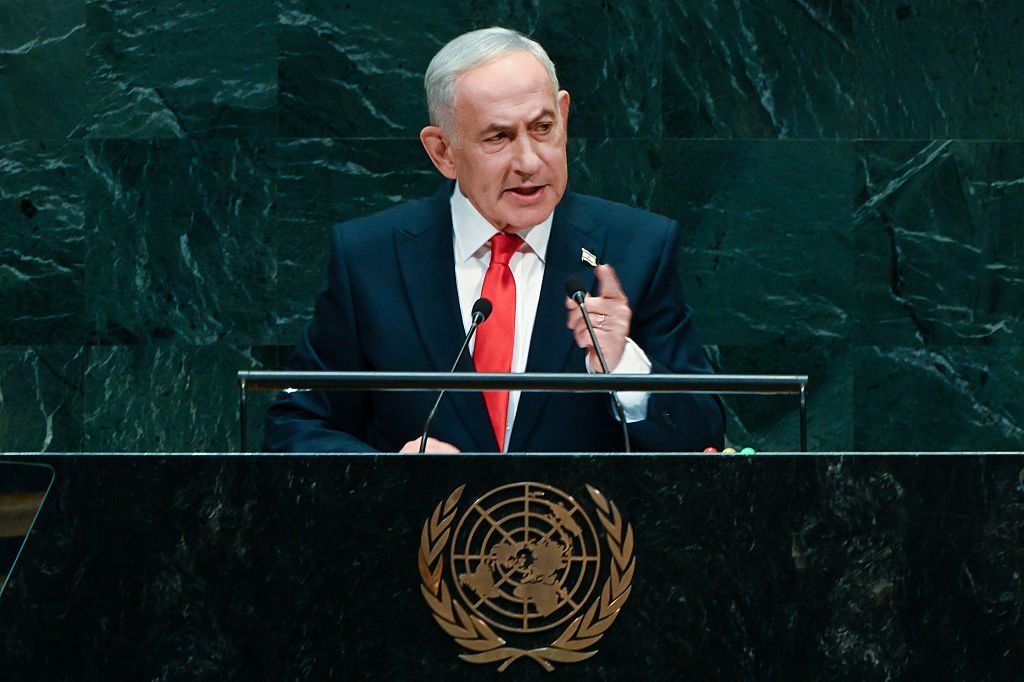
The General Assembly is the perfect stage for anti-imperial posturing; that, after all, is what it is for. “They accuse Israel, tiny Israel, of colonialism” — Israel is always “tiny” in this scenario — “and who’s accusing us? Well, among them are people in Britain and in France,” Netanyahu said in his speech. Britain, in this telling, forfeited all moral authority when it chose to colonise a third of the world. What right do Andy Burnham and Ed Miliband have to lecture Israel on human rights in Palestine, when Britain was once Palestine’s imperial master?
Really, the General Assembly is seldom the intended audience for this kind of speech. There was in any case hardly any audience for Netanyahu to address: the majority of delegates filtered out of the hall in indignation the moment he arrived on stage. But no matter: Bibi, like every leader at the UN, speaks with a domestic audience in mind. In just over a month, Israel will hold a general election which he is on track to lose. This was a stump speech, and a rather desperate one at that. Likewise, when Milei took to the lectern in New York, he inveighed against the “implanted” British population on the Falklands, terms ironically redolent of how critics of Israel speak about Jewish settlement in the Middle East.
We are accustomed, in the West, to associate anti-colonial rhetoric with the Palestinian cause. Even supporters of the State of Israel tend, if sometimes only subconsciously, to accept the premise that Israel is a “settler colonial”, essentially European power — the “villa in the jungle” — and that the Palestinians are the wretched of the earth.
It is therefore easily forgotten that Israel is a postcolonial state, and that its historical identity is defined as much against a series of imperial powers — culminating with the British Mandate — as it is against the current depressed population of Palestinians. When Israelis celebrate their independence day, they celebrate independence from Britain. Their pantheon of national heroes consists of anti-colonial “freedom fighters” who stood up to the British and won. (The British, of course, have tended to take a different view of such characters.)
Anti-imperialism is especially acute on the Israeli Right. Netanyahu is the political heir to Menachem Begin; the Revisionist strain of Zionism, to which they both belong, diverged from the Zionist establishment in large part because they thought it overly conciliatory towards British rule. As the Republic of Ireland fashions anti-Zionism into an article of the national faith, and as Ed Sheeran is denounced by his Irish fans and relatives, it is worth recalling that Revisionist Zionists and Irish nationalists once found common cause in their struggle against Perfidious Albion. Ze’ev Jabotinsky, the founding father of Revisionist Zionism, even visited Ireland in 1938 to discuss the tactics of “freedom fighting” with Robert Briscoe, a Jewish, Zionist IRA veteran.
This is something they share with nationalists in other parts of the world which once were shaded pink. Earlier this year Narendra Modi, one of Netanyahu’s most indefatigable supporters on the world stage, removed a bust of the British architect Edwin Lutyens from the presidential palace in India. Do not be deceived by keffiyeh-clad activists in Dublin and beyond. Cries to “decolonise” and efforts to make Britain feel guilty over its imperial past can still carry a strong Right-wing flavour.
