









20 October 2026 - 11:30am
For all the talk of a “Burnham bounce”, it’s far from clear that the next general election will produce another Labour majority. The party’s projected vote share remains below the 33.7% won by Keir Starmer in 2024, which was itself the lowest majority-winning vote share in British electoral history. Labour’s current support might be enough if the Right remains fractured, but if the party is to form a government after the next election, it may need friends in a new parliament.
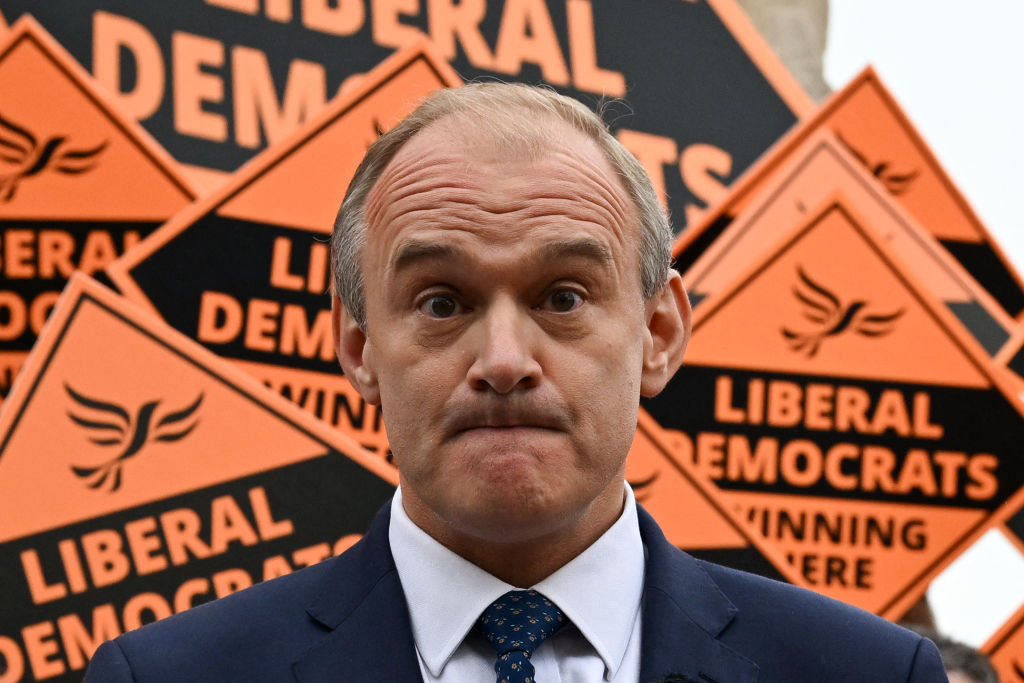
The most likely coalition partner would be the Liberal Democrats, whose leader, Ed Davey, made positive noises about a pact in an interview with the Sunday Times this weekend. Davey was himself a member of David Cameron’s Cabinet when the Lib Dems were last in government, as part of the Conservative-led Coalition. Having been reduced to just eight seats at the 2015 general election, the party has since recovered, with 72 MPs elected in 2024 and constituencies once represented by Cameron and Theresa May going yellow. Indeed, the Lib Dems gained 60 seats from the Tories and none from Labour.
This profile of seats makes a Labour-Lib Dem pact very risky for Davey. If his party’s largely unthreatening and often Tory-coded MPs were suddenly propping up a tax-raising Labour government, they could rapidly find themselves on the sharp end of their constituents’ views in Oxfordshire, Surrey and the rest of the Home Counties.
In Davey’s calculation, the wrath of constituents would be worth it to achieve the great Liberal hope that has been around for more than a century. According to the Sunday Times interview, Davey’s demands in coalition negotiations would include proportional representation (PR), a policy which Andy Burnham has already backed. The change may not even need a referendum, the Lib Dem leader believes, if Labour also has a commitment to PR in its manifesto.
The Liberals were among the supporters of the Proportional Representation Society, founded in 1884, and advocated for PR being included in the Representation of the People Act in 1918. Their battle never ceased, but first-past-the-post remains in place — despite some near misses when they were promised referendums on electoral reform by Tony Blair (never delivered), and achieved one under Cameron but subsequently lost.
However, PR is much less appealing for Lib Dems today than it once was. In 1992, the party won 17.8% of the vote and 3.1% of MPs. Fast forward to 2024, and just 12.2% of the vote got the Lib Dems 11.1% of the MPs. Its recent success reflects the way the party’s vote has become highly efficient — it has enough support to win where it can and sod all elsewhere — which means that first-past-the-post is arguably more friend than foe to Davey’s party. The same is even more true in local government, where massive Lib Dem majorities have been won on minority vote shares.
Under PR, it’s now possible that the Lib Dems would lose seats. Many of their 2024 gains were propelled not by what they stood for, but instead by their ruthless local campaigning and positioning as the most effective anti-Tory vote in large parts of the South of England. These dynamics play out much better in single-MP constituencies under first-past-the-post than under PR. Without having to tactically vote Lib Dem to kick out or keep out the Tories, what would compel voters to do so?
For Labour, this logic would be almost reversed: the party would be throwing away its historic mission to form majority governments in favour of clinging to power for a few more years. But the reality is that first-past-the-post has been kind to Labour, helping it win nine majorities since the Second World War, just one fewer than the Tories. Under PR, even the best elections for Labour would be followed by negotiations with Lib Dems, Greens or some hodgepodge group of the Left.
If the party joins together with Labour after the next election, the Lib Dems would be snubbing their current voter base to win a reform that could end up costing them seats. Labour, meanwhile, would be giving up on ever forming a single-party majority government again. In other words, a pact between the two parties would pave the road to ruin for both.
Lee David Evans is an historian of the Conservative Party and the John Ramsden Fellow at the Mile End Institute at Queen Mary, University of London. He is the author of Coronations & Defenestration: Choosing (and losing) Tory Leaders and the co-host of the podcast Since Attlee & Churchill.
 LeeDavidEvansUK