








23 April 2026 - 7:00am
“It is my birthday,” the Egyptian queen suddenly announces in the middle of William Shakespeare’s Antony and Cleopatra. She wasn’t going to do anything for it — “I had thought to have held it poor” — but then decides she will celebrate in style: “I will be Cleopatra again.”
Today marks 462 years since Shakespeare’s own birth, during which time he has been vaunted as the greatest English-language writer and performed on every continent. The problem with this popularity, though, is that, in a bid for originality, new adaptations have frequently used his plays to further very modern political causes. Can we not just let Shakespeare be Shakespeare?
Earlier this year, to promote his new film adaptation of Hamlet, the actor Riz Ahmed explained that everyone has got the famous “To be or not to be” speech wrong. Apparently, it’s not about suicide. Nor is it about a man with an impossible burden, teetering on the edge of despair, trying to think about what comes after death. It’s not about whether it’s better to endure misfortune or die. No, the most famous speech in the English language is about… radical resistance to oppression.
Ahmed essentially takes two words — “oppressor’s wrong” — as evidence that this is what the speech is “really about”. Using this logic, one could just as easily say the speech is “really about” ageing (“whips and scorns of time”), romantic yearning (“pangs of disprized love”) or being passed over for a promotion (“the spurns / That patient merit of th’unworthy takes”). But this would obviously destroy the richness of the text. It is clear here that Ahmed is recruiting Shakespeare for his own political purposes, co-opting the Bard to the cause of some generalised “resistance”.
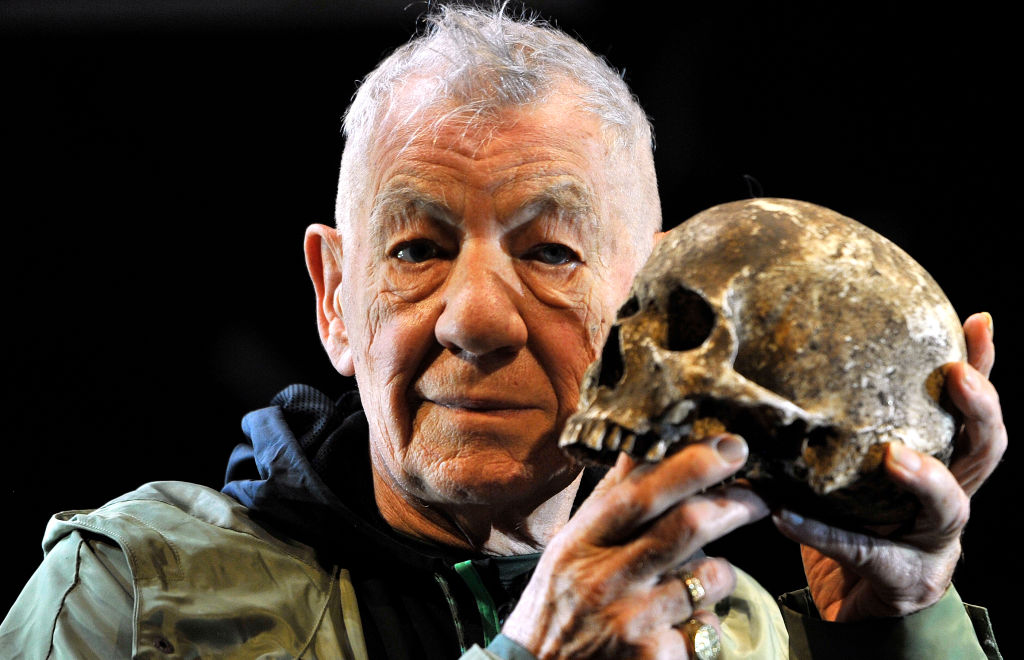
The great Ian McKellen has also got in on the act. A clip of him reciting a speech from Sir Thomas More, often attributed to Shakespeare, on The Late Show with Stephen Colbert went viral in February. Known as “The Stranger’s Case”, the speech is an impassioned plea to recognise the humanity of refugees. And of course McKellen performs it beautifully. He’s been reciting this speech in various interviews for over a decade, often framing it with reference to the refugee crisis and as a rallying cry against bigotry. Scholars are less confident that this speech was actually written by Shakespeare. But the association is enough for most of McKellen’s audiences to accept that the playwright behind Hamlet and Othello would automatically be on the side of “no borders”.
In some ways, all this is reassuring: Shakespeare still holds such cultural power in 2026 that people need him on their side. But it is worth considering the intellectual lineage of this approach. McKellen and Ahmed are, perhaps unwittingly, following the method of “cultural materialism”. This was a movement in literary criticism in the late Seventies and Eighties which identified subversive elements in the text and used it to further a current political issue. The text is used explicitly to try to change the present. Far from being radical, this has been the guiding principle for studying and performing Shakespeare for at least two generations now.
Some productions take the cultural materialism further. The actor Elliot Page will introduce a production of As You Like It later this year with an all trans and non-binary cast. In an interview, Page claims that “Shakespeare wrote characters who defy easy categories long before we had language for it.” But the director Phoebe Kemp goes further, saying “there are moments where Shakespeare’s view of gender and sexuality is restrictive.” The production will “challenge” this. Here is a slightly different move. The theatremakers are simultaneously claiming Shakespeare and teaching him a lesson, taking him to task. Ironically, it is a rather colonial way of dealing with the culture of the past.
If we only see Shakespeare through the lens of our own concerns, we will not be able to access his thoughts. We will never be able to get out of our own time, let alone consider if there is any truth in how he thinks about things. And as he is perhaps the most penetrating thinker that we know of who wrote in English, this feels like a loss.
Does Shakespeare have a worldview? In his comedies, he comes down on the side of a natural hierarchy of goodness and virtue. Yes, he does not seem to like “tyranny” (Macbeth). But he always emphasises the chaos and violence that comes from an absence of power (Julius Caesar). He always shows us the stupidity of the mob (Coriolanus). He believes in the possibility and virtue of forgiveness (The Tempest).
Surely, it is more interesting to see where Shakespeare’s thought differs from ours and live with that difference. Or even see what truth there is in a previous way of thinking. It is actually easier to “interrogate” and “challenge”. The really difficult thing to do with culture is to defend it. What are we defending in Shakespeare? Vitality, dexterity of language, penetrating philosophy and full-blooded passion. For his birthday this year, that seems like a worthy aim.
Join the discussion
Join like minded readers that support our journalism by becoming a paid subscriber
To join the discussion in the comments, become a paid subscriber.
Join like minded readers that support our journalism, read unlimited articles and enjoy other subscriber-only benefits.
Subscribe