







 Prefer us on Google

18 August 2026 - 7:00am
Trafalgar Square, London
“This is not a demonstration: it’s a vigil. I understand we’re angry, we’re distraught, but we have to remember why we are here.” Here we were at Jason Arday’s vigil in central London, and organiser Weyman Bennett was pleading for calm. Thousands had gathered to commemorate the life of the former University of Cambridge professor, who died on Friday. But with attendees raising their fists in salute and chanting “No justice, no peace”, and speakers calling for a “reckoning” while naming those they blamed for his death, the distinction between vigil and rally began to look rather thin.
For the crowd, there was little doubt about who was culpable. One banner read: “Racism within mainstream media is responsible for Jason Arday’s death.” Another demanded that “the racist UK media must be dismantled.” Labour MP Bell Ribeiro-Addy, speaking from the stage, called the press “wicked”, while her parliamentary colleague Diane Abbott said that “the vicious media campaign drove [Arday] to his death.”
The Arday scandal — which encompasses claims of academic fraud and biographical fabrication, legal threats and attempts on the professor’s part to involve the police — is tangled and baroque. Yet the speakers and attendees at Monday’s vigil saw it in far more Manichean terms. Another Labour MP, Dawn Butler, declared: “This isn’t a battle of black versus white. This is a battle of right versus wrong. This is a battle of good versus evil.” She added that “now is the time for unity. Now is the time to bring down the systems that don’t protect us.”
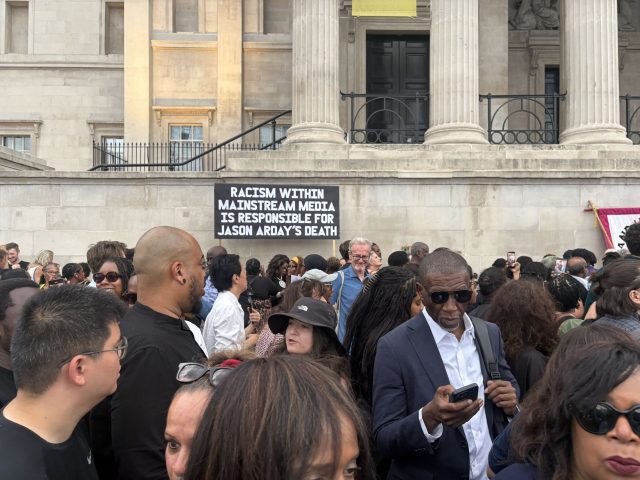
The audience was majority-black, but the white members of the crowd cheered on every use of the racialised “we” and “us”, obligingly raising their fists in the Black Power salute when asked by another speaker. Jolyon Maugham, the director of the Good Law Project who has authored a petition demanding a public inquiry into Arday’s death, acknowledged that he was somewhat out of place, declaring that “today of all days is a day for white people to listen, and not to speak.” His speech, which touched on “the richness and inherent humanity of black people” and the need to regulate “our increasingly revolting press”, lasted for several more minutes.
In among these diatribes against the media and references to “black excellence”, Arday himself — who by the accounts of several people who knew him was gentle and kind, but flawed — was obscured. Instead he was treated as a combination of W.E.B. Du Bois, Martin Luther King and George Floyd: a trailblazing scholar, a champion of civil rights, and a martyr. Simon Woolley, the principal of Cambridge’s Homerton College, called Arday’s death a “public assassination” and a “lynching”. He lauded “this wonderful man” who “never stole a pack of crisps”. Arday, in this telling, “was exonerated of plagiarism, but the hounds of hell sought to pursue any inaccuracy that meant they could say ‘Jason is a bad man.’”
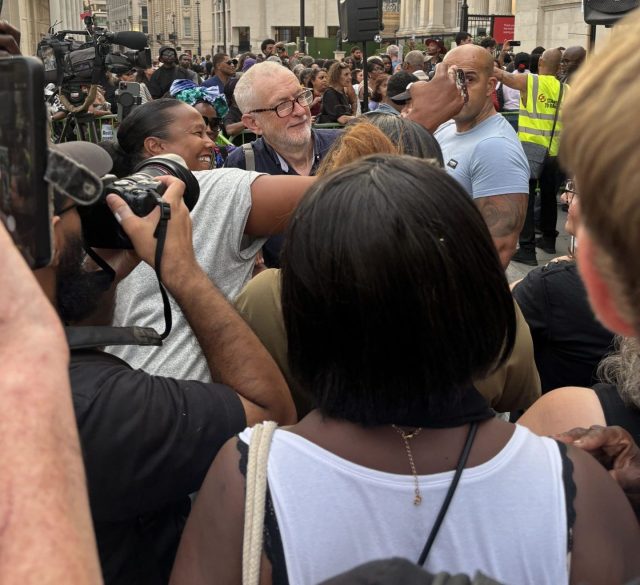
While his family’s public statements in recent days have stressed his roles as a “father, partner, brother, uncle and son”, those present at the Monday vigil were eager to emphasise Arday’s academic “excellence”. Butler impelled the crowd: “When we say his name, do not miss out the ‘Professor’, because that’s exactly what they’d want us to do.” She and other speakers frequently corrected themselves whenever they missed out the title; a message read out on behalf of an unnamed colleague of Arday’s stated that “his scholarship was valued by many” and spoke longingly of “the fairer society that Jason spent so much of his life trying to create”.
What will this fairer society look like? Despite the appeals to unity, the Arday vigil seemed intent on casting his death as the sacrifice of one man at the hands of a racist mob, while reinforcing the very same racial divisions it claimed to oppose. “It wasn’t just a campaign against Jason. It was a campaign against all of us,” Abbott insisted. Another speaker, the activist Patrick Vernon, drew comparisons with the murder of Stephen Lawrence, ticking off the slogans which are by now familiar to anyone who has followed America’s racial politics in recent years: “Say his name”, “Rest in power”, “Black lives matter.”
“Black lives matter.” Observers might have noted that Arday’s tragic death has now come to symbolise the far wider issue of perceived systemic injustice and fraying race relations. The petition for an inquiry is, at the time of writing, approaching 100,000 signatures; Vernon’s fundraiser for his late friend has already brought in over £180,000 in donations. Maugham encouraged attendees to put Prime Minister Andy Burnham “under as much political pressure as we can”. For those who watched the Arday affair unfold from the sidelines, the vigil offered a glimpse of just how profoundly his death has galvanised his supporters. “This is not the end,” Weyman Bennett said ominously. “This is the beginning.”
