









3 March 2026 - 11:45am
Ireland has grown more diverse in recent years, and so has the country’s variety of recorded crimes. In 2022, two gay men were murdered in Sligo by the son of Iraqi-Kurdish refugees. In 2023, three children were stabbed at random in Dublin; the attacker only spoke Arabic to his translator in the following trial. In October 2025, a Kuwaiti national pleaded guilty to the murder of his eight-year-old daughter in Wexford the previous year. A more modest addition to this catalogue of horrors happened last November in Cork, when a man walked past a woman and elbowed her in the face, knocking her unconscious. She sustained a broken eye socket, while her attacker remains at large.
Footage of the assault, belatedly released by Gardai last week, has been viewed millions of times online. The interest is not hard to explain. Unlike elsewhere in Europe, it was relatively unusual to hear of crimes like this in Ireland until quite recently. Yet the country has gone through major demographic changes. The island of five million people now receives over 18,000 asylum seekers per year, a sixfold increase since before the pandemic. Men from Africa and the Middle East are overrepresented in violent crime in most European countries which collect such data. Despite this trend, the Irish state seemed convinced it would buck it.
Years ago, when I raised the failures of assimilation in Europe with a senior politician, he responded, rather sanguinely, that Gaelic football had helped matters. Naivety of that sort is fairly common among Irish officials, surpassed only by the government’s cynicism towards its own people. We cannot know whether the GAA has had the hoped-for effect on migrant crime because the government has declined to publish statistics broken down by nationality. One suspects it would have done so by now if the results were flattering to the demographic experiment on which it has embarked.
While the public is not to be trusted with the full picture, it is nonetheless expected to foot the bill. The state spent €1.2 billion housing asylum seekers last year, the highest figure on record, marking a 20-fold increase over the past decade. Yet there has been little public discussion about what the Irish are getting in return. One dividend has been the creation across the country of an asylum centre archipelago, which hoovers up public funds, batters the tourism economy, and has on multiple occasions endangered local residents. All three consequences were visible last year in the City West Hotel — now home to 1,600 asylum seekers — when an African migrant allegedly raped a 10-year-old Irish girl.
Around 33,000 migrants are housed in these centres, typically placed in local communities with little notice or consultation. Their financing and governance are opaque, but what is known about them is alarming. One report from Gript, drawing on FOI data from three centres, found they were plagued by violence, arson attacks and threats to kill staff and other residents. It is a topic the government has proved allergic to discussing, likely because these are foreseeable results in a system which fails to screen arrivals. While the Irish state claims to use Eurodac, the EU’s biometric database, to vet migrants for criminal backgrounds, Gript claims that records up to 2023 suggest it has never been used by Irish authorities to conduct criminal background checks.
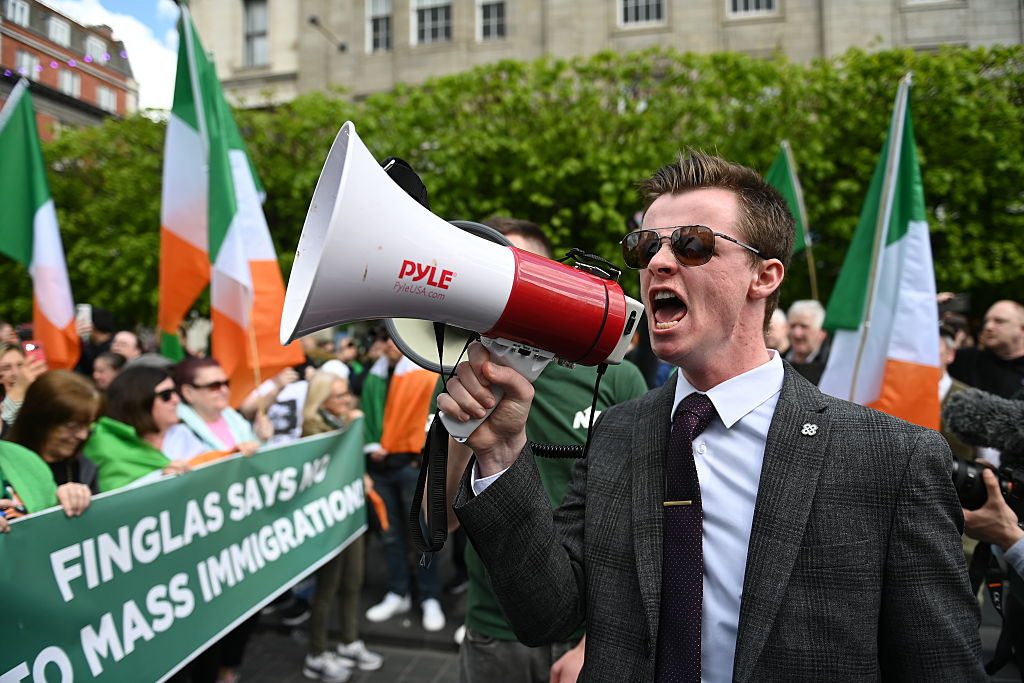
As the state declines to perform its most basic function — keeping its people safe — civil society has had to step into the breach. Those most vulnerable to attacks are women and girls, so it’s no surprise they have been among the most vocal opponents to the policies which are more likely to make them less safe. The Women’s Coalition on Immigration, a newly formed non-profit, has urged the government to follow Britain in releasing crime figures disaggregated by ethnicity and country of origin.
“The organs of state minimise migrant crime and there is a media omertà around the issue,” Laoise de Brun, its founder, told me. “Women and children should not be offered up on the altar of multiculturalism.” The question, now, is whether the government, with all its professed enthusiasm for elevating women’s voices, is minded to listen.
Michael Murphy is a journalist and documentary filmmaker covering immigration and international affairs.
 michaelmurph_y