









31 July 2026 - 3:20pm
Earlier this month, the UK-EU Agreement on Gibraltar entered into force. It marked the culmination of a decade-long political campaign from Gibraltar’s Chief Minister Fabian Picardo, who had been on a mission to uphold and restore European free movement for the territory and its people. At midnight on 15 July, as the deal took effect, the border between Gibraltar and Spain was opened up.
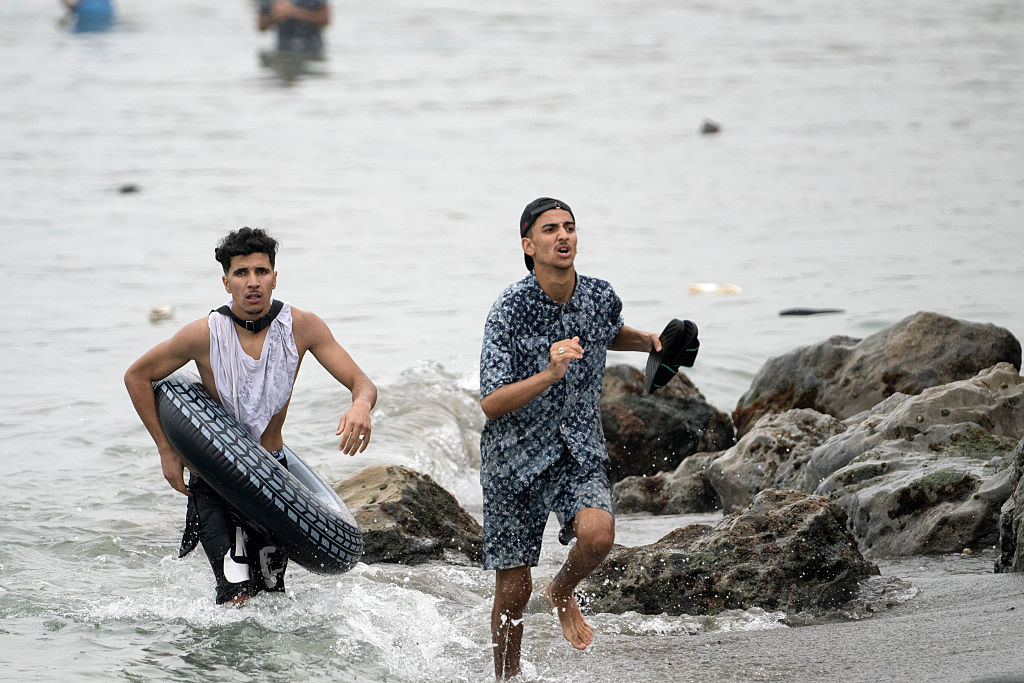
Unfortunately, this was followed barely a fortnight later by the most conspicuous failure of border security in modern European history, right on Gibraltar’s doorstep. Yesterday, thousands of migrants surged into the Spanish exclave of Ceuta on the African side of the Strait of Gibraltar, swimming around the jetty and breakwater which marks the border with Morocco. Over 50,000 people are believed to have arrived in the first 24 hours, and more than a dozen were trampled or drowned while making the journey. This follows a similar border breach in Ceuta in 2021, when 6,000 Moroccan migrants swam to Ceuta in order to enter Spain.
The incident this week is believed to have been triggered by a ruling from the Supreme Court of Spain earlier this month prohibiting “hot” returns of migrants picked up by the Spanish authorities at sea. Spain responded to the incursion by deploying military backup to the Guardia Civil in Ceuta, and promised to reach an agreement with Morocco to return as many of the trespassers as possible. However, unlike Gibraltar, which is an overseas territory of the UK, Ceuta is considered an integral part of Spain, and is a part of the EU. As such, it is likely that at least some of the new arrivals will make their way to Spain and the European continent.
This situation has already triggered alarm among other Schengen members. Italian Prime Minister Giorgia Meloni has suggested suspending Spain from the travel zone, while France is reinforcing the controls which it has already implemented on the Spanish border.
Yet Gibraltar, which is only a few miles from Algeciras, the closest stopping-off point on the Spanish mainland from Ceuta, is embarking on a policy of radical liberalisation of its frontier with Spain.
Gibraltar has its own separate territorial jurisdiction from Britain, and those who arrive there cannot claim asylum in the UK. However, if the territory experiences an unmanageable wave of illegal immigration, this will likely become a political headache for Westminster. What’s more, there may be some among the Ceuta migrants who are willing to gamble that getting into Gibraltar takes them a step closer to entering the UK.
So will Picardo suspend the new agreement in order to protect the territory’s borders? Under the terms of the agreement, Gibraltar is treated as if it is effectively inside the EU and Schengen — with Spanish officials conducting entry checks on arrivals to its air and seaports — even though it remains officially outside both blocs. Its status as a British dependency is the source of resentment in Madrid, and the UK’s withdrawal from the EU was regarded as an opportunity to inflict costs by being officious about the Gibraltar border. The recent agreement has come at the cost of great diplomatic capital for Picardo, and he is unlikely to want to antagonise the Spanish by suspending it at this point.
But if nothing else, this crisis reinforces the lesson that control of borders is the fundamental practical application of sovereignty. Not having that control results in the migration of people who may be a nuisance or a threat. Since the Brexit vote in 2016, there has been a huge amount of focus on “friction” at borders, as well as the costs imposed by checks on goods and people. But the inevitability of these checks was always because the European Commission understood that borders are sovereignty, and that even though it was dependent on member states for revenue and military force, Brussels’s control of the bloc’s frontiers was the basis of genuine power.
It is understandable that somebody like Picardo, who grew up at a time when the Spanish border was shut to Gibraltar, would place value on freedom of movement. In that sense, he is similar to Angela Merkel who grew up in East Germany — and who famously insisted that free movement within Europe was sacrosanct at the same time as announcing that Germany was a safe haven, plunging the continent into a migration crisis. But Gibraltar is a far more precarious political entity than Germany, and it has just won free movement at the cost of total dependence on Madrid for its physical security. It has done so at a particularly awkward moment.
Chris Bayliss is an independent consultant who works on energy infrastructure in the Middle East.
 baylissbaghdad