









28 October 2026 - 7:30am
Many Israelis will have woken up today with a familiar feeling. After last night’s exit poll indicated that Benjamin Netanyahu’s coalition would be reduced to 50 seats, with 52 seats for Gadi Eisenkot’s opposition bloc, plenty would have gone to bed confident that Bibi’s days were numbered.
However, overnight results have presented a different picture. As in 2009, when it looked as though the Tzipi Livini-led Kadima would form a government; in 2015, when Isaac Herzog’s Zionist Union looked set to topple Netanyahu; or most recently in 2020, when Benny Gantz’s Blue and White party appeared to have finally removed Bibi, only for the incumbent to once again hang on, Israel’s longest-serving prime minister may have done just enough to remain in power.
At the time of writing, with a little over half of votes counted, Likud has 21% of the vote compared to 16% for Eisenkot’s Yashar and 9% for the Arab-majority alliance of the Joint List. If maintained, this would lead to 55 seats for Netanyahu’s bloc and 49 for the opposition; Likud would remain the largest party with 27 seats, compared to 21 for Yashar. This is still short of the 61 seats needed for a majority in the Knesset, but hopes that Netanyahu’s party would be decisively defeated have not transpired.
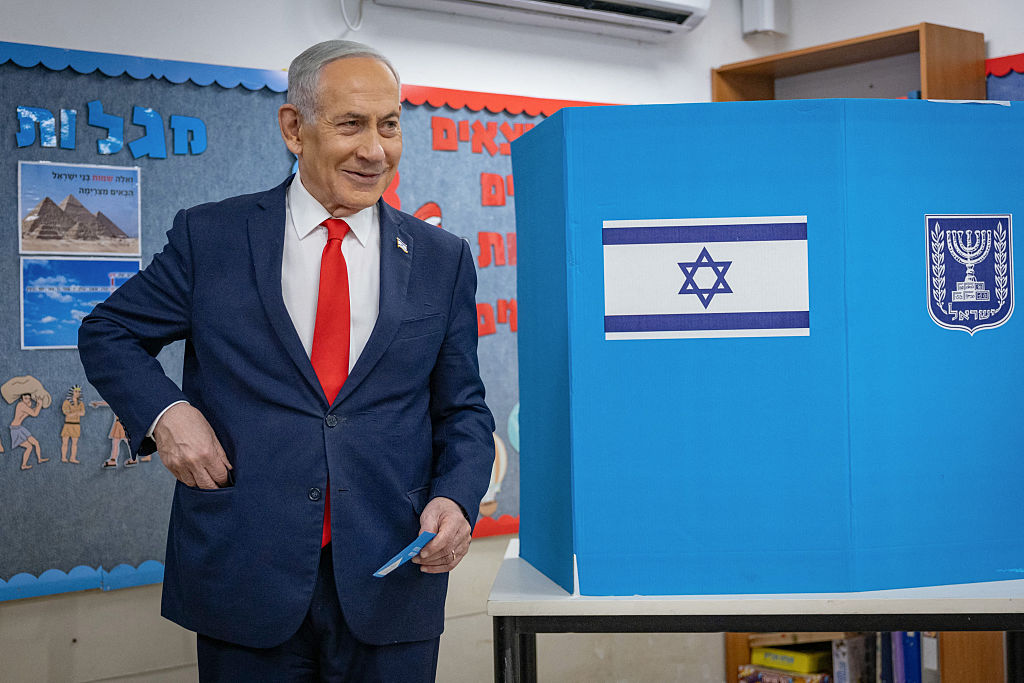
Yesterday’s turnout of almost 78% was the highest since 1999, and it could rise to 80%, which would be the highest in Israeli history. High levels of participation were recorded across Israeli society — including among serving IDF personnel, whose more than 50,000 votes may not be fully tallied until Friday. It is estimated that another 50,000 Israelis living overseas returned to vote, and there was similarly high turnout among Palestinian citizens of Israel, who make up around 20% of the population. The Joint List of Arab parties is currently projected to win 12 seats and the Islamist Ra’am party four seats, which would give the Palestinian parties their largest ever representation in the Knesset.
Netanyahu yesterday requested an extension of the polling deadline which the opposition parties mostly opposed, and there will likely be legal challenges, with different sides claiming that their supporters were disadvantaged by the polls closing before everyone could cast a vote. Throughout the day, there were complaints made by Arab Israelis about long queues and slow voting times in their communities. Adalah, the Legal Center for Arab Minority Rights in Israel, claimed that police officers were checking voters’ identities at the entrances to polling stations as a way to delay their entry.
Left-wing newspaper Haaretz reported that in some cases officials even closed the doors of the polling stations to halt voting. At one polling station in the Arab village of Kafr Qara, only a single person had cast a vote by 10 in the morning; in the town of Segev Shalom, a polling station closed without explanation at 10:20, leaving at least 150 voters waiting outside.
Nonetheless, any legal challenges and the further counting of military votes are unlikely to meaningfully change the distribution of seats, which is set to produce a near-equilibrium between Netanyahu’s coalition and the opposition, with the Arab parties as potential kingmakers. While Eisenkot has consistently vowed not to form a coalition with the Arab parties, there are rumours that he will try to win their support to force a “no confidence” motion against the current government, with the aim of removing Bibi from power and then forming a minority government with himself at the helm.
Although this government would be unable to pass a budget or govern effectively, there would have to be another election, this time without Netanyahu having the advantage of incumbency. An Eisenkot minority government might try to pass a watertight bill on the independence of the election process, with support from the Arab parties, and then call the election. Much of this depends on the attitude of Avigdor Lieberman of the Yisrael Bitenu party, who stated he would not take part in any minority government. With the prospect of removing Netanyahu at hand, however, this may be enough to change his mind.
Both sides are claiming victory this morning, and Netanyahu appears to have avoided the decisive defeat that he feared and for which many hoped. Still, Likud’s losses indicate his rejection by a large swathe of the electorate, and all together the anti-Likud parties should now hold 70 seats in the Knesset, up from 56 in 2022. This suggests that, even if he can find a way to remain in position, Netanyahu’s days of dominating Israeli politics are finally at an end.
