







 Prefer us on Google

11 Nov 2026 - 2:00pm
When Kemi Badenoch was asked by reporters from Politico how “worried” she is about the ascendency of Marine Le Pen’s Rassemblement National (RN), the Tory leader gave a cagey response. She said the Conservatives would work “with whoever is in the French government”, while offering, in Politico’s words, “neither endorsement nor criticism”.
Her uneasy response illustrates how difficult it is proving for Europe’s centre-right to come to terms with a possible Le Pen presidency. This should come as no surprise: while anti-migration, Eurosceptic parties are no strangers to power on the continent, an RN victory would constitute a repudiation of the European status quo on a scale not seen since the Brexit referendum a decade ago.
Le Pen has, like Italian Prime Minister Giorgia Meloni, toned down some of her more radical positions. She no longer advocates leaving the European Union or the euro, or exiting Nato while war rages on Europe’s doorstep.
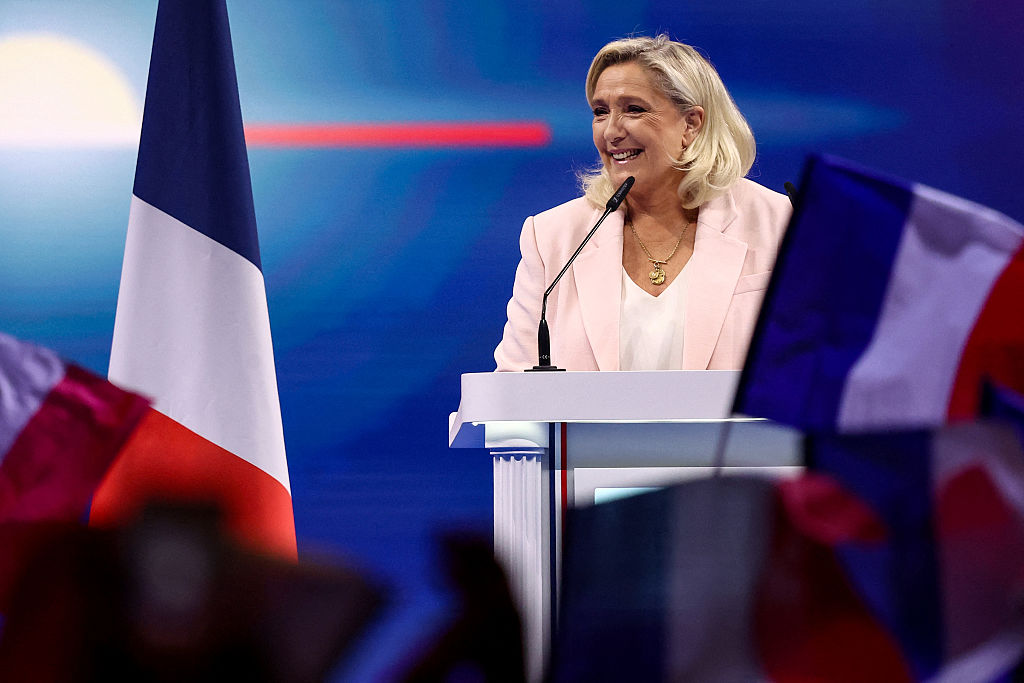
Yet an excoriating rejection of the consequences of centrist establishment rule remains crucial to her appeal. Launching her presidential campaign in Orléans in late October, Le Pen promised a “rebirth of France” based on restoration of the “rule of law”. She asked: “Who can claim there is the rule of law when hordes come to ransack and burn our buildings, or to carry out raids in front of law-enforcement officers who have been deliberately disarmed, both materially and morally?”
In the context of the riots which have swept France in recent weeks, her message could not be better timed. “Crime and violence” now consistently rank as French voters’ top concerns, while 90% of the country believes France is heading in the wrong direction.
Both in France and internationally, the increasing alignment of Right-wing politics with voters’ key concerns leaves more moderate, centre-right politicians caught between a rock and a hard place. They can’t criticise Le Pen’s policy programme without downplaying the issues that voters care about most. But to express support or admiration for a campaign promising “rebirth” would amount to recognition of the abject failure of a decade of centrist rule.
Le Pen’s is hardly the first challenge to the centre-right of this kind, with Meloni again a key precedent. Ahead of Italian elections in 2022, European Commission President Ursula von der Leyen took an overtly threatening tone, suggesting that the EU was preparing “tools” for punitive action against a future Meloni government. Meloni’s eventual victory showed that voters wouldn’t be intimidated; France’s much greater heft within the EU would make a similar “Project Fear” approach even riskier.
Of course, von der Leyen used her annual “State of the EU” speech in September this year to rail against “ultranationalists” seeking to “shatter our European unity”, in a thinly disguised jab at the RN. It’s hardly a surprising stance for her to take, given that Le Pen wants to significantly decentralise power within the EU. But Brussels likely realises that France cannot be lectured like an errant child.
Meloni has, for her part, avoided unnecessary confrontation while in power. By expressing willingness to cooperate with Le Pen, centre-right leaders such as Badenoch evince tentative hope that the French firebrand will prove less destructive than feared.
This, however, may be the only kind of hope left to them, as it becomes harder to cow Right-leaning voters, dismiss their concerns, or deny the centre’s role in putting France on what the public roundly agrees is the wrong track. Le Pen’s attempt to soften her more radical edges shows her own ability to compromise. But given France’s weight within Europe, if she wins it may ultimately prove up to her — not the centrist establishment — to set the terms of cooperation.