









4 December 2025 - 1:00pm
Right now in Brussels, there’s something in the air. It’s a whiff of corruption, combined with the smell of fear.
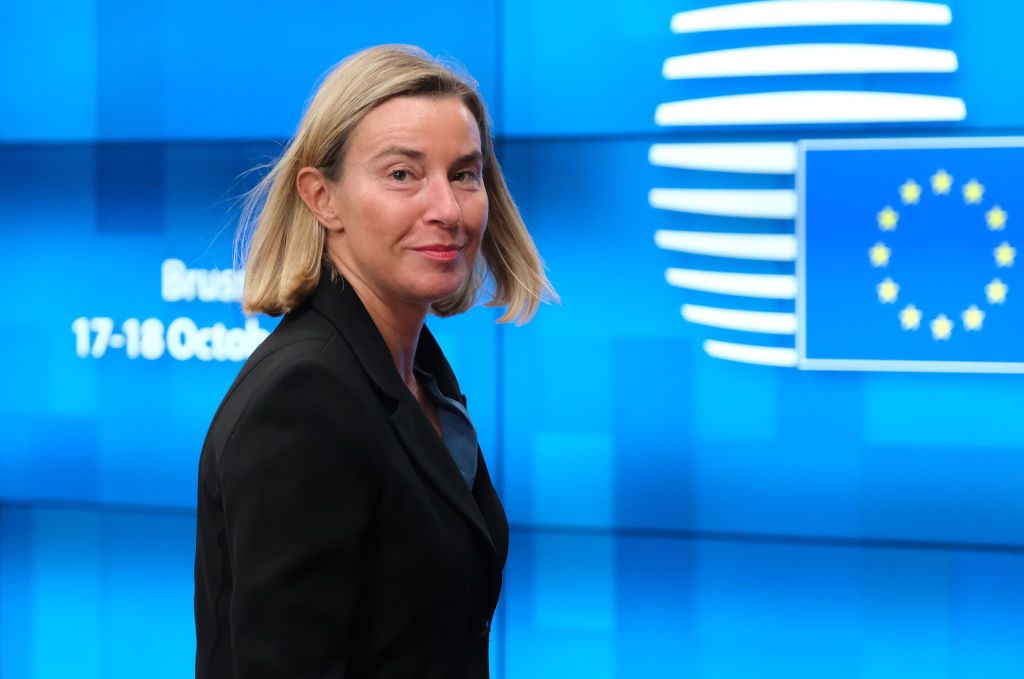
First, there was Qatargate, in which various MEPs and officials (plus assorted relatives) were charged with taking bribes and related offences. That one is still unfolding, but this week a new scandal has erupted. On Tuesday, Federica Mogherini — the current rector of the College of Europe — was detained by the Belgian police. According to the BBC, she’s now “been accused of fraud as part of an EU investigation into the misuse of funds”.
For those who might not be familiar with every Euro-institution, the College of Europe is a big deal. It is to the EU establishment what the École Nationale d’Administration was to the French establishment: a postgraduate finishing school for the technocratic elite. The College’s chairman is none other than Herman Van Rompuy, the archetypal eurocrat and Nigel Farage’s old bugbear.
Mogherini’s previous roles include a stint as Italian foreign minister. From there she was promoted to High Representative of the Union for Foreign Affairs and Security Policy and Vice-President of the European Commission — a word salad of a job title that basically means EU foreign minister. As such, she was in charge of the European External Action Service (EEAS), the EU equivalent of the Foreign Office. In other words, Mogherini is a cut above the riff-raff in the European Parliament. It’s one thing to detain and charge a mere MEP, but for Euro-plod to come for a proper Brussels bigwig is extraordinary.
So what exactly is she alleged to have done? This is where it gets a bit gnarly. According to Politico it’s all about the procurement of training services by the EEAS (i.e. the organisation that Mogherini used to run) from the College of Europe (i.e. the organisation that she currently runs). That might seem a rather dry matter over which to cause so much high-level embarrassment. But whatever happened, it was enough for the European Public Prosecutor’s Office to investigate her — as well as a senior EU diplomat, Stefano Sannino, who has just stepped down from his position.
For Ursula von der Leyen, it’s a new headache. She already has a “fragile relationship” with Mogherini’s successor as EU foreign minister, Kaja Kallas, who rivals the Commission President for media attention. What’s more, von der Leyen’s enemies on the Eurosceptic Right look set to use the new scandal to call another vote of no confidence in her leadership.
But what’s most at risk here is the credibility of the European Union itself. By imposing a layer of authority above national government, it has created a revolving door of plum public jobs without democratic accountability. The voters can wave goodbye to one set of politicians back home, only to see them reappear in Brussels with a new executive role. Mogherini is far from the only example. Von der Leyen was a defence minister under Angela Merkel, Kallas was prime minister of Estonia, and Von Rompuy was prime minister of Belgium.
For all the faults of UK politics, when we’ve had enough of our politicians they don’t usually pop up somewhere else in government. Instead, they have to retire to the Lords like Theresa May, or find work in the private sector like Rishi Sunak, or start an institute like Tony Blair, or carve out a role in the media like Boris Johnson.
That’s not to say that we’ve been governed brilliantly since leaving the EU — far from it. But Brexit does mean we retain the most essential feature of a democratic system: flushability.
Peter Franklin is Associate Editor of UnHerd. He was previously a policy advisor and speechwriter on environmental and social issues.
 peterfranklin_