







 Prefer us on Google

9 August 2026 - 4:00pm
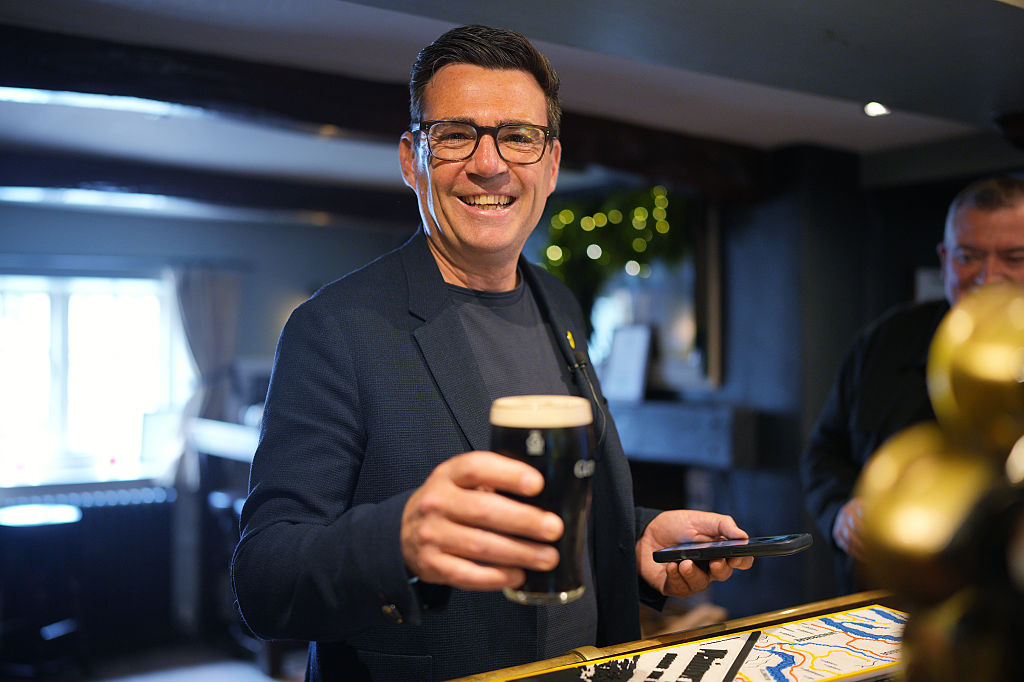
This week, the Times reported that Prime Minister Andy Burnham has been upbraided by his social media team over fears that his comms have become too “blokeish”. The source of No. 10’s concerns seems to have been a recent TikTok video showing Burnham and Chancellor John Healey ranking their favourite pub snacks. Factoring in his well-documented fondness for football and Oasis, the PM appears to be hitting a respectable score on the bloke-ometer.
That this should concern anyone is very odd. Frontline British politicians have long been desperate to be perceived, in one way or another, as “normal blokes”. Harold Wilson had his pipe and Tony Blair his rolled-up sleeves; Boris Johnson proffered mismatching mugs of tea, while David Cameron pretended to like football. Whether they were mirroring Essex man, Mondeo man or Workington man, the message was always the same: I’m one of you.
There was a cynical electoral logic to all this. Being seen as “one of the lads” signalled authenticity to large swathes of the electorate. Although it was never the most important thing — in 2024 YouGov found that only 4% of Britons cared whether senior politicians were football fans — it still helped the notable and promotable members of Westminster stave off suggestions that they weren’t in touch with the man in the street. Blair understood this instinctively, making John Prescott his deputy prime minister. Acting as the no-nonsense, working-class counterweight to New Labour’s smoother operators, Prescott quickly became Britain’s premier bloke.
In recent years, however, the bloke’s cultural cachet has fallen. Politicians are now more likely to castigate him than model themselves after him. Keir Starmer (remember him?) never shut up about the problems with boys and men. After the Netflix drama Adolescence and ex-England manager Gareth Southgate’s warnings about “callous, manipulative and toxic influencers”, the then-Prime Minister said he was “worried” that the country “may have a problem with boys and young men that we need to address”. He repeatedly described this problem as “toxic masculinity,” and blamed figures such as Andrew Tate for luring teenage boys into misogyny.
Politicians like to hold up the flashy spectre of Tate, as if that is where ordinary British blokeishness naturally leads. The reality is the exact opposite. Your traditional British bloke is more likely to regard Tate as a creepy loser than a male role model. The idea that there’s any relation or agreement between them speaks to the Westminster elite being totally out of touch with ordinary men.
Maybe this isn’t much of a change. After all, politicians were never really blokes. Famously, Harold Wilson only smoked a pipe in order to appear like the common man, opting for cigars when “offstage”. And yet, for all the falsity, this image still mattered. Politicians’ embarrassed attempts to reach the bloke showed that he had influence in Britain. Is this still the case? Judging by the Times report, it appears not.
This should be a source of sadness. There is a whole cohort of ordinary, unshowy blokes who find the surrounding culture at best uninterested in them and at worst actively hostile. Burnham, with his Everton scarf and his 6Music sensibilities, is one of the few senior figures who still makes an effort to appeal to these men. The fact that his own team is urging him to dial it back only underlines how far the centre of gravity has shifted.
Really, Burnham should fight back. He’s already said he’ll avoid wearing a tie whenever possible, so why not take it further? He should show up to his audience with the King wearing a pair of faded jeans and some creased Adidas Sambas. Make Labour’s new campaign slogan “Let’s rock and roll.” Have a manifesto commitment to deliver a new James Bond film every year. There’s a silent majority of blokes out there who have been abandoned by an embarrassed political establishment and who — in the horrible modern lexicon — deserve to be seen. Burnham, rather than listening to the haters, should go full bloke.