









7 June 2026 - 8:00am
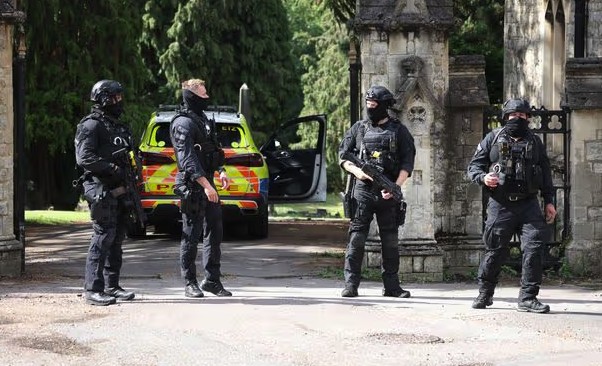
When 21-year-old Almunthir Daqamah allegedly appeared at the University of Surrey’s Manor Park Student Village on Thursday morning and shot a campus safety officer with a high-powered crossbow, attention immediately turned to the weapon of choice.
Unlike the broader pattern of knife crime — where everyday bladed objects such as kitchen knives and utility blades still account for the majority of offensive weapons — recent cases have drawn attention to a different category of violence. Following Daqamah’s arrest and Vickrum Digwa’s conviction for the murder of University of Southampton student Henry Nowak, scrutiny has shifted toward the use of unlicensed, legal, or culturally sanctioned items as weapons.
This raises wider questions about the availability and misuse of so-called “ceremonial” or sporting objects — items that may be designed for display or sport, but can be adapted for lethal use and are readily obtainable online or in specialist markets. In Digwa’s case, the court also heard claims of a religious justification, further complicating how intent and cultural framing intersect with the use of such weapons.
Ordered, most likely, online and delivered to almost any address, a crossbow can be purchased in the UK without a licence, background check, or routine police oversight. Under current British law, acquiring one is not materially more difficult than buying a penknife or a pack of razor blades. According to the Office for National Statistics, crossbow incidents are typically subsumed within broader categories such as “sharp instrument” offences or general assault data, making it difficult to isolate the scale of their use. Nevertheless, legal practitioners familiar with such cases suggest these cases are not rare in practice.
A spate of crossbow murders stretching from 2018 to 2025 finally resulted in the Home Office announcing this year that crossbow sales would be banned and that existing owners would require a suitability licence. But the legislation is not yet in force.
Crossbows, air rifles and now, as the Digwa case illustrates, large Sikh daggers — or shastars — are only the most visible symptoms of a larger and less-discussed problem: the weapons Britain has quietly decided to tolerate. There is an entire ecosystem of quasi-military and ceremonial objects operating beneath the threshold of serious legal scrutiny, available to anyone with an online shopping account, a grudge, and in some cases, a claimed religious mandate.
Browse the crossbow market and the design language reveals something significant. These are not tools for sport. The aesthetic is tactical: Picatinny rails, pistol grips, foregrips, suppressors, the full grammar of the assault rifle transposed onto a medieval projectile weapon. The crossbow manufacturers know their market.
And the crossbow is not even the biggest problem. Converted handguns — blank-firing weapons originally designed for theatre, film, and starting pistols — were responsible for more shooting incidents in the UK in 2023 than real firearms, accounting for four deaths and 17 serious injuries in that year alone.
What connects these weapons is the space they occupy in the cultural imagination of a particular kind of violent actor: not the professional criminal, who will source a firearm through established networks regardless of legality, but the disaffected loner, the jilted lover, the ideological obsessive — the young (though not always) man in a private war with a world that has failed or humiliated him.
For this figure, the crossbow, the zombie knife, the replica pistol modified in a bedroom, the shastar or samurai sword all serve a similar psychological function: props in a fantasy of agency, violence rendered theatrical or cinematic, the GTA hitman or guerrilla insurgent made briefly real. It is Travis Bickle sharpening a knife in front of a mirror — except he is not on screen. He is in your street. The weapon is not incidental to the pathology; it is part of it.
The Surrey attack should prompt more than a debate about fast-tracking crossbow licensing. It raises a harder question: whether Britain has the language to understand what these weapons signify to those who use them — and the will to regulate not just the objects, but the culture that sustains them.
The arsenal of the disaffected does not begin with an online purchase. It begins with a male fantasy the law has been reluctant to confront, and a culture that too often excuses offensive weapons so long as the perpetrator looks like he belongs.
