









2 April 2026 - 10:00am
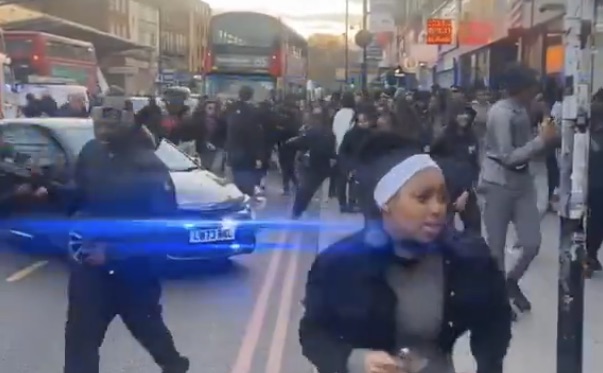
This week, social media has been awash with videos of a sudden outburst of disorder in Clapham in south London. The phenomenon has been blamed on “link-ups” — gatherings of teenagers during the school holidays, which in practice have led to shoplifting and aggressive disorder. As a result, businesses have been forced to close, and a large police presence has been called in.
There does not seem to be any political motivation or particular grievance underlying this behaviour. While shoplifting has certainly taken place, neither does robbery appear to be the primary objective of the gatherings, at least not for its own sake. Instead, the phenomenon is largely social in nature, driven by online status-signalling and a desire to demonstrate physical assertiveness in the real world.
So far, the police response has been reactive and concentrated on dispersal rather than arrests. The authorities seem to regard it as bad behaviour to be managed, akin to trouble after a football match, rather than a serious threat to public order. There have been relatively few arrests thus far, and the Metropolitan Police is facing calls to ramp up its response.
It is reasonable to infer that the police view the unrest in south London as a localised issue, confined to a specific community. On that assessment, a more restrained response may be seen as the most effective way to prevent escalation. Crucially, officers do not appear to regard it as politically motivated — a judgement that reduces the likelihood of it spreading.
One can see the logic here, but it may prove a miscalculation in this case. These gatherings are social media-driven, with those involved posting footage of themselves shoplifting to boost their status. This is visible to kids across the rest of the country; if it is seen to be consequence-free, there is a good chance that others will join in. The technology being used to organise the gatherings has changed dramatically since the 2011 London riots, which were spread by Blackberry Messenger. Today’s participants instead rely on TikTok, meaning that the online promotion is far more viral. But it’s also unencrypted, theoretically giving the police far more intelligence-gathering power.
But as we saw in 2011, there is no guarantee that such a phenomenon will be limited to inner-city areas and minority groups. It could well spread to provincial towns across the country.
A situation in which the police is seen to have failed to protect one community by policing another too softly may end up getting very messy for the Met, both politically and literally. In the wake of Southport last year, there are reasonable questions to ask of Britain’s policing standards and whether some forms of street disorder are simply allowed to run rampant.
Chris Bayliss is an independent consultant who works on energy infrastructure in the Middle East.
 baylissbaghdad