









4 June 2026 - 4:00pm
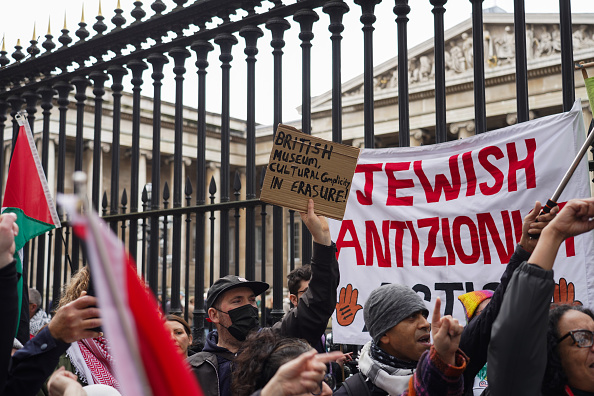
Is deciding to be neutral on any given issue still a political act? Nicholas Cullinan, director of the British Museum, has published a statement defending the postponement of a Jewish Culture Month lecture over security concerns. In it, he declares that the Museum, like similar cultural institutions, is “caught between opposing political pressures” whereby ideology threatens to derail every operational decision.
He is partially correct. The Museum claimed that 25–50% of those registered to attend the lecture on Ancient Israel and Judah, delivered by one of its senior curators, had signed up with the sole intention of disrupting it. But that is not a sign of “opposing political pressures”. Rather, it is an example of what should be a politically neutral institution capitulating to external pressure from a group seeking to prevent the lecture from taking place.
Cullinan’s own better instincts surface later in his statement, where he remarks that “the test of an institution’s commitment to free expression is not whether it avoids controversy. It is whether it creates the conditions for ideas to be examined rigorously, respectfully and without intimidation.” Quite right. The problem is that the Museum’s action in postponing the lecture was an advertisement for the opposite principle, effectively handing a victory to the disrupters. The correct response would have been simply to eject them from the event.
The British Museum is not alone in this. In September, Bournemouth’s Russell-Cotes Museum cancelled an exhibition on Jewish life in the town, citing “incidences of hate crime” in the area. “We are proud of our diverse communities,” the museum said in a statement — a sentiment that, one assumes, did not extend to those responsible for the antisemitic incidents in question. Last summer, the Edinburgh Fringe similarly cancelled two Jewish acts over concerns for performers’ safety amid fears of a hostile audience.
As I wrote in these pages last year, cultural institutions are increasingly embracing “decolonisation” tactics, twisting the truth to fit their own political narratives. The controversy surrounding the British Museum lecture suggests that this tendency is no longer confined to curatorial interpretation alone, but instead frequently extends to decisions about what can be discussed and under what conditions.
The purpose of institutions such as the British Museum is to act as custodians of a shared cultural inheritance, and to teach the public about the country’s past in as truthful, scholarly and accessible a manner as possible. In this current climate of popular activism, such a role is being challenged. The danger is, if intimidation is tacitly encouraged through the cancellation or postponement of certain events or exhibitions, then the historical truths of which these institutions are custodians will be twisted to fit a narrative. While such actions purport to be carried out under the guise of inclusion, in reality they seek to exclude people, perspectives, and entire cultures that are at odds with their worldview.
The rescheduled lecture on Ancient Israel and Judah will likely attract greater attention, from both supporters and would-be disrupters. The Museum must ensure that security is robust enough to remove offenders swiftly while allowing the event to proceed uninterrupted. History is not always pleasant, but its truth is not negotiable. Cultural institutions exist to present that truth, not to allow pressure groups to dictate how it should be understood.