







 Prefer us on Google

28 July 2026 - 4:00pm
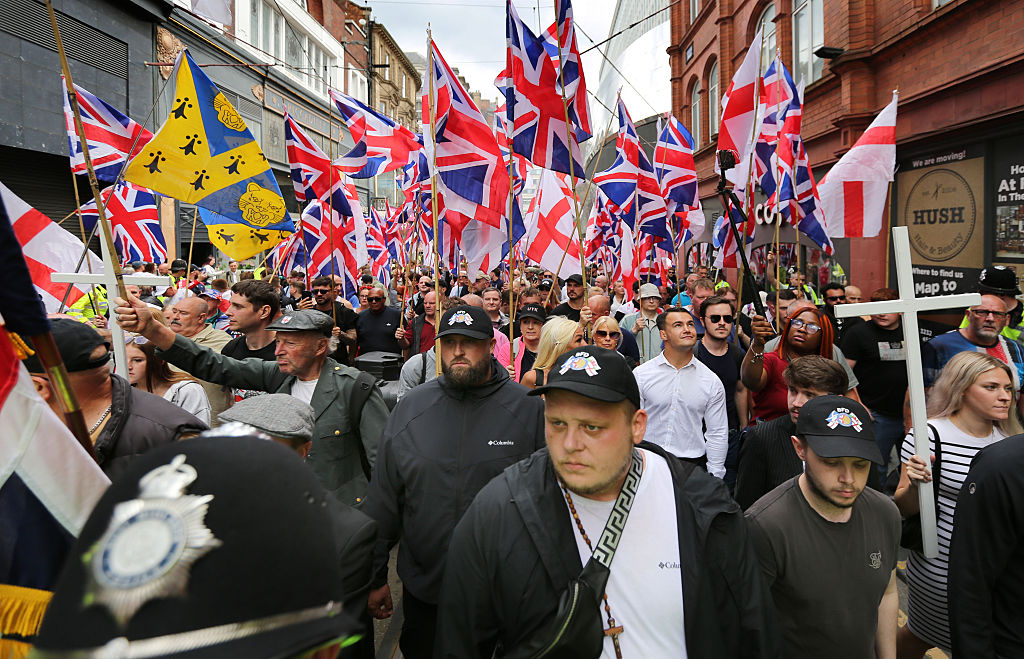
Campaigners have accused Birmingham council of giving “free rein” to the nationalist movement “Operation Raise the Colours”, resulting in the escalation of social tensions in city. It is another grim sign that local government capacity in England’s urban centres risks being overwhelmed by community-relations management.
Operation Raise the Colours, which describes itself as a “grassroots movement for unity and patriotism”, was launched last year by a group of men from South Birmingham who started a trend of putting the Union Flag and St George’s Cross on lampposts, roundabouts, and other forms of public infrastructure. While it has won praise for promoting patriotic sentiments in a perceived era of national self-flagellation, the campaign has also been accused of promoting racism and anti-immigration rhetoric — claims the movement vehemently denies.
Now, residents in England’s second-largest city have reportedly met with Birmingham City Council and West Midlands Police and Crime Commissioner Simon Foster several times in the past six months, expressing concern over the conduct and activities of the Operation Raise the Colours campaign. The Brummies United Against Racism group — which states that it is “especially concerned about the growing anti-migrant and xenophobic narratives being pushed in political discourse and the media” — is particularly active in opposing the campaign, blaming it for threatening residents. Tensions have grown to the point that the enforcement of an injunction is being demanded.
This confrontation provides an illustration of what is now a growing responsibility for local councils and police forces: the management of community tensions between various elements of British civil society. Birmingham is especially high-risk on this front, becoming politically fractured in the wake of Labour’s spectacular decline in the city, with the party losing 48 councillors and overall control of the council in the latest English local elections.
While Reform UK is now the biggest party on the council, it was locked out of power by an agreement between the Liberal Democrats, the Green Party and several independent councillors to govern together as a minority administration. In the eyes of some voters, the administration has little democratic legitimacy as it does not include the party with the greatest number of councillors and does not even command a majority.
To fuel anti-establishment sentiment and exacerbate political disaffection among white working-class communities in the city would be a gift for genuine hard-Right organisations such as Patriotic Alternative, which has previously circulated leaflets in the southern Birmingham suburb of Moseley. While accusations of discrimination, intimidation, and harassment backed by credible evidence should be investigated by West Midlands Police, the perception of a radical-progressive local council intervening in the activities of what is widely considered a civic, patriotic campaign — one which originated in Birmingham itself — is likely to provoke an indigenous backlash.
Recent political, social, and cultural changes in Birmingham reveal a complicated portrait of modern England, as local councils, police forces and public institutions struggle with the responsibilities of “diversity management” in a nation of competing identitarian interests. This will be a nationwide problem, but intensely felt in parts of the country where there has been a local surge in Reform UK and Muslim independent representation. If recent electoral results are anything to go by, sections of East Lancashire and West Yorkshire are essentially being reduced to battlegrounds between British nationalism and Islamic conservatism. Birmingham may well be the epicentre, but social cohesion challenges run throughout the country. A new national government won’t be enough to fix them.
