









9 Nov 2026 - 10:00am
Austin, Texas
As a Chicago television reporter, Anna Davlantes exposed mob intimidation in the city’s suburbs and was threatened as a result. For another assignment, she climbed into a tank of sharks and broadcast from underwater. Neither experience, it turns out, fully prepared her for her current job as Alpha School’s chief communications officer.
Gangsters and sharks are at least predictable: you know what they want and roughly how they’ll go about getting it. The educationalists and aggrieved Substackers with strong opinions about what Alpha teaches, and how it uses AI to teach it, are harder to pin down. When this Texas-based private school group opens its first outpost in London next year, the scrutiny will only intensify, and an already fragile independent school sector will have to brace itself for another threat to its survival.
That is because Alpha schools have no teachers in the conventional sense and, as if that were not controversial enough, they unapologetically put artificial intelligence at the centre of their pupils’ learning. The founding claim is that a child working with adaptive software for two hours a morning, and not allowed to move on until they have shown 90% mastery, learns at least twice as fast as a child in a traditional classroom.
No teacher, Alpha argues, can tailor lessons to 30 pupils at once, but a laptop with AI can, which leaves the adults free to roam the room, coaching and motivating. Similar experiments are underway elsewhere, but not at this scale. Critics argue that Alpha’s impressive results rest largely on its own testing of a self-selecting, affluent intake, and that pupils who struggle with the model tend to leave.
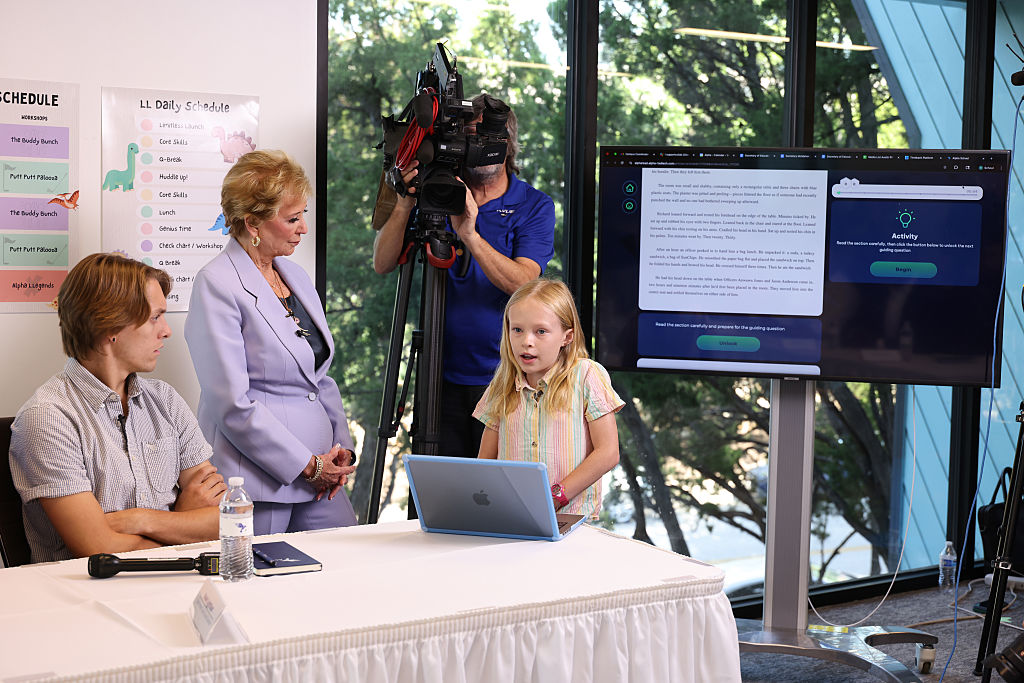
The schools I visited in Austin this week run to a well-established rhythm. Mornings are dedicated to academic subjects, via Alpha’s own “Timeback” AI programmes. Afternoons are for “passion projects” ranging from building apps to writing musicals, and on Fridays pupils present their week’s progress to peers, with their data on a screen. Progress is checked not by teachers but by “guides”, who are paid around $100,000 a year — so as to attract high-calibre applicants — and recruited for their interpersonal skills rather than their subject knowledge.
Pupils who get stuck on, say, their maths or English are helped online by a remote academic team spread across the world. If a pupil misbehaves, or falls behind in their work, their guide talks with them, goes through their data, and sets individualised goals. But the real sanction is choice. Families sign up to Alpha’s ethos before they join, and high school pupils must opt in; those for whom the model repeatedly fails tend to move on.
The first Alpha school was co-founded in 2014 by MacKenzie Price, before tech billionaire Joe Liemandt stepped in to bankroll its rapid expansion. This autumn alone saw the opening of 27 new Alpha schools across the US, with many more to follow. Fees range from around $40,000 to $75,000 a year. Alpha insists it is not only for the rich. The same software, one leader told me, is used in schools charging $10,000 to $15,000 a year, as well as in pilots in a Houston school district and in South Carolina, though these have fewer guides in the classroom.
Even in the “showroom” schools, there are noticeable gaps: the creative arts, the humanities and sport are either farmed out to external providers or so pared back that one wonders how well-prepared the pupils are for university. There are, for example, no science practicals. AI can do many wonderful things, but it can’t capture the wonder of a dissection, or the moment a titration finally turns pink.
The problem when Alpha expands to London is that, in Britain’s highly competitive independent schools market, such weaknesses will be ruthlessly exploited by more conventional rivals. Yet those rivals, some closing at short notice in the wake of VAT reform, have rarely been more vulnerable. If ever a disruptive force could make significant inroads into a changing but still lucrative market, it is now.
Whether or not Alpha succeeds, AI is already in British classrooms. It is planning lessons, marking work and, covertly, doing homework. The danger is that this technology will divide rather than level up: the affluent will get both the innovative software and the people around it, while everyone else will get a screen to make up for the teachers the school cannot recruit.
If the benefits are to be spread widely, AI has to be treated as a supplement to teachers, not a replacement. Good tools should be free in schools, and judged on independent evidence. Here, Alpha may have more to teach British schools than its critics allow. For all the debate about schools without teachers, it spends lavishly on people. Whether less well-funded institutions can give the same attention to students, and avoid becoming utilitarian education factories, is another matter.
David James is deputy head at a leading independent school in London, and also teaches at a local state school.
 drdavidajames