









5 September 2026 - 5:00pm
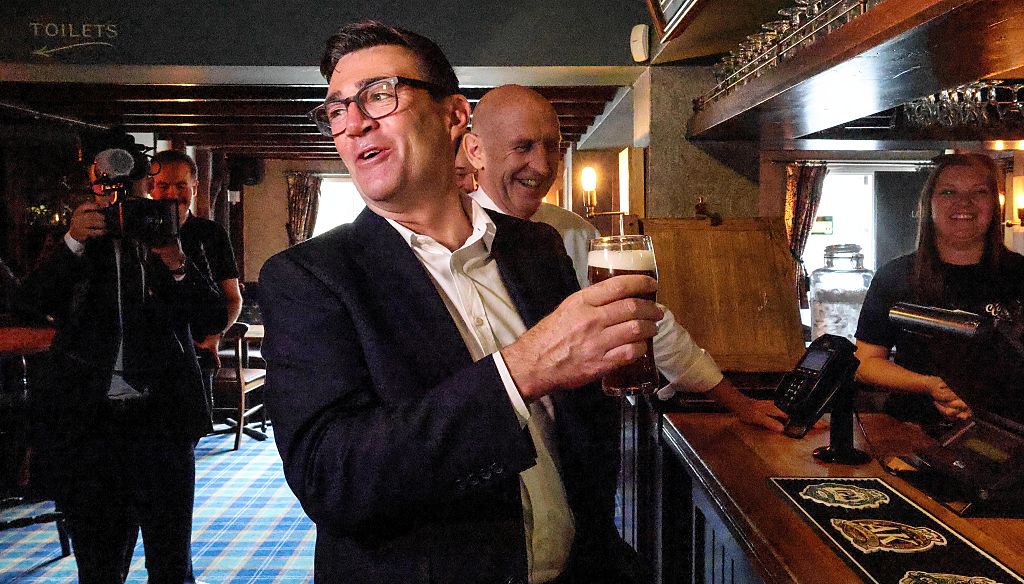
It’s confirmed: Andy Burnham has crap taste in London pubs. Asked by the London Standard for his favourite, he chose The Dog House, a Punch pub in Kennington; pressed by Time Out for more, he added The Chandos, a Samuel Smith’s by Trafalgar Square, and The Barking Dog, a now-closed Wetherspoons in Barking. It’s hardly a tour of London’s idiosyncratic institutions. His reasons for these choices are revealing: Everton away days at The Chandos, a single “memorable” night at The Barking Dog, and The Dog House was where he and his wife held their 30th birthday, but Time Out also noted that Morrissey was once a regular there. This is, one suspects, his real reason.
For a politician who rarely takes a breath without spewing guff about pride in every postcode, this is a remarkably shallow relationship with a city where he worked and lived for 25 years. Burnham further said that it is a “myth” he is anti-London and claimed: “I don’t think there’s a pub in London I’ve not been in.” To the Standard, he said Londoners were “spoilt”.
But irritatingly, Burnham is right. Pubs probably are the one shining light in London’s increasingly terrible nightlife. Nightclubs close or return as private members’ clubs; bars increasingly resemble those in Dubai or Singapore, with the same cocktails, kitten-heeled table service and identikit menus of globally-appealing picky bits. Restaurants demand bookings and two-hour sittings; even a casual drink can involve surrendering your credit card details before sitting down. A pub remains one of the few places where you can turn up without a plan, make friends with a stranger and wake up with a wretched hangover.
And when Burnham calls pubs “the beating heart of our communities” he is close to the truth. You find a community smoking fags in beer gardens, just as you find them praying on their knees in churches, but both are places where community becomes visible, not what creates it.
So we get Burnham’s revealed preferences. He calls pubs “heritage”, yet his examples are one pub from an estate of 1,300, one Wetherspoons of 800, and one Samuel Smith’s of 200. And while pubs remain a refuge from the rest of London nightlife, plenty are going down the same homogenised route as bars and restaurants.
So ancient boozers become sticky-floored saloons serving freezer-fried food and whichever handpulled ale the chain has secured at scale. Others turn into table-service cocktail bars with wainscoting. Once the landlord lived upstairs; now you would be lucky to see the same faces behind the bar for six months.
It is not as though the old pub was paradise. Go back to the Seventies, before the “40 years of neoliberal failure” Burnham talks about, and many were grim. My father remembers Dirty Dicks near Liverpool Street as being smoke-filled, with sawdust underfoot for spilled beer, gobs of spit and the occasional bit of vomit. Some pubs still divided men and women into separate rooms; lunch might amount to a curling sandwich oxidising beneath a glass dome, or a murky jar of pickled onions.
Nor was this some misty age of independent publicans. In 1971, roughly 52,000 of Britain’s 75,000 pubs were brewery-owned. Margaret Thatcher’s 1989 Beer Orders tried to break the Big Six brewers’ grip; instead the sell-offs helped create the modern pubco, replacing one form of corporate control that brewed beer with another that didn’t.
Burnham is right about his diagnosis, but his choices are suspicious. He talks grandly about “heritage”, “working-class culture”, and pubs as community institutions, while being relaxed about whether pubs retain anything local or distinctive after the investment managers have had their say, or the company becomes a PLC. He has even warned that “once pubs are gone they don’t come back”, which is ironic considering Wetherspoons plans to reopen his beloved Barking Dog.
If these interviews were an orchestrated attempt to dispel Burnham’s anti-London association, they’re not convincing. Three chain pubs, Morrissey trivia and an Everton anecdote reveal his shallow relationship with not just London, but pubs as well.