









16 October 2026 - 2:00pm
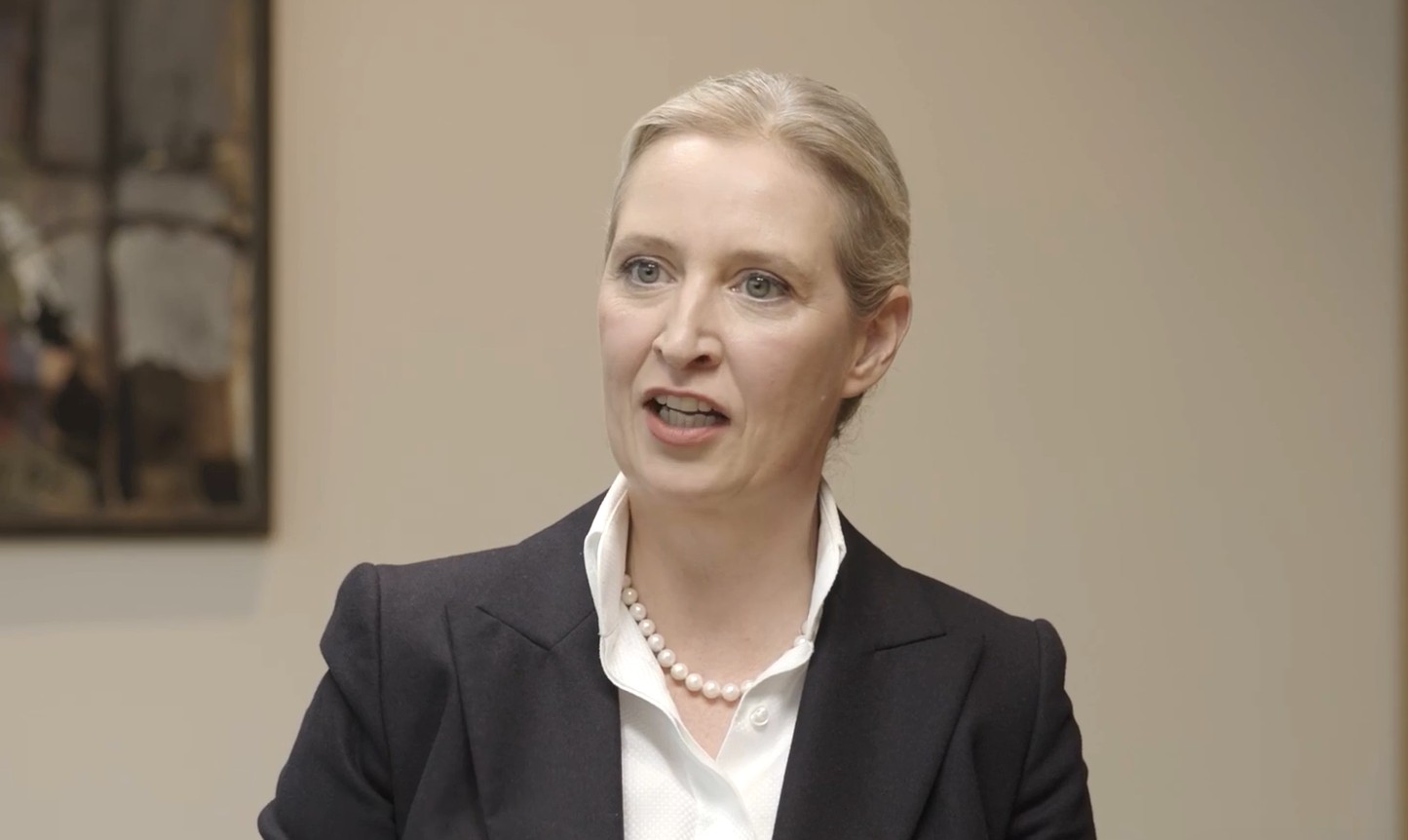
Alice Weidel has said that the Alternative for Germany (AfD) does not want the country to become a “caliphate”.
Speaking to the Economist, the co-leader of the hard-Right German party claimed that Syrian and Afghan asylum seekers were responsible for the “skyrocketing” rate of some of the “worst crimes” in Germany since 2015. She argued: “The law enforcement is very clear in Germany, 100% of the Syrians — because the war has ended — have to go back to their country.”
“We need to send these people back,” Weidel stated. “We need to detain criminals and also religious extremist leaders. We don’t want a caliphate in our country.”
She went on to reference a statement from Syrian Foreign Minister Asaad al-Shaibani which called the Syrian diaspora in Germany a “strategic national asset”. Weidel said: “We are having severe problems in integrating these people.”
Weidel’s party has consistently been the highest-polling party in Germany since March this year, and currently sits at 30% in polls compared to the 18% recorded for its closest rival, Chancellor Friedrich Merz’s Christian Democratic Union (CDU). The AfD has recently seen major breakthroughs in regional elections, including becoming the largest party in Saxony-Anhalt in September, where it is the first hard-Right party to hold a parliamentary speaker position since 1945.
The AfD takes a hard line on migration, with Weidel calling for “remigration” and “large-scale repatriations”, something Merz has argued amounts to “ethnic cleansing”. The Munich-based think tank ifo Institute has meanwhile rejected the idea that migration has led to an increase in crime in Germany. Other European Right-wing leaders such as Nigel Farage and Marine Le Pen have also distanced themselves from the AfD. Yet Weidel has previously expressed support for Restore Britain’s Rupert Lowe, writing on X that both the AfD and Lowe’s party would “put our nations and our people first”.
During the Economist interview, the AfD co-leader argued that Ukrainian asylum seekers would have to leave Germany once the war with Russia was over, and claimed that the “prolongation of the financing of an already-lost war” was imposing a “huge risk” on Germany’s national security.
She further pointed to the costs of being the “main financier” of Ukraine, stating: “We already spend over 100 billion [euros]. No other country has spent that much, and we are highly indebted.”
There is also a “huge cost” to “open borders”, Weidel claimed, though she suggested that Germany’s demographic “disadvantages” — referring to the country’s ageing population — meant that she “loved” the idea of attracting foreign professional workers.
“But we cannot attract professionals if we leave foreign criminals who distort our public order,” she said. “We cannot attract these people anymore.”