







 Prefer us on Google

22 June 2026 - 7:30pm
Former Federal Reserve Chair Alan Greenspan has died at the age of 100. His reputation predeceased him. He headed up the Federal Reserve from 1987 to 2006, the second-longest term of any chairman, and this period coincided with a sustained economic expansion in the US, interrupted only by several mild recessions. The expansion turned out to be the mother of all asset bubbles in housing and stocks which, when popped in 2007, caused the most devastating global financial crisis since the Great Depression.
Speculative asset bubbles can be the product of central bank policy as well as of the irrational enthusiasm of stock market investors and homebuyers. The same interest rate cuts by the Fed which can help stimulate a struggling economy can also indirectly enable speculation in stocks and bonds and real estate, as speculators borrow cheaply to gamble on high-risk, high-return assets. One job of the Federal Reserve is to preemptively pop asset bubbles before they become dangerously swollen by raising interest rates.
Greenspan, however, was so worried about the threat of inflation that he ignored the danger from asset bubbles. This made him popular with the wealthy, who profited from low inflation, a booming stock market, and ever-rising house prices. That was, until the music stopped.
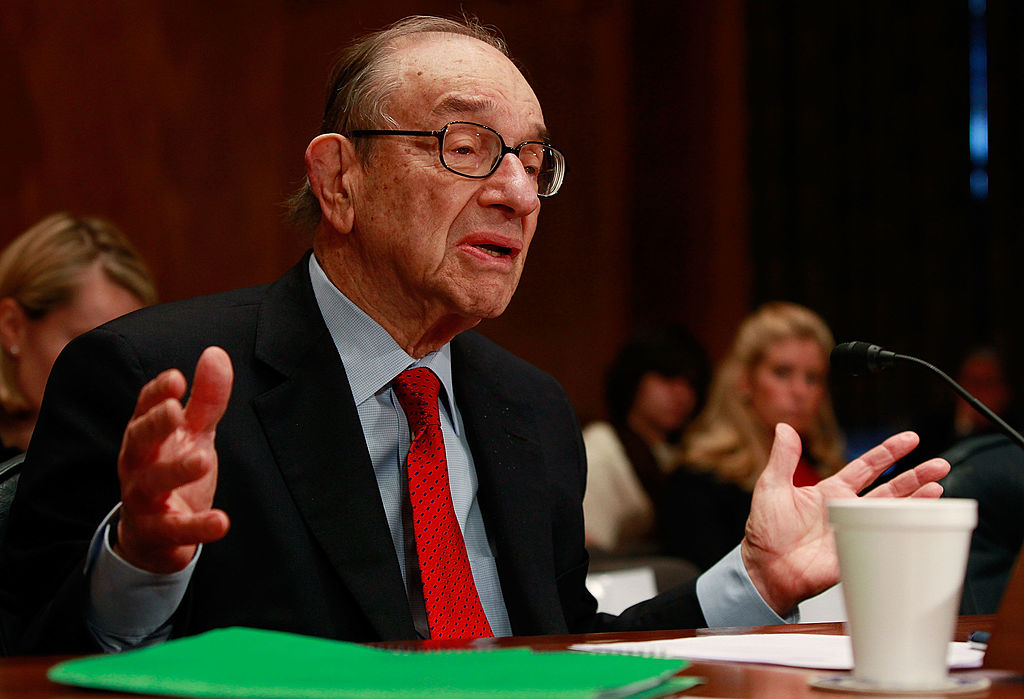
In 2008, after the economy collapsed, Greenspan, then out of office for two years, testified before Congress that he had “found a flaw” in his free-market worldview. When Democratic Representative Henry Waxman pressed him by saying, “In other words, you found that your view of the world, your ideology, was not right, it was not working,” Greenspan agreed: “You know, that’s precisely the reason I was shocked, because I have been going for 40 years or more with very considerable evidence that it was working exceptionally well.”
In reality, there was zero evidence in the 40 years between 1968 and 2008 that libertarianism was a reliable philosophy. But Greenspan was a true believer. In his youth he was a disciple of the libertarian guru Ayn Rand. He replied to a negative review of her novel Atlas Shrugged in the New York Times with a letter to the editor, in which he declared: “Creative individuals and undeviating purpose and rationality achieve joy and fulfilment. Parasites who persistently avoid either purpose or reason perish as they should.” Indeed, Rand was present when Greenspan was sworn in as chair of the Council of Economic Advisers in 1974.
As chair of Ronald Reagan’s National Commission on Social Security, called the Greenspan Commission, he made his own hostility to the programme clear: “Do I like the present Social Security system? No. If you asked me whether it would be necessary in the ideal society, I’d say no.” In his role as Fed chair in 1996, Greenspan then praised the idea of privatising Social Security. He went from being a libertarian Social Security reformer who thought Social Security was a mistake to a libertarian Fed chair sceptical about regulating financial markets.
Greenspan cannot be blamed personally for the replacement of the mid-20th-century economic consensus, which enabled the greatest expansion of the middle class in history, with the neoliberal consensus that followed from the Seventies onward, characterised by rising inequality and declining worker power. But he can and should be blamed for his actions as Fed chair, where he served as arsonist instead of fireman, pouring oil rather than water on the flames of speculation. He failed in his one job, and by the time he questioned his libertarian creed the worldwide damage had been done.
Today, there are uncanny echoes of the Greenspan era in the debate over whether the high values of AI-related tech stocks represent the dawn of a new age of plenty, or merely the latest in a series of stock market bubbles. A better guide in this debate than Greenspan or Ayn Rand is John Maynard Keynes, who once observed: “When the capital development of a country becomes a by-product of the activities of a casino, the job is likely to be ill-done.”