




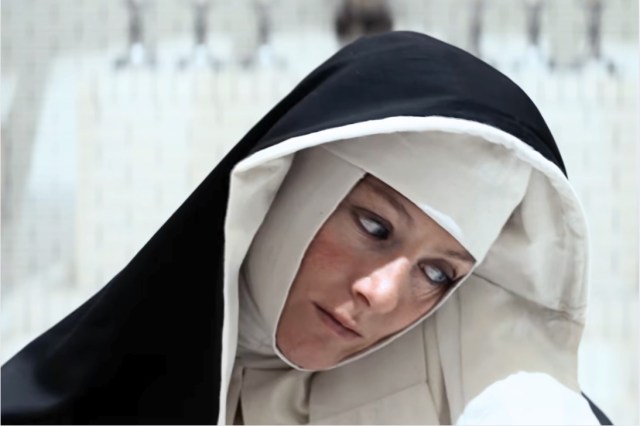
‘Russell is a maximalist with an intensely morbid streak.’ (The Devils/YouTube)





Think quick: when was the last time you remember a film causing a serious controversy? Not just a bit of handwringing from critics, or swarms of angry commentators online — but actual, real-world protest, even censorship? The closest thing might be Todd Phillips’s Joker, back in 2019, which initiated a minor media blitz warning of possible shootings and incel-adjacent terrorist activity. Though of course nothing remotely bad ever happened: the film went on to be the highest-grossing R-rated movie ever, and even won two Oscars.
We live in a world where self-righteous outrage and vengeful online fandoms are endless and ubiquitous — given the ease with which people (regardless of political persuasion) take to the internet to decry some book or film or artist as immoral and worthy of cancellation, one could be forgiven for thinking that modern audiences are constantly being confronted with truly shocking, and offensive art. Why, then, does it seem like cinema has in fact never been more risk-averse, tepid, and oppressively homogeneous?
Take a film like The Drama, which did surprisingly well for its studio, A24, back in May. A film like that may benefit, as The Drama did, from early buzz around a few supposedly controversial plot points, in this case a lengthy scene in which Zendaya’s character confesses to planning, but never executing, a school shooting as a young bullied kid. One or two negative reviews popped up, citing its being vaguely “problematic,” whether because the film didn’t highlight the racial implications enough, or because the critic deemed it insensitive to find comedy in something like a school shooting. But then the film came and the “controversy” was hardly that: instead it’s a decent satire on the Puritanical anxieties of upper-middle class Millennials in big coastal American cities. Nobody batted an eye, the film did well, then the film was gone. Robert Pattinson and Zendaya starred in all the other giant blockbusters of 2026, and no one was truly offended.
The question remains: what would audiences do, if presented with something actually shocking? Something upsettingly sexual, violent, and blithely offensive towards every institution within spitting distance? Well, Ken Russell’s infamous 1971 film The Devils has returned to the big screen to answer that very question, and the answer appears to be: people like it. A lot. Due to popular demand, the film has already extended past its initial week-long run in the US, where it has already made more than $4 million, truly remarkable for a repertory release. Last week it opened in the UK. Critical reviews have been rapturous, almost in direct proportion to how disappointed reviewers were 55 years ago. What seemed over-the-top, heavy-handed, and cynical to the critics in 1971 now seems rather loony, courageous, and thoroughly committed to its own extremity.
So how is it that a film made more than half a century ago ago — one that was censored, truncated, and dismissed by critics for decades — has become the most exciting “new” film of 2026? One immediate answer is that the extraordinary 4K restoration of Russell’s official director’s cut, first assembled in 2004 but never shown in cinemas, gives today’s audiences the very things we’re often told they don’t want: graphic nudity, semi-pornographic sex acts (many involving religious icons; one involving a burnt human femur), surrealism, absurdism, camp, Expressionism, vulgarity — not to mention a complex but ultimately heroic protagonist defined by his unapologetic virility, spiritual seriousness, hypocrisy, and pride. The film is an orgiastic, sadistic, Dionysian picture of the French Wars of Religion as a kind of depraved and cynical theatre: one which in Russell’s hands overflows with all the destructive energy, unashamed Romanticism, and individualism of the countercultural Sixties.
Based on a play by John Whiting and a novel by Aldous Huxley, the film was financed by Warner Brothers in 1971. The studio threw a serious amount of money behind it, enabling Russell and his set designer, a young Derek Jarman, to build a series of mammoth sets at Pinewood Studios, outside of London, filling it with hundreds of extras and filming for months in difficult conditions. As a work of pure cinematic technique, the film is a masterpiece. Russell is a maximalist with an intensely morbid streak and a love for the grotesque: he uses the setting of the play and the novel as a canvas on which to paint every bit of religious hypocrisy and sexual decadence imaginable. Yet underneath the burnings, tortures, church-floor orgies, convent exorcisms, and cackling audiences of evil French decadents, there’s an almost naive, sentimental insistence on the power of love and self-belief. Russell is always daring you to reconcile these extremes, always baiting his audience not to take him seriously. But he is, in his rascal way, very serious about certain things. Shortly after the film’s release, he was asked in an interview what he thought audiences should look for in his work, and replied, without a hint of irony, “Two contrasts: the force of nature and truth and beauty, against the corruption of a decadent society. That’s what I think all my films are about.” What could be more Romantic?
Thus the real heart of the film is its main character’s progress towards sincere martyrdom: Father Urbain Grandier (Oliver Reed) begins the film as the de facto leader of the walled French commune of Loudun, a man who loves the pomp and power afforded him by his priesthood, and considers himself above the problems of the people. At the same time, he prays earnestly for the dying, and genuinely tries to protect the city from Cardinal Richelieu’s ministers, who want to tear down the city’s fortifications to prevent the possible sheltering of Huguenots. Grandier’s downfall begins with the obsession of Sister Jeanne (Vanessa Redgrave), an insane hunchbacked nun shut away in the town’s Ursuline convent. Jeanne is consumed with erotic dreams of Grandier as Christ; when she learns Grandier has fallen in love and married in secret, she accuses him of possessing her through Satan-worship. This initiates a full-on exorcism and a macabre show-trial, which turns into a full-on orgy in the Loudun cathedral, ending in the Grandier’s burning at the stake. The way Russell orchestrates it, you get a morbid sense that this is what both religious and political power have always used — these moments of ritualised madness, rape, and abandon — to manipulate a population which has to be cowed and sexually repressed the rest of the time.
In this sense, The Devils bears an extraordinarily complicated relation to the chaotic decade that preceded it, a period which gave birth to cheap exploitation cinema and a new wave of producers willing to risk money on spectacles designed to draw audiences to violent and sexually explicit content — an era which effectively ended with the financial disasters of Francis Ford Coppola’s Apocalypse Now (1979) and Michael Cimino’s Heaven’s Gate (1980). But nowhere did this risk-taking impulse join with the countercultural zeitgeist like it did in Ken Russell’s films. Russell was the ultimate filmmaker of the Free Love generation — something that was already apparent with his brilliant 1969 adaptation of D. H. Lawrence’s Women in Love. With his great run of Seventies films — including Lisztomania, The Music Lovers, Mahler, and his psychedelic adaptation of The Who’s rock opera Tommy — Russell created one of the most outré and avant-garde filmographies in the history of mainstream cinema. His favourite subjects were always tortured artists, and his style was unapologetically flamboyant, theatrical, and aggressive. But it was with The Devils that he pushed his concerns into darker, riskier territory: the film’s most disturbing set-pieces are shocking not just because of the debauchery they show, but because those acts are mixed with so much bleak humour, and finally somewhat redeemed by the earnest martyrdom of Father Grandier, who becomes the Christ-like scapegoat for an entire society’s perversion and evil.
This is why it’s so interesting that contemporary audiences are taking to the film. Two decades of bitter online fandoms, culture warriors, and internet commentators have led to a moviegoing public that generally treats its films as objects in an ideological contest. The Zoomer and Alpha discomfort with sex and nudity in film is well-known. And everyone is familiar with the Millennial tendency — amongst fervent conservatives and progressives alike — to call for the cancellation of any artists or media they perceive to be opposed to their own political programmes. We live in a climate that is generally inhospitable to artists, whether due to the domination of corporate entertainment, or the widespread sentiment that the goal of art is to provide its audience with a moral directive, and never to risk offending the wrong people.
I suspect that what The Devils is offering its audience is exactly the kind of dangerous, unstable, kinetic wildness that’s missing from the current film landscape — as well as a heady charge of moral complexity and Romantic seriousness. The overwhelming tenor of contemporary film is one of intense claustrophobia, malaise, and overdetermination — just look at those two surprise Gen Z successes this year, Obsession and Backrooms. We’re often told that young audiences want original films, and high ticket sales this year — the highest since before the Covid pandemic — have apparently been driven by younger audiences. Certainly the remarkable success of those films attests to this. Still, consider their actual tone and structure: both films are airless nightmares about the total loss of self, with a film grammar as locked-down and exhaustively composed as any “elevated horror film” made within the past 15 years. There’s no room within their compact frames for any experiment — never any genuine sense of abandon, no real risk, nothing truly shocking. Nothing about contemporary cinema actively goes against the normal mainstream culture, not even the original films young audiences want.
In total contrast to the majority of contemporary films, the real excitement of Russell’s The Devils is just how wildly loose, dangerous — and, yes, free — it feels. The film is an argument for the right to be violent, sexual, voyeuristic, obscene, and offensive to anyone and everything. True, it portrays dozens of the kinds of acts young people today tend to get very squeamish and upset over, but it does so in the service of an intense, passionate plea for freedom itself: for the freedom to love, for total artistic freedom, for freedom from religion and political oppression and sexual repression. It remains remarkably countercultural — and this is exactly what contemporary audiences are gravitating towards. They sense that cinema is at a kind of frigid deadlock, just as our broader culture seems to be heading towards a sexless and Puritanical digital anomie that hates the human body, and denigrates the realities of human love.
The Devils is the most exciting film of 2026 because it is the most countercultural film of 2026. What precisely “countercultural” means in 2026 is, of course, almost impossible to envisage. We’re drowning in a shallow pool of endless content, most of which might as well have been made by machines. We have no real observable subcultures; we lack any sense of “scenes” or “movements”; most cities now are too expensive for these things to organically emerge, so successful creatives tend to be so because they were either born into wealth, or lucked out after years of hopeless struggle. But The Devils is a reminder of what it once looked like to make something genuinely offensive and risky — and, astoundingly, it feels wilder and more dangerous than anything any filmmaker has made in this century. Everything about it is a challenge to our exhausted, cynical, post-Romantic assumptions. And everyone who goes to see it knows this, deep down. Let’s hope the revival lasts a long time. The people clearly need it.
Sam Jennings is an American writer and musician living in London. More of his writing can be found at his Substack, Vita Contemplativa.
 samueljennings9