




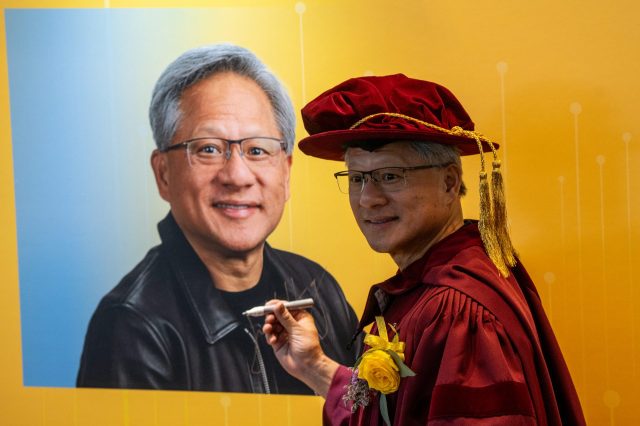
‘For me, l’affaire Huang obscures a far more troubling story.’ (Vernon Yuen/Getty)





Two things are increasingly clear. First, Jensen Huang was not forced to quit as chief executive of Nvidia because of an affair. Second, the honeytrap story is a diversion. The real question now is: a diversion from what? For me, l’affaire Huang obscures a far bigger, more troubling story, one encompassing the failure of a central component of US global strategy.
For years, Washington has relied on economic pressure — from dollar sanctions to tariffs — to keep its geopolitical rivals in line. Semiconductor bans too: the US long sought to keep China in the technological dark ages by restricting the sale and use of AI chips. Not only has this strategy now failed, it’s had the ironic consequence of pushing Beijing to develop its own home-grown alternatives.
The key player in the Huang saga is Megaspeed, the Singaporean firm for which Alice Huang (no relation) worked as a senior director. Megaspeed is a cloud-computing company that purchases advanced Nvidia computing equipment, before renting out capacity to clients that operate their AI systems. In other words: the classic cloud-business model.
In theory, US law restricted Chinese access to AI-infrastructure in third countries such as Singapore. But it’s downright naive to think that you can control both the dispersion of hardware, and the use of virtual capacities, when it’s so easy to hide your identity on the internet. After all, most modern computing power resides in what we figuratively call the cloud. I don’t want to push the metaphor too far, but the idea that any one country could control such a virtual world is absurd. And, as Bloomberg has noted, Nvidia didn’t even know where their physical chips were at any one time.
So, was Megaspeed instrumental in the smuggling of chips, or anyway helping Chinese companies gain access to cloud services US law should have prevented them from accessing? Probably — but it’s much worse even than that. Far more significant than the mere sale of a high-tech product is leaking the knowledge to produce it, let alone its more-advanced successor.
We know that Alice Huang was a corporate fixer. But the diffusion of knowledge across borders doesn’t really happen though people like her. Far more significant than Huang herself was the generation of Chinese students labouring away on PhDs in Western science and engineering departments. In mathematics, I recall an instance when an entire year group of graduate students was recruited from China. That’s unsurprising when British universities are critically reliant on Chinese students to remain solvent.
Since we ourselves educated an entire generation of Chinese scientists and engineers, why are we surprised that we fail to keep them down, especially when China itself now boasts some of the top universities on Earth? In the end, you can’t place an export ban on knowledge. Just look at the atom bomb, another technology invented in the US, but which was quickly acquired by both the Soviet Union and Red China.
It’s worth understanding how we got to this point with Nvidia. During the Bush presidency, US foreign policy was run by neoconservatives. Economic cudgels were there, but they played a subordinate role. Under Barack Obama, however, America became much more reliant on its financial arsenal. In a sense, this isn’t surprising. The dollar is the world’s dominant currency, meaning the US has control over any dollar transaction, even those conducted abroad. This made it possible for Washington to place secondary sanctions on countries — forcing foreign banks to comply with US policy or risk being cut off from the dollar, which for most would have been inconceivable.
There were technological arguments here too. As late as 2022, one could read that China was failing to produce chips as good as those in Taiwan or the Netherlands, both US allies. That ultimately led the Americans to think they could stifle Chinese technological leadership through lawfare alone. In 2018, Congress duly passed the Export Control Reform Act to strengthen the legal framework around high-tech products. A year later, the Department of Commerce placed Chinese giant Huawei on the list of companies that need a special licence under Washington’s export-control regime. In 2020, again under the Trump administration, the US restricted Huawei’s access to chips manufactured abroad using US technology.
But the single biggest measure came in October 2022, this time under the Biden administration, which imposed a ban on the sale of high-performance semiconductors to China. That specifically included advanced AI chips: including those produced by Nvidia, with the ban widened to include the machines that build them.
That’s how US law became extraterritorial — the most important company that knows how to make these machines is ASML, based near Eindhoven. ASML is one of the greatest tech companies in the world right now, and which, together with its European supply chain of high-precision optical and mechanical engineering specialists, has carved out a profitable niche market. But dependent on the US for its own security through Nato, the Dutch government chose to yield to US pressure to make ASML follow Washington’s restrictions. Soon enough, the Biden administration went even further, restricting US citizens from working for any firm that could produce high-tech machines or even help with the distribution of sanctioned goods to China.
It’s a policy that continued with the second Trump administration. In April last year, shortly after the President announced his “Liberation Day” tariffs, his government imposed new licensing requirements to restrict the sale of an older generation of Nvidia chips, the H20. This was a dumbed-down processor designed specifically for the Chinese market, and which had previously not fallen under the restrictions. After China retaliated to US tariffs with tariffs of its own, as well as export controls, Trump undid the H20 ban, with an arrangement that the US would receive a 15% cut of any sale. At the start of 2026, Trump’s went further, authorising a case-by-case licensing for the more powerful Nvidia H200 chip, albeit subject to certain restrictions.
In short, under Trump II, the direction of policy reversed. Yet it’s now clear that the US strategy of strangling China has failed. Quite aside from Nvidia, President Xi has asked Chinese firms to buy Huawei chips over those made by Nvidia or AMD, its US competitor. And why not? After all, Huawei has come a long way to catching up with its American rivals. They aren’t quite there yet, but, as with AI itself, the lag is now only a few months. With everything happening at Nvidia now, combined with other potential disturbances that could soon hit the AI industry, I wouldn’t be surprised to see China reach technological parity by 2030.
That’s the perverse effect of America’s various gambits — with the People’s Republic now poised to beat the US as its own game. And if that’s hubristic enough, the Americans have even less excuse given the lessons of other industries. Take cars, a sector German once dominated but which China has lately conquered. Ola Källenius, the chairman of Mercedes, lately expressed bewilderment about his company’s declining sales in China. But why? The fact is that, with better technological knowhow, the Chinese are buying their own cars, just as they’re making their own semiconductors.
There are broader lessons for the Europeans here too. Our economic sanctions against Russia are failing for the same reason that America’s chip policy foundered. Oceans are vast, borders porous, and the world of international commerce has so many backchannels that only a fool would think they could close every loophole. That’s especially true in Russia’s case: bordering 14 countries, and with over 20,000 kilometres of external land borders, strangling Putin’s regime by sanctions alone was never going to work.
As for the Americans, if their ill-conceived sanctions pushed China to sharpen its own chip sector, something similar is happening in finance. Both China and Russia have built payment systems based on the same blockchain technology behind cryptocurrencies. It’s early days, then, but the great decoupling from the dollar has begun. That matters far more than who, exactly, Jensen Huang had affairs with.
