




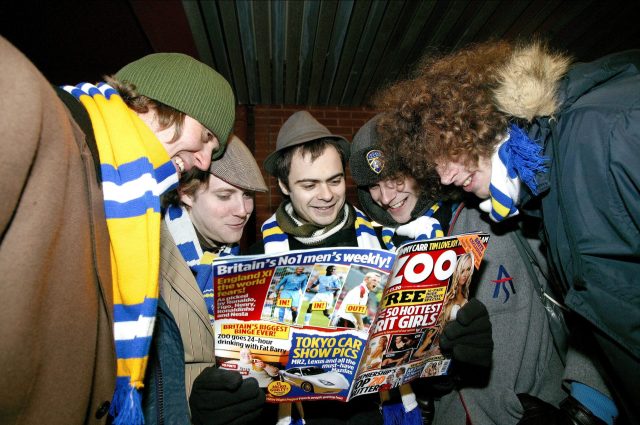
‘By the time ‘Nuts’ was selling a few-hundred-thousand copies a week, magazine racks looked like a warzone littered with women’s naked bodies’. (Mick Hutson/Getty)





It wasn’t so much the straw that broke the camel’s back as the rope. Rough manila rope to be specific: about an inch and a half in diameter, looped around my neck. It was 2016, and my cool-lass liberal views on pornography and sex were shaky at best, the night my boyfriend picked up the ends and pulled hard. My airway cut off, black bled into my peripheral vision. He pulled again, harder. Tiny white stars burst in the darkness, a throbbing drum beat filling my ears as blood bound for my brain stopped dead.
As I gasped — well, tried to — in blind-panic and mock-excitement, I couldn’t help but wonder… was this empowerment? Was this where a decade and half of choice feminism had got me? And, well, it’s precisely where. Saying “yes” as he strangled me so hard that spiral-groove abrasions crawled down my throat afterwards. But then, this night on my back and entirely in his hand scared me sane, was the hinge of my sexual politics.
A decade prior, in 2006, I was a committed choice feminist (we should support any-and-all choices a woman makes, including those for the pleasure and profit of men), and a senior editor on men’s weekly magazine Nuts (see previous brackets). A decade on, in 2026, I’m an anti-porn radical feminist, surveying where two-plus decades of choice feminism — and its rabid little sister, pick-me feminism (we should support any-and-all choices a woman makes, unless it obstructs the pleasure and profit of men) — has got us as a society.
Put simply: men have women, more than ever, by the throat. Regardless of the straws one high-profile conviction has us grasping, we’re still up to our necks in the conditions and culture I helped to create in the Noughties. It’s a culture that enabled men like Russell Brand, in which they could act out the misogyny they ceaselessly “bantered” about, while women like me cheered them on from the sidelines, standing on the backs of our sisters to get a better view.
It’s worth saying that I expect to be accused of bad-faith bandwagon-jumping. I’ve written about my two-and-a-half years at Nuts just twice before: in a play about rape culture, and, journalistically, in a Left-leaning newspaper. The latter: an examination of the damage we’d done to the (largely working-class) young women who appeared in the magazine, the damage I’d done as a young working-class woman.
My naked (certainly naive) honesty, admitting that I’d been seeking a permanent path out of my own financial precarity through the exploitation of others, was met with intellectualised disgust. The readers — middle-and-upper-class-Left — decided I was a moron, a liar, a woman faking a mea culpa, hungry for attention (of course!).
My gears were ground to dust by those for whom the poverty I spent my early years in was a coked-up dinner-party point-of-order. And I was baffled. Wasn’t I attempting to hold myself accountable? But then, I was starting down the path of rejecting liberal feminism. I was the enemy who one day would be back to try and take their porn (correct! Ding ding!).
Their disdain wasn’t just hacked up for me though; they had plenty left for the young women in Nuts (who, apparently, were also idiots). And they certainly didn’t think any better of the uneducated working-class men they assumed exclusively bought the magazine. But then, they didn’t know what I did. What made Nuts so powerful, so dangerous.
The readers weren’t just white-van-driving blokes from council estates, but all men (Nuts sold over 100 million copies over its lifetime), with a particularly strong showing among middle-class boys. The office regularly fielded complaints from teachers at very good schools in very nice areas whose classrooms were being flooded with it.
And these are the boys who concern me the most. The generation — now in their thirties, running companies, setting standards, raising sons and daughters of their own — made men not just by magazines that made soft-porn the wallpaper of their lives, but by a culture that was soaked in aggressive sexism.
***
The Nineties closed out with a 16-year-old Britney Spears on that paedophile-fluffing cover of Rolling Stone, and with FHM projecting a nude picture of 21-year-old Gail Porter onto the Houses of Parliament without her knowledge or consent. And, just like that, as the Noughties began, the gates of misogyny were flung wide open.
Live on BBC Radio 1, Chris Moyles offered to ‘“take” 15-year-old Charlotte Church’s virginity when she passed the age of consent. Kylie and Geri Halliwell copped-off for a gleeful Chris Evans on TFI Friday. A female audience member was groped on stage at a Johnny Vegas stand-up show. Russell Brand and Noel Fielding joked about being rapists alongside a stone-faced Lily Allen on Channel 4’s The Big Fat Quiz of the Year. Indie lad-band The Pigeon Detectives sang about knocking women about (“You’re hurt cause I hit you/ But we know it’s only a game/ You said I make you walk into a door/ But I can’t control myself.”)
A hyper-sexist, hyper-sexualising culture that turned women and girls into hollowed-out things to be leered at and, ultimately, fucked, was unleashed. Exploitation was conflated with consent, objectification and degradation celebrated, complaints from radical feminists (who rightly pointed out how misogyny can never be divorced from the material reality of women’s lives) deflected with supposed-celebrations of female agency and freedom (miserable bitches just needed to lighten up, right!).
If you joke about being a sexist pig, a rapist — you can’t be a sexist pig, an actual rapist, right? That was the argument, and one that gifted men, sexist pigs, and rapists like Russell Brand, unfettered access to women’s bodies.
There’s no two ways about it: objectifying women was hugely profitable for all concerned in the Noughties. Though initially, we didn’t realise this at the magazine.
Nuts — one of the biggest ever magazine launches from IPC Media, publishers of NME, Marie Claire and Horse & Hound — landed in January 2004 (a week before rival Zoo, developed under the codename Project Tyson; yes, after the boxer and convicted rapist).
I was deputy news editor, our glossy pages filled with girls, crime, jokes, sport and cars — but not nipples, which were banned. After all, we’d say, “it’s the magazine fathers and sons can read together”. On the cover of that first issue — of which one million copies were given away — stood, in a gym-appropriate vest, model and fitness pro Nell McAndrew.
Promotion was via a massive £8 million advertising budget: a large chunk spent on TV ads showing women spooning DIY while their blokes read the magazine. “Women!” boomed the voiceover while the theme from The Great Escape played. “Don’t expect any help on a Thursday!” This slice of regressive sexism aired to millions during an ad break in the final series of Friends on Channel 4.
Early covers starred Beyonce in a denim skirt, Britney in a bikini, J-Lo in lingerie, before men in focus groups told us (shockingly!) that they actually wanted to see nipples. Specifically, British nipples. And so, celebrities were replaced with glamour models. Until, they said, they actually wanted to see “real” British nipples, those attached to the girls from their hometown, the pub, the office. Girls that might, on the right night, laugh at their jokes and, ultimately, shag them.
It was, it became clear, about proximity, access, attainability. And so, to unleash those extra sales (and profits), breasts and nipples were in (or should I say, out), as were “real girls”. These overwhelmingly working-class girls were now the stars of Nuts (but not sharing in the profits; they weren’t paid, taking their own pictures and sending them in, unlike the professional models making tens of thousands).
At the same time, the ideas for “real girl” features — which I became responsible for after being promoted to features editor and then associate editor, number three on the magazine — became increasingly porn-coded. The covers screamed “Britain’s Sexiest Secretaries!”; “Topless For the First Time!”; “Girls With Girls!”; “Babes Go Topless Together!”; eventually devolving into “100 Big Boobed Girls!”, “The Giant Boobs Issue!’, and “VERY BIG BOOBS!”. Literacy and brain cells were shed as quickly as the women’s clothes.
But readers didn’t just want access to the girls, they wanted to know what to do with them. So, we dialled-up the magazine’s sex content with “confessions”, “advice” and “tips”. “Naughty sex guaranteed!” read one cover line; “Turn good girls bad!” promised another. We were careful not to breach consent in the articles, but it was more assumed than sought. And while practices like strangulation were off-limits, I ghosted columns about anal, deep-throating, tit-wanks. One sex tip I remember editing said simply: “Treat me rough!”. Girls, in our world, were gagging for it, always. Willing to act out every fantasy and make it reality.
Before Nuts and Zoo, naked pictures of “up for it” women were packaged in the magazines sold in newsagents from the top-shelf. Pornography was clearly labelled and ring-fenced as such. But by the time Nuts was selling a few-hundred-thousand copies a week, magazine racks looked like a warzone littered with women’s naked bodies, their faces fixed and unsmiling. Going into Tesco for a meal deal suddenly felt like staring into an abyss. Flesh-and-blood women and girls were assaulted by acres of flayed female flesh. Dehumanised images reflected back at them, at us, at me. We were all stripped bare of dignity and personhood, whether we took our clothes off or not. It was an experience I knew too well.
***
Another night, this time when I was still at primary school. My mum was working as a barmaid in town, her boyfriend calling me into their bedroom, where he sat naked. In one hand, his penis; in the other, a pornographic magazine (of the Fiesta, Escort kind).
He told me to sit down, pushed the open magazine towards me. Across the double-page spread, a woman — big breasts, tiny waist — on her back. Her legs spread wide, tangled hair shooting from the darkness. Another, on all fours, held together by a staple.
“Hold it up”, he demanded, beginning to move his hand up and down. I complied, holding it over my eyes. “Lower,” he barked. He needed to see my humiliation to get off. There was no escape — not for me, not for them. We were bound together in an unholy covenant of degradation. I saw these women in the real girls in Nuts, reduced to one use: facilitating the orgasm of men.
Any argument against this was destroyed on another night, when I sat in the Nuts office uploading 100-plus pictures of topless women, before digitally decapitating them for a new website called “Assess My Breasts”. The name of the “game”: men ranking every pair out 10. But, to protect the women’s “dignity” (the argument went), we’d remove their heads, their identities, leaving just a disembodied pair of tits. It felt like a tacit admission of how little anything else mattered.
The internet broke both me that night, and Nuts itself eventually. As the Noughties ticked into the 2010s, our new tech (phones) and new methods of distribution (the internet) meant that pornography could be easily accessed by pretty much everyone, everywhere, at any time, for free.
It became the air we breathe, and the crucial role Nuts played in pornifying our culture for this step-change is clear. We made “soft” porn mainstream, and left the door wide open for the extreme stuff to slip into its places. By 2010, 88% of porn involved “physical aggression” like “spanking, gagging, and slapping”.
“Pornography is a celebration of rape and injury to women,” wrote Andrea Dworkin. And who can look at modern porn — hair-pulling, face-spitting, rough anal, double-penetration, choking, “gangbangs” — and not agree with those words? And so, when pornography is mainstream, the celebration of rape and injury to women is too. The acts on screen bleed into acts in the real world.
These days, in fact, it seems we only reserve shame for women who say no. To being strangled. To anal. To threesomes. Who have a problem, like one of Brand’s victims, with having their breasts grabbed in public.
We need to radically overhaul the culture we’ve built brick-by-brick over the last two-plus decades. And the path back begins with de-pornifying the culture we corrupted so thoroughly. We don’t need to teach men and boys what consent is (please!), but we do need to remind them that ignoring it, forcing your way through it, has dire consequences. And say, forcefully, that women and girls are more than a pair or tits. Or a mouth, a vagina, an anus. “Tarts” for men’s pleasure. Russell Brand’s been told that in no uncertain terms — now we need all men and boys to hear that too.