




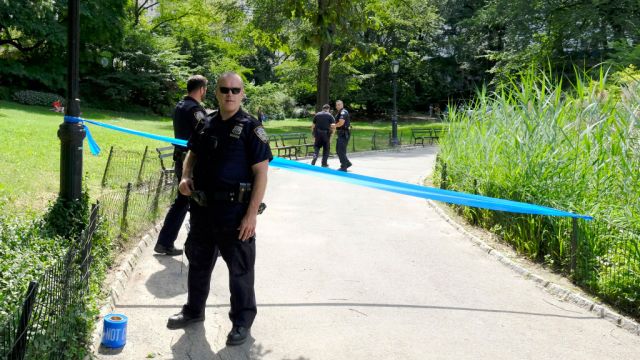
The park has seen a disproportionate increase in crime. Credit: Getty





Last week, a New York court had to adjourn an arraignment hearing for Jonathan Robles — the man accused of killing a 63-year-old artist in Central Park — after a psychiatric evaluation concluded that he was unfit to stand trial. In September, the 36-year-old Robles beat his victim, Frances Lee Rogers, 20 times with a stick, causing massive internal bleeding. Rogers thus became the park’s first murder victim since 2022.
The media image of the park, of course, is still that of a verdant oasis — a perception reinforced by events like the New York City Marathon that saw more than 60,000 runners streaming beneath Central Park’s fall foliage across the finish line. The exuberance of the runners and spectators, set against the brochure-perfect leafy backdrop, masked a darker reality: a breakdown in public safety and order within Manhattan’s most precious asset. The growing toll of violent deaths, as well as injuries and unpleasant encounters, are evidence that New York City has splintered into an array of unrepresentative but powerful special interests, which no longer come together to approximate a public interest.
The numbers tell one story: according to the New York Police Department, park visitors have fallen victim to 93 felonies this year, as of the first week in November, nearly 18% higher than last year and the highest figure in 16 years. From the mid-1990s until 2019, serious crime in Central Park trended downward. But after a lull in 2020 and 2021, crime has gone back up. Violent felonies — murder, rape, robbery, and assault — have disproportionately risen over seven years, up 52% since 2019, compared to 27% citywide.
Rogers, the 63-year-old artist who enjoyed painting the park’s birds, was far from the only recent victim. Between 2003 and 2016, no one lost their life to murder in Central Park; since then, four people have. In late October, an assailant dragged a woman walking nearby on Fifth Avenue at a theoretically safe time — 8:30 p.m. — into the park and raped her, the park’s fifth rape this year, up from three by last fall. Also in October, three masked men beat and robbed a 32-year-old woman, in another supposedly safe section of the park near the Upper East Side. Robberies and assaults have reached 35 this year, up from 28 last year and 25 in 2019.
Another set of numbers doesn’t quite tell the other story: crash deaths. According to the NYPD, two park visitors have lost their lives to traffic deaths, compared to one last year. Those statistics do include Douglas Adams, 71, a cyclist killed in a collision with a dog in October, and Richie O’Brien, 41, a pedestrian killed by a cyclist in September. But the numbers don’t include 18-year-old Romanch Mahajan, fatally thrown from a horse carriage in June. The statistics governing crashes in Central Park are a mess, with both the police and the city’s transportation department inconsistently counting victims of bicycle crashes, as opposed to victims of motor-vehicle crashes.
Last year, one e-biker, Salvador Nico-Garcia, 43, died in a crash with a pedestrian, but before that, news stories and personal memory indicate that the park could go years without a fatal crash, just as it could go years without a murder. Stats on injuries are even more unreliable, but such crashes are up; after one serious injury this year, doctors had to put a woman hit by an e-bike driver into an induced coma.
These worst-case scenarios don’t capture what longtime visitors experience: day-to-day chaos.
The park, with 42 million visitors a year, is an enforcement-free zone. Drivers of motorized pedicabs and e-bikes zip along pedestrian-only paths, or they go the wrong way down one-way cycling drives. Cyclists and e-bike riders on these drives don’t stop at crosswalks for pedestrians. To sit on a lawn near a park drive and listen to music is to hear cyclists berate pedestrians at regular intervals for their very existence. A particularly depraved measure of incivility: after a cyclist hit and fatally injured O’Brien in September, several passersby attempted to aid the victim, and other cyclists speeding by screamed at them for being in the way. Vendors illegally hawk everything from mangos to hats and gloves to massages.
Why has the park devolved into a scenic dystopia? Two proximate reasons. Eight years ago, the city closed the park’s drives to cars and trucks. Since then — in partnership with the Central Park Conservancy, the nonprofit group that has mostly funded, rebuilt, and maintained the park since 1980 — the city has embarked upon a redesign to give most of the extra room that the closure created to cyclists. Now, the drives have two cycling lanes, one for slow riders and one for fast movers, including amateur racers as well as food-delivery workers. Finally, since 2023, the city has allowed e-bike drivers to use the drives. Now, with no consistent enforcement of the 15- mile-per-hour speed limit, e-bikers and cyclists use their extra room to speed, and motorized pedicab drivers use the room to maneuver in circles, gather in clumps waiting for customers, or drive the wrong way.
Second, the city, over the past decade, as part of its move away from broken-windows and quality-of-life policing, has gradually ceased to effectively enforce any laws or rules, whether against e-bike drivers, cyclists, vagrants, or vendors. Enforcing prohibitions against seemingly small infractions would prevent bigger crimes.
For example, in March, an illegal food vendor in the park slashed a competitor. If the government won’t enforce its vending laws, ensuring the legal hawkers have ample space to earn a profit, illegal vendors will attempt such enforcement on their own. In a graver example, had the city enforced the prohibition against illegal sleeping in the park, Rogers, the murdered artist, wouldn’t have been in the park to be murdered; Rogers was homeless, as was her alleged killer.
Proactive policing is particularly important in a space like Central Park, which, like Times Square, Penn Station, and the subway system, is attractive not just to regular visitors, but to transients — good transients such as tourists, but also bad transients who take advantage of other visitors’ lack of familiarity with the area to prey on them. As opposed to (healthy) neighborhoods, where permanent residents and business owners and workers can (theoretically) help to enforce social and behavioral standards, third-party mediators must keep order here — and they aren’t succeeding right now.
Moreover, no coalition is forcing them to succeed — because nobody in power is mediating among the park’s various special interests to consider the broader public good. Instead, discrete factions are advocating for discrete policies, and the outcome is public chaos. The collective that represents food-delivery e-bike drivers doesn’t want enforcement of traffic rules, for example, and illegal-vendor advocates don’t want enforcement of vending rules, because such enforcement could have a disparate impact on illegal migrants who perform such work. Homeless advocates don’t want action against outdoor encampments; their policy position is no-strings-attached housing for all. Most frivolously, amateur racing cyclists don’t want to adhere to a 15 mph speed limit.
The biggest culprit is the Central Park Conservancy. In an optimal world, the city itself would use its tax dollars to fund and maintain the park, as the park, in turn, helps increase nearby property values, which results in higher tax revenues. But during the city’s 1970s fiscal crisis, the park fell into such neglect that the city allowed the nonprofit to take over responsibility for reconstruction and upkeep. The conservancy has done good work over the decades, but it is supposed to be apolitical, and rightly so; it shouldn’t speak on controversial public issues as if it carries the weight of a public agency.
But since last year, the conservancy has stepped into a politically contentious area: advocating for the ban of the park’s horse carriages, on the grounds that the park drives are too crowded for the horses. This argument is nonsensical; with cars and trucks banned from the park, the drives should have more room for the carriages than they once did. Yet the conservancy’s new position was a key reason why the city council last month banned the carriages. The council acted on this issue and on no other issue affecting the park, despite the fact that the death of Mahajan, the horse-carriage passenger, in June, was the only of this year’s four deaths to be a true freak incident, and the only such fatality in living memory.
The conservancy is abusing its power here for a simple reason: another special interest. The horse-carriage drivers are a vulnerable and easily maligned minority who are up against about 200 animal-rights advocates who have long made noncredible claims of abuse against the horses. The animal-rights coalition has been persistent and consistent over two decades, and so it got its way; absent a successful legal challenge, the horses will be banned beginning in 2028.
The city council’s action here and on no other issue plaguing Central Park has created yet another new danger in the park: the specter of workplace violence against the demonized and ostracized horse-carriage drivers. In mid-November, a woman, spewing false allegations of “animal abuse,” allegedly attacked a horse-carriage driver in the face with a skateboard, and now faces a felony assault charge. The council’s action, supposedly to increase public safety in the park, has reduced it.
Absent a civic culture that supports elected officials who govern in the public interest, Central Park’s special interests aren’t so much competing with and benignly neutralizing each other as they are devouring the public park.
Nicole Gelinas is a senior fellow at the Manhattan Institute and a 2026 Moynihan Public Scholar at the City College of New York.
 nicolegelinas