


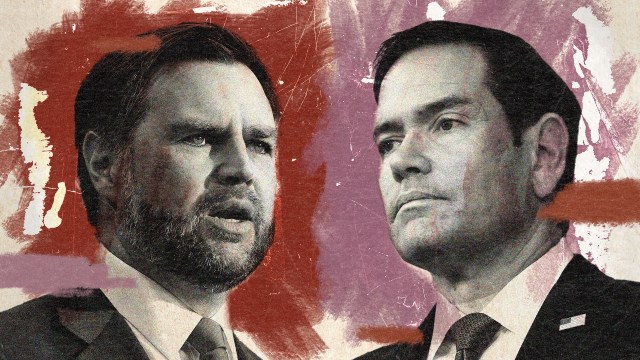
Who will lead the New Right? (JG Fox/Getty)





In the early days of the second Trump administration, most observers took it for granted that JD Vance was the MAGA movement’s designated heir: the populist prince who would extend the Republicans’ advantage among young voters and consolidate the realignment that saw the working-class shift to the Right beginning in 2016. But now that sunny certainty has given way to doubt, with Marco Rubio poised, by some accounts, to challenge Vance’s claim to the GOP standard in 2028.
Is it true? Sort of. What’s afoot is mostly a political phoney war that could erupt into open hostilities — but hasn’t yet. Mainly outside forces are stoking the rivalry (such as it is): namely, neoconservatives and other foreign-policy hawks for whom Vance is too sceptical of the US-Israel relationship, too eager for diplomacy with Iran, and too close for comfort to Tucker Carlson. That, in turn, has led to the camps briefing against each other behind the scenes, even as the two principals, by all accounts, remain on friendly terms.
But the briefings and counter-briefings could become a self-fulfilling prophecy, pushing Rubio into a campaign he’s unlikely to win. Or, at least, rendering Vance’s dilemma even more bedevilling than it already is: does he break even more sharply with his colleagues over the war, or get forced into a muddled message that prevents him from mounting an antiwar campaign come 2028?
The hawks’ strategy isn’t to promote Rubio, who has yet to signal any intention to contest the 2028 primary. “I still don’t believe Marco wants to run,” as one senior Trump World figure told me recently. Rather, they are working double-time to frame Vance’s views and associations as somehow heretical and disloyal to President Trump, thus discrediting the Vice President to such an extent that someone else can comfortably contest the nomination: Rubio, the secretary of state and acting national-security adviser, is seen as an obvious and more reliable choice for now, but others may also fulfill the role.
The GOP phoney war, in other words, is driven less by either of the two principals than it is by the Anybody-But-Vance camp, not least Fox News and many in the Murdoch press. And that camp’s members are primarily animated by fears that the Republican Party’s stance on the Middle East might shift in tandem with the same changes that have already turned most Democrats and Independents against the Jewish state — at least, in its current, needy and maximalist version. To a lesser extent, they also worry that Vance would accelerate the GOP’s shift away from free-market orthodoxy.
The most overt flashpoint arguably came this month, when it was revealed that Rubio helped draft a secret report indicating that Nvidia CEO Jensen Huang had had an affair with an alleged Chinese spy. By contrast, Vance personally went in to bat for Huang. “We were told that he was under no investigation,” the Vice President told reporters, adding: “Frankly, I think we have to in our country remember that we don’t try people in the court of public opinion.” He also explicitly backed the Nvidia board’s decision to reinstate the embattled CEO.
That, as I say, is as sharp and public as a Rubio-Vance disagreement has ever been. One notable aspect is the way in which the divergence between the two men scrambles the expected pattern. Vance, who entered politics as a populist and trade hawk, might have been expected to support Huang’s ousting. Populism, after all, is all about asserting the primacy of politics — and national security — over commerce. Yet it’s Rubio, once a conventionally pro-business Republican, who reportedly led the intelligence community’s campaign against Huang.
The switcheroo over Nvidia shows why an open contest between the two men — should one erupt — would defy simple ideological categorisations. It’s easy to forget that before joining the administration, Rubio was part of a trio of Senate populists alongside Vance and Missouri’s Josh Hawley. The three men, along with a wider “New Right” intellectual ecosystem around them in Washington, broadly stood for the idea that US security and the welfare of American workers and communities should determine the shape of the political economy.
In 2019, Rubio delivered a speech at the Catholic University of America, drawing on the Church’s social teaching to articulate what he called a “common-good capitalism”. Two years later, in the wake of the East Palestine, Ohio, train derailment, Rubio signed a joint letter with Vance that blamed the neoliberal model of economic governance for the disaster. They wondered if the rail industry’s push to minimise “direct human input”, meaning labour costs, may have made the accident more likely, or aggravated its severity. In his final years in the Senate, moreover, Rubio increasingly looked askance at Wall Street’s domination of the real economy, raising fears that private-equity and hedge-fund asset-stripping would debilitate manufacturing, especially in defence-critical industries.
Put another way, those who imagine elevating Rubio over Vance would mean reviving the GOP’s pre-Trump political economy may well be sorely mistaken. For Rubio, a hawkish approach to foreign policy and a more populist or patriotic economics go hand-in-hand. If anything, then, Rubio’s Nvidia intervention might, in retrospect, look like a principled stand on national security, while the Trump- and Vance-backed Huang restoration smacks of “governing for the stock market” (and more specifically governing for allies in the tech industry, in the Vice President’s case).
The deeper and more consequential divergence, of course, involves the Iran war. Fact is, Rubio has been, and remains, a much more conventional Middle East hawk: a position that is now deeply unpopular with nearly all demographic groups save for older Republicans. The secretary of state declined to blame the war for the Republicans’ midterm wipeout, and has defended Operation Epic Fury in grandiose “civilisational” terms, thus wrapping old-school neoconservative policy in rhetoric congenial to the online Right.
By contrast, when Trump launched his invasion on 28 February, Vance pointedly disappeared from X (usually his favourite outlet and news source) for several weeks. And through background quotes and leaks, his team made it clear that the Vice President had harboured private reservations about the intervention. This, even as, by his telling, he helped execute the President’s policies, including diplomacy with Tehran back when Trump saw promise in a negotiated settlement.
Then came the midterm rout. In its immediate aftermath, Vance explicitly blamed the war and its inflationary effects, and called for recalibrating the US-Israel relationship. His neocon critics — who were already blaming Vance and his friend “Tucker Qatarlson” for the failure of the Trump-approved talks — saw a golden opportunity. Vance was “disloyal” to the President, charged Marc Thiessen, the George W. Bush speechwriter-turned-hawkish pundit. The hawks’ online loudmouths also targeted Vance allies inside the administration, most notably Saurabh Sharma, a key gatekeeper at the Presidential Personnel Office, going so far as to suggest that he is Muslim (Sharma is a Catholic convert).
Trump, however, backed Vance’s account of how the war had hurt Republicans in the midterms, only adding that he’d do it again, all the same. Donald Trump Jr went even further, counterpunching the hawks in defence of Vance. Still, the war puts Vance in a most unenviable spot. He must awkwardly state his objections and drive toward a diplomatic off-ramp as best he can — crucially, without upsetting the boss or appearing disloyal in the eyes of the MAGA base.
Why worry about that last group? The war unquestionably shattered the wider Trump coalition that returned the President to the Oval Office. The coalition included MAGA diehards at its core but also depended upon many others: young people; black and Hispanic men; and working-class Obama-to-Trump voters (including conservative swaths of the labour movement); among others. Still, the MAGA core remains, and expects Trump to designate an heir.
For his part, Trump at times hints that Vance is that heir and at others pointedly withholds his blessing. A great deal of Trump World Kremlinology went into interpreting the President’s body language at a recent news conference featuring both Vance and Rubio, with the Vice President pointedly declining to say whether the Iran war had been worth the candle, while the secretary of state stuck to a positive message (albeit in a downcast tone).
But Vance really is personally loyal to Trump. Trump’s endorsement was essential to his clinching the GOP nomination in the 2022 Ohio Senate primary. And if it weren’t for Trump, he wouldn’t be the second-most-powerful man in the world, but likely a lone senator swimming against his own party’s ideological tides.
This all leaves Vance with a difficult choice. He can intensify his critique of the war — and of the Israelis who pushed hardest for it — and gamble on alienating Trump and some MAGA remnants. Or he can go all-out against the hawks, risking a very unpleasant work environment for the next two years and still lose the antiwar youth, who haven’t failed to notice that Vance’s public, on-the-record statements against the war didn’t come until after it was tested at the ballot box.
Rubio, meanwhile, stands or falls on how voters might view the war in a year or two. But emphasis on falls. If the midterms were any guide, running unapologetically on the war is a political suicide mission. And Rubio can read polls just as well as any politician can. Who would put himself through that sort of a national election if the alternative is being feted as a foreign-policy guru and delivering corporate keynotes at $250,000 a pop? This is why the attempt to build up Rubio as an alternative to Vance feels to me more like an outside “op”, as the kids say, than a real candidacy taking shape.
But that raises another question: why would Vance wish to take on the same uphill battle, made only marginally less arduous by his dissent on Iran?
As I first reported for UnHerd, the political fallout appeared so grim in the war’s early days that his camp considered swearing off 2028 and looking to 2032 and beyond. The picture since then hasn’t really improved. What the Vance camp banks on isn’t so much the Vice President’s ability to thread the needle between MAGA loyalty and Iran-war dissent. It’s whom the Democrats pick.
It’s easy to look back on the midterms and see inexorable, indomitable Democratic strength. But congressional races are different from presidential ones. And the generic Democratic brand in 2028 must rest upon a concrete person. If that person is goofy and unpopular or a throwback to “woke one” — say, Kamala Harris or Alexandria Ocasio-Cortez — the debacles of the second Trump administration might prove surmountable, after all.
It’s possible that Team Rubio is making the same calculation, though, again, there is so far scarcely any sign of an organic “Marco 2028” groundswell. Mostly, my sources in Trump World see an effort by people not named Marco Rubio to meme such a campaign into existence — and this, chiefly by attacking Vance rather than building up Rubio. So the 2028 GOP phoney war — if that’s what it is — mostly reveals one of the second Trump administration’s steepest costs: the damage it has done to two of the most promising leaders in the New Right.
Sohrab Ahmari is the US editor of UnHerd. His next book, on The Triumph of Normal, is forthcoming from HarperCollins.
 SohrabAhmari