




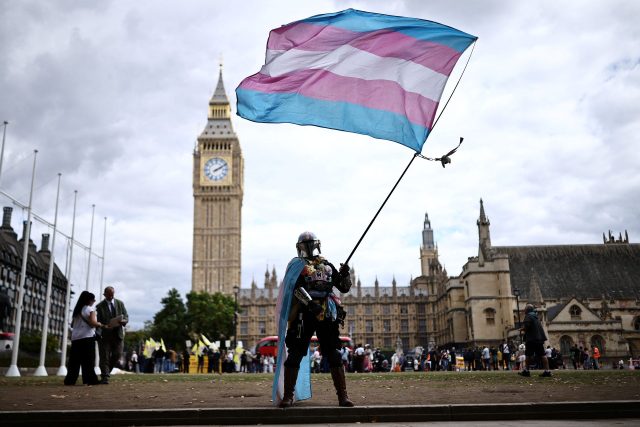
Unlike Burnham, Hilary Cass read the Bill — and then retracted her endorsement. (Henry Nicholls/Getty)





If Andy Burnham had been following the parliamentary scrutiny of Labour’s controversial Conversion Practices Bill, he might have been a little more circumspect in reiterating his support for the bill yesterday. Only last week, Baroness Cass demonstrated the hazards of giving legislation your blessing before you have had time to read it properly.
Cass, whose landmark review in 2024 transformed the treatment of gender-distressed children in England, explained that back in June she was given less than an hour to look at the bill before being asked to produce a statement of support. After only a cursory read, she had expressed her agreement in principle — with ministers then rushing that into a press release. But then Cass did what all legislators should do. She went away and read the draft bill properly. She listened to the concerns of clinicians and families and carefully considered the ramifications.
And she then changed her mind.
The proposed legislation would make it a criminal offence to attempt to change someone’s sexual orientation, or transgender identity, through conduct deemed abusive. Conviction of the new offence could mean five years in prison. Courts could also impose protection orders to prevent anticipated abuse, with up to two-years’ imprisonment for breaching them.
Few people would defend coercive attempts to convert gay people into heterosexuals. Genuine abuse requires protection, whatever its prevalence, and whoever the target. However, one of the fundamental issues with the current draft bill is its inclusion of transgender identity — in particular, what exactly “conversion” looks like for these people. One of the fundamental difficulties in defining “conversion” stems from the fact that, unlike sexual orientation, gender identity itself is remarkably difficult to define. Some people believe that it is innate and entirely separate from sex, equivalent to a gendered soul. They believe that although biological sex and gender identity often align, they sometimes differ, producing a profound and lifelong feeling of incongruence. Others understand (and indeed experience) gender identity to be fluid, something that evolves and changes throughout life. Others don’t believe it exists at all, beyond a cluster of preferences and proclivities for activities and fashions associated with culturally determined sex roles.
If people suffering from gender incongruence didn’t request medical intervention, we could leave the feminists and philosophers to debate its meaning. However, the moment medicine becomes involved, defining our terms becomes a clinical necessity. Clinicians need to know what they are treating.
What is known as “differential diagnosis” is a cornerstone of clinical practice. A patient complaining of leg pain may have a muscle sprain, a fracture, or a life-threatening cancerous tumour. The pain is real, but the symptom tells us remarkably little about its cause, and it’s the cause, not the symptom, that determines a treatment in medicine. In the case of leg pain, the treatments could range from a hot bath to an urgent amputation. Any doctor who accepted the patient’s preferred explanation for their symptoms without investigating alternatives would be failing in their duty.
The same principle applies to gender-related distress. The diagnostic classifications for gender incongruence or gender dysphoria only describe desires and discomfort. They do not establish why a particular individual has developed the beliefs that may underpin these experiences.
Consider a 10-year-old girl who hates being a girl and has a very strong desire to live and be accepted as a boy. This may reflect long-standing gender incongruence; perhaps her brothers always got preferential treatment in the family. It might also reflect sexual trauma or distress about the onset of puberty, or fear of male attention. Perhaps she is struggling with same-sex attraction. She may have autism and has developed rigid ideas about what activities girls are supposed to enjoy or how they should dress or behave. Perhaps she has discovered someone on TiKTok who offered her a simple explanation (and solution) as to why she feels different to her peers. This is not an exhaustive list and several of these factors may coexist. One child psychiatrist recently showed me a spreadsheet of at least 10 psychiatric diagnoses that can present with gender dysphoria as a symptom.
It is a clinician’s job, then, to investigate all these possibilities without working towards a predetermined outcome. In doing so, they may well come to a different understanding of the patient’s gender identity than that of the patient themselves. Doing this properly is challenging for patients and clinicians alike. It will involve exploring the patient’s understanding of their own experiences. Exploring internalised homophobia is very likely to provoke anger. Discussing the possibility that a teenager might feel differently in the future is also highly likely to provoke a strong reaction. It is part of a therapist’s skill to handle these conversations sensitively, but the possibility of causing distress should not stop them from asking necessary questions.
The Cass Review recommended this kind of holistic assessment, and NHS England’s current service specification requires clinicians to investigate the individual factors that contribute to the transgender identity for every patient. However, the very conversations that the NHS expects clinicians to undertake are now at risk of being characterised as conversion practices if they result in a change of gender identity. A change in identity is not itself the statutory test; the legislation focuses on the clinician’s intention. But intentions cannot be directly observed. They can only be inferred from recollections of what was said and done, potentially long after the consultation, and with the outcome already known. As we know, recollections can vary.
Proponents of the bill insist that clinicians are fully protected by a “healthcare exemption”, which is intended to avoid a chilling effect in exploratory therapy. Conduct undertaken in healthcare is excluded from criminal sanctions unless it falls far below the standards reasonably expected of a practitioner. This sounds very reassuring, until you start to look for the standards.
One of the (many) extraordinary things about gender medicine is that there are no agreed standards of care, and existing ones are highly contested. For many years, the World Professional Association for Transgender Health (WPATH) Standards of Care were considered the gold standard. Then, in 2022, WPATH updated these to include a chapter on eunuchs, identifying the Eunuch Archive — an online community devoted to castration, genital removal and eunuch identity — as an important source of information. The website combined discussion forums about castration, including methods of self castration, with thousands of sexually explicit castration fantasies. Peer-reviewed research into these stories documented themes of attraction to, and mutilation of, the genitals of pubescent or adolescent boys.
Critics understandably questioned the appropriateness of such a source in clinical guidelines, asserting that it undermined the legitimacy of the whole approach. If material of this nature is deemed to be an appropriate resource within international clinical guidelines, it is reasonable to question the reliability of those guidelines for acceptable professional practice. Two years later, the Cass Review warned that the WPATH Standards of Care had overstated the evidence underpinning their recommendations for the care of transgender people. In July 2026, WPATH acknowledged in a US court that paediatric transgender medicine was an area of intense medical debate.
Since the publication of the WPATH guidelines, the Cass Review has resulted in significant changes to the NHS services for children questioning their gender. However, the fundamental disagreements within the professions about the boundaries between legitimate exploratory therapy and conversion practices remain unresolved. The evidence heard by the committee last week illustrates just how far apart these positions remain.
Without an industry standard to adhere to, some clinicians regard open-ended exploration as essential to competent assessment. But others would characterise anything other than affirmation of a transgender identity as conversion therapy. Both positions can be found in the peer-reviewed clinical literature. Take the case of a same-sex-attracted adolescent boy presenting with gender dysphoria. A clinician who readily affirms the transgender identity may be accused of “transing the gay away”, facilitating conversion of sexual orientation. A clinician who explores the possibility that the young person is struggling to come to terms with same-sex attraction may be accused of attempting to convert the patient’s gender identity. Both will sincerely believe that the other is practising far below acceptable professional standards. And yet both approaches could result in accusations of harmful conversion therapy.
The trouble across all this is that the healthcare safeguard is built on a consensus which does not exist. It is like promising that everyone will be protected by the rules of the game, without specifying which game is being played.
The safest course of action for the clinician may longer be the safest course of action for their patient. Faced with the prospect of a criminal investigation, even experienced clinicians may shy away from the difficult conversations that are essential to good clinical care. This bill creates a danger that gender medicine will only attract clinicians who are absolutely certain of their position, driving away precisely those whose willingness to question their own assumptions, makes them good clinicians.
And the potential impact of this legislation extends well beyond specialist gender clinics. In forensic psychology, for instance, challenging a patient’s deeply held beliefs can be essential to protecting the public. Consider a man convicted of serious sexual offences against women who, while in prison, begins to identify as a woman. At his parole hearing, he states that his previous offending belonged to his former male identity and that, as a woman, he no longer poses a risk. A forensic psychologist has a duty to explore that belief, including the relationship between his sexual interests, gender identity and offending history. These will be difficult conversations. But under the proposed legislation, the patient may well interpret such questioning as an attempt to undermine their gender identity and make a complaint of conversion therapy. The prospect of investigation, the accusations of criminality which would follow the application of the new legislation, may be enough to deter many psychologists from going anywhere near this kind of exploration — and the consequences of that silence may well be borne by someone else entirely.
We don’t need to wait for the legislation to see how readily these kinds of accusations will be made. On 12 November, clinical psychologist Dr Anna Hutchinson gave evidence to the parliamentary committee scrutinising the Bill. Within hours, she was described online as a conversion therapist. Name-calling doesn’t automatically become a criminal charge, but it doesn’t need to. Clinicians will be reported to employers, professional regulators and the police long before any court decides guilt or innocence. A single complaint can seriously damage a professional reputation even when it is eventually dismissed. As many have already discovered, the process is the punishment and watching it in action is a powerful deterrent to anyone considering working in this field.
Cass understands this. Her review exposed profound failures in a field where professional disagreement had become almost impossible and children were being harmed as a result. Transgender identities cannot be included in the conversion practices bill until there is a clear and explicit clinical consensus about the boundaries of legitimate assessment and treatment. If clinicians cannot agree on what constitutes conversion therapy, how can politicians expect police officers and judges to make these distinctions? There is something very refreshing about Cass’s willingness to reconsider her position publicly; she has demonstrated the intellectual rigour and integrity we should expect from all our politicians. There is a lesson here for Burnham: enthusiasm for legislation should follow scrutiny, rather than precede it. Clinicians and their patients can ill afford the luxury of premature political certainty.
Sallie Baxendale is a consultant clinical neuropsychologist and a professor of clinical neuropsychology at University College London. She was shortlisted for the Maddox Prize, in recognition of her work “defending evidence-based science”.
 unherd