




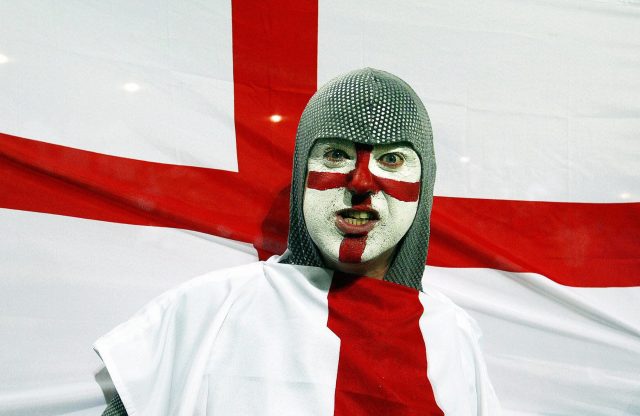
England’s up for grabs. (Christophe Simon/Getty)





In the late 2010s I wrote a book, New Model Island, which claimed that England doesn’t exist. In truth this was a sly provocation. As the fine print of the book made clear, cancelling England was really meant to expose the glaring lack of coherence behind the English nationalist cause. To get a sense of the problem, ask a simple question: can you name more than a dozen inarguably English — rather than British — cultural signifiers, which apply to the whole country and stop at the border and coast? Most people will respond with a series of straw-clutching examples (though few, to be fair, have clutched at straws quite like the celebrity toff Ben Fogle, who titled a 2017 book: English: A Story of Marmite, Queuing and the Weather).
Some years later, I still think that England is a global anomaly — a half-country that cannot, and possibly will not, ever free itself mentally from its historic alter-ego, Britain. But the world is everything that is the case. If England is what we are to be left with after Britain itself has broken up (a growing prospect given the outlooks in Ireland, Scotland, and Wales), can we think of it as something more exciting, and more humane, than the muddle of post-imperial clichés that have dominated traditional English nationalism up to this point? What, indeed, would a truly radical England look like in practice?
As a thought experiment, let’s sketch some basic coordinates for a hypothetical English nation state. A key starting point here is that, relatively unusually, it would probably be the outcome of movements from without rather than within. In other words, assuming a newly formed England is the result of Irish reunification and Scottish and Welsh independence, it would be in the tricky position of having been created negatively rather than positively. Its point of origin would be a series of borders imposed by now foreign citizens in the surrounding “Celtic” nations — its core identity that of a remnant rather than a new whole, like an oddly shaped piece of gift paper left behind after all other presents have been wrapped.
A host of implications — some practical, some more abstract — would arise from this. But they would all hinge on a crucial point. This is that the new English nation, having been brought into being by outward rather than inward forces, would have to fight very hard to reverse this negative tendency. In other words, it would have to assert itself as a truly expansive and modern entity, rather than one that continues to move backwards and inwards into a nostalgic remainder of the Anglo-British state.
The latter is what current conservative and far-Right English nationalisms — from old-school Toryism to new-school flag-hoisting — rather foolishly yearn for. By relying on a hodge-podge of signifiers from the heyday of the United Kingdom (Flanders Fields, Keep Calm and Carry On, a mash-up of Union and St George flags), and from the bourgeois imaginary of the South East (Pimms, country gardens, stiff upper lip), it prepares for the prospect of a break-up of Britain by not preparing at all.
In this vision, an indie England would be nothing more than a reloaded — or in Rupert Lowe’s terms “restored” — version of the vanished British Empire, with its imperial culture centred on London. But the opposite is likely to be true. A new England that defaults to Rightist fantasies would be a sort of rump empire — a sunken star caught forever in the shadow of its former brilliance. It should go without saying that a nation needs more than such imperial nostalgia to move forward in the long term.
What this points to is the need for a basic overhaul of the English national architecture, of the kind that almost all other countries (but not the UK) have undergone at some point over the last 200 years. In this context, it would be very difficult to justify the survival of the old British monarchy, and very difficult to resist the need to reinvent the English nation as a forward-facing republic for the third millennium. Assuming, as seems likely, that the Celtic nations would automatically become republics, a “cuck monarchy” reduced to a merely English realm would be a rather paltry focal point for the new nation’s political sense of self.
Other northern European nations may have developed informal “bicycle monarchies” in the 20th century, in tandem with successful wider modernisation. But the British monarchy is far too closely bound up with the pomp and circumstance of UK-era imperialism, and its elitist class system, to be reformed in this way. As a result, shirking a republican rebirth in the foundation of an indie England, and retaining the decaying House of Windsor (a dynasty that began its rule only after the invention of the UK), would be a fatal misstep, which would likely lead to internal malaise, and external irrelevance, from the start.
A Republic of England, then? Yes. But there would be a case for using a term like “Commonwealth” in the all-important new national nomenclature. For one thing, it is a historically resonant term that recalls both the radical debates of the 16th century, when Levellers, Diggers, and ordinary English citizens were disputing what a new England could be in view of Cromwell’s Commonwealth. It also invokes the more consensual national culture of the mid-20th century, when the British Empire morphed into the notionally more liberal “Commonwealth of Nations”.
If comparisons to this post-imperial body render “Commonwealth” unacceptable (and if references to Cromwell are too much for citizens of Irish descent), there should at least be some careful thought in the national name and makeup about some of the loose ends of the UK (the Channel Islands, St Helena, Isle of Man etc.). Would these automatically default to English rule after the dismantling of Britain? For all its flaws, a term like “Commonwealth” would acknowledge this complicated legacy, in addition to England’s radical history — and indeed its ongoing potential for internationalism and a renewed multiplicity.
There would be yet stickier matters to confront regarding (newly) international relations. Even assuming the breaks with Ireland, Scotland, and Wales were clean (a big if), and led to full sovereignty for each, after almost a millennium of various forms of entanglement there would be a pressing need to avert scrappy Balkanisation by creating a more informal post-UK alliance. Call it a “small-u union” if you like.
A customs union broadly along the lines of the European Union seems the most likely template here (and some pooling of defence and other resources would surely be inevitable). But those of us old enough to remember the purgatory of the Northern Irish “backstop” debates of the late 2010s can attest that such things are fiendishly hard to implement in practice. How, for example, would a new Four Nations customs union overlap with the EU itself, of which Ireland (and possibly Scotland and Wales), would also likely be a part? And how, more pointedly, would England be prevented from resuming its dominant role in such an arrangement, given its vastly bigger population and wealth?
However intra-British Isles relations evolved in this regard, comparisons between the new England and its former partners could be more productive in another sense. The ultimate form of devolution that is independence for the Celtic nations would surely help to shine a light on England’s internal political geography. Without comparable devolutions within England, indeed, the result is again likely to be an uneasy, hierarchical society, in which the Anglo-British UK is exchanged for a smaller English rump imperium dominated by London.
For an English nation state to survive and thrive, it would have to lastingly reject its decomposed imperial past, by ending the quasi-imperialist — or at least radically centralised — dynamic that has guided its politics and culture since at least as far back as the Norman Conquest. A federalist settlement of the kind that followed the reunification of Germany in the early Nineties provides a decent model for this. Indeed, the current British prime minister Andy Burnham has touted this as a solution to English regional inequality, so it is no mere hypothetical.
As with the hypothetical customs union, the finer details of these federal units would be torturously hard to draw. But in the context of a major national renovation, they would be a plausible, even essential imperative. The government office regions of the millennium years (North East, North West, Yorkshire and Humber, West Midlands, East Midlands, South West, South East, London) suggest loosely equitable boundaries. But they could do with some fine-tuning, and some more imaginative names. Could the old Anglo-Saxon heptarchy supply inspiration here, in the creation of a new Wessex, Northumbria, and East Anglia? Or would something more sci-fi and speculative be in order — anyone for “Fenlandia”, “Greater Kernow”, or “Novolancastria”?
In advocating federalism (in Head North, the 2024 book he co-authored with Liverpool city region mayor Steve Rotheram), Burnham also called for the abolition of the House of Lords and its replacement with a second chamber along the lines of a “Senate of the Nations and Regions” (echoing a similar suggestion in a Gordon Brown-led Labour Party report of 2022). If we remove “nations” from this proposal, it offers a decent starting point for English republican governance. Alongside this, the current movement towards proportional representation in the House of Commons would surely have to accelerate. At the top of the superstructure, an Irish-style ceremonial president would likely be a more culturally acceptable form of Head of State than a stronger, US-style executive. The net result would be a basic, functional constitutional model, resembling those in the vast majority of countries elsewhere in the world. A written constitution would be essential to underpin all this, and the new national system more generally.
This might all sound like a thoughtlessly iconoclastic erasure of English and/or British traditions. But as noted, there are compelling, even urgent reasons for a thoroughgoing modernisation of England and its makeup, not least the one already mentioned: that its identity is largely based on the United Kingdom of the last two centuries rather than an autonomous England (which only really existed, confined to something like its current outline, for a couple of hundred years in the Middle Ages — though the vaguer notion of “English identity” was rather more durable).
What is more, if we look at the deeper origins of England, we see that its early history was defined by a various, polycentric culture and politics, rather than the more unitary centralism that was set in stone after 1066, and which ultimately gave rise to the centre-margins dynamic of the British Empire and trad “Englishness”. For the Right, the Middle Ages is a source of mythic Tolkien-esque notions about the origins of the English “race”, a time that apparently spawned a valorous Carling Black Label Englishness ready-made for the DIY meme culture of alt-Right social media (cue images of white knights vanquishing dusky-hued foreign foes, and interminable thread arguments about the existence of a pure English ethnicity).
But if we look beyond these travesties of history, and indeed the murky wider debate about ethnic origins (research shows that the gene pool of England is highly nuanced and blurs into that of the surrounding nations), we can derive more positive inspiration from the early Middle Ages, and in particular from the Anglo-Saxon opening chapter of the English story. At this founding moment, the “Angel-folc” — such as they were — were arranged in a series of shifting regional kingdoms that in many cases carried over the older tribal divisions of the pre-Roman period. Though very far from being egalitarian (slavery was common in Anglo-Saxon England), there are enlightened legacies of this period of English history — not least the memory of a culture in which the class system was not centred on a cloistered aristocracy felt to be a completely different species from the ordinary populace.
Rather than viewing a post-independence England as a shrunken stub of the UK, we should embrace the maximalist, more various, more open version of England that is recoverable from its first iteration in the post-Roman period, and view it as a populous patchwork containing multitudes. If there is a single principle that should guide a new republican England — if it does indeed come to that — it must be a commitment to this expansive, changeable form of national consciousness.
The Scottish artist-writer Alasdair Gray once advised Scots to “work as if you were in the early days of a better nation”. We should heed his advice. The whole problem with England and Englishness prior to this point has been a tendency to dream of a forlorn past rather than a better future. If a new England is to succeed, it will have to follow Gray’s dictum and work out how to reinvent itself based on the imaginative capabilities of its contemporary citizens, not its historic heroes — for all the usefulness and validity of memories and models from history. As we prepare for this prospect, we should realise that England is, in every sense, up for grabs.