




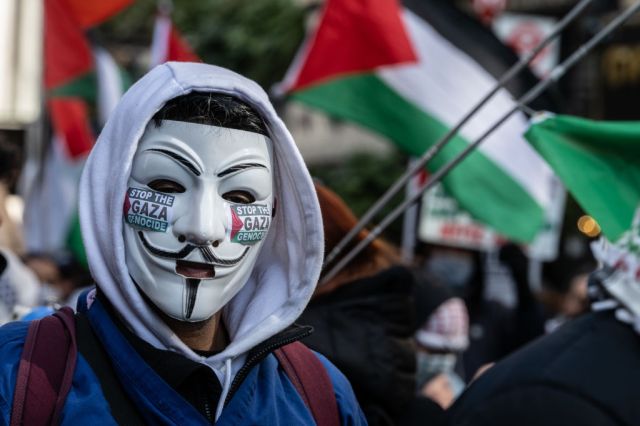
A kind of Left Orientalism exoticises and fetishises the icon of the modern guerrilla. (Guy Smallman/Getty)





In the Fifties, Tribune, the celebrated journal of the Labour Left, announced that “There is a danger of war in the Middle East!”. Plus ça change, we might say now. The region spanning the Eastern Mediterranean and the Gulf has ever been an ethno-religious tinderbox and a resource-rich periphery to the greedy imperial core, rarely a peaceable land. But the editorial continued with a line of argument that feels deeply incongruous today: “Israel may be compelled to fight,” it stated. “Let Socialists see to it that she should have arms to withstand the Arab forces… The cause of Israel is the cause of democratic Socialism.”
Tribune was founded in 1937 by two wealthy socialists, one of whom would later become Chancellor in Attlee’s postwar administration. Its original purpose was to campaign for an anti-fascist, anti-appeasement popular front between Labour and more radical Left parties, including the Communist Party, which at the time was a small but serious outfit with parliamentary representation, cadres of high-minded intellectuals, and many thousands of worker-militants in powerful trade unions. It quickly became a celebrated weekly, publishing George Orwell and the future Labour leader Michael Foot. During the war, it was edited by Nye Bevan, the legendary Welsh miner who went on to found the NHS — and is still a hero of the Labour Left today.
In the 75 years since Tribune’s editorial, such lofty sentiments with regards to Israel have become unimaginable on the Left. Instead, explicit anti-Zionist postures have become not just fashionable but an essential component of the contemporary progressive identity. “From the River to the Sea” is the Newer Left mantra, an article of faith repeated ad infinitum by those professing an acquaintance with today’s versions of “democratic socialism”. The ability to pursue anti-Israel policy with singular, near-obsessive intensity has become the primary litmus test of one’s political acceptability. Pro-Palestinian activists in Britain have even protested the Left-wing Senator Bernie Sanders for his apparently lacklustre displays of fealty to the cause, and their American comrades have taken a similar approach to Zohran Mamdani.
To be sure, an enthusiastic socialist Zionism was bound to falter as the nature of Israel changed: while the Jewish state could be viewed as a David against Arab Goliaths before 1967, the long-running occupations since have flipped the dynamic. Israel is no longer a haven of social-democratic values. Long gone are the socialist celebrations of Israel’s purportedly democratic, collectivist ethos encapsulated by the kibbutzim, the powerful Histadrut, and the construction of a European-style welfare state in a region of familial autocracies. All that is now anathema. Jerusalem embraced the neoliberal turn as thoroughly as Western Europe and the post-Bretton Woods United States. Its politics shifted markedly to the hard-Right, not least as Mizrahi Jews — descendents of those expelled by Arab nationalists across the region — came to wrest political dominance from the generally more liberal-minded, old Ashkenazi elite.
Irrespective of the internal political economy of Israel proper, there are sound, principled reasons for the Left to vigorously oppose ethnic cleansing in the West Bank and the ruthless bombardment of the Gaza Strip. But whatever the actions or political complexion of the Israeli government, it is Zionism itself which is today opposed almost universally on the radical Left. Indeed, according to the implied geographies of “River to the Sea” chanters, and according to the official policy of the Green Party of England and Wales, the mere existence of Israel is held to be the egregious result of a great historical injustice, of “racism”, to be corrected at the first opportunity. It’s not just Israel that has changed, but the Left that has changed too.
A revamped Tribune, under new ownership, merely echoes this broader trend. The story of the magazine mirrors the sociological and ideological transmutations of Left politics over nearly the last century. Last week, for example, the magazine hosted an event with Andreas Malm — the Swedish academic and author of How to Blow up a Pipeline, who was recently barred from entering the UK — along with Huda Ammori, one of the founders of Palestine Action. It has been suggested that Malm, who appeared at the event via video link, had his permission to enter the UK revoked as a result of his characterisation of October 7 as “fundamentally an act of liberation”. In a 2024 essay, he had mused on “the best writings of Islamic Jihad”, the land of Palestine’s “subjugation to fossil [fuel] empire”, and angrily lamented the apparently “real disgrace” that he could not “without equivocation” lend his support to the “armed resistance”. Malm also admits that his initial “cries of jubilation” and screams of “astonishment and joy” on October 7 (all fairly unequivocal) were somewhat tempered by the realisation that “they will destroy Gaza. They will kill everyone.”
In this, Malm has been proven prescient. Immediately after news broke of the Hamas-led massacres, anyone even vaguely familiar with the recent and ferocious history of IDF responses to terror attacks correctly predicted that the next phase of conflict would dwarf the scale of any human suffering yet seen in this densely populated strip. But Malm never seems to have conceded that his celebrated “resistance” itself knew full well what the consequences of its actions would be. Nor does he acknowledge that the provocation of a barbarous retaliatory assault was in all likelihood precisely their intention, in order to disrupt the Abraham Accords. The annihilation of Gaza, in the cold calculation of former Hamas leader Yahya Sinwar, was a price worth paying to threaten the gradual but definite lapse in the regional solidarity felt by the powerful sections of the ummah. For rulers residing in the palaces of Gulf petrostates and the region’s martial dictators, a normalisation of economic, military and diplomatic relations with Israel took precedence over years of interminable occupation and conflict. Palestine was becoming a mere awkward footnote in the more important considerations of regional realpolitik. In spite of all this, Tribune’s other worthy guest Ammori started what is now a proscribed organisation dedicated to the sabotage of UK military equipment, and has offered adjacent commentary to Malm. Her Palestine Action co-founder told an excitable crowd on 8 October that “the al-Aqsa flood” (Hamas’s preferred term for their most successful pogrom), must be turned “into a tsunami of the whole world”.
So what explains Tribune’s about-turn, from the enthusiastic Labour Zionism of its genesis towards the most rabid forms of apologia for indiscriminate Islamist terror against civilians (particularly if those civilians happen to be Jews)? It is more than simply the actions of the Israeli government and the IDF. There are ideological double standards at work. The deaths of hundreds of thousands of Tigrayans at the hands of Ethiopian forces in the early 2020s would not have led to wild celebrations at any hypothetical terrorist reprisals against civilians in Addis Ababa.
There are several elements to the story of the Left’s, and Tribune’s, ideological journey, the first relating directly to the magazine itself, which last year was acquired by Mohamed Ali Harrath. Harrath was a founder of the Tunisian Islamic Front as well as the owner-founder of the Islam Channel. That particular outlet has been censured by Ofcom for broadcasting, among other things, explanations of the precise circumstances in which marital rape and domestic abuse are allowed (“not in a way that damages her eye or damages her tooth or damages her face and makes her ugly”, according to these learned scholars). Harrath, a Sunni Muslim, has also been filmed engaging in outlandish sectarian rants against Shia Muslims. Under such ownership, it’s no wonder that Tribune has departed from its traditional Labourism. But there are broader forces at work. Not least the emergence of a sinister, tacit, de facto alliance between the Left and fundamentalist Islamism — a phenomenon the French philosopher Pierre-André Taguieff identified as Islamo-gauchisme in 2002 but that has only flourished since.
This is a strange political nexus where the most bien pensant, hyper-woke progressive Leftists can find common cause with varying brands of millenarian Shia Islam and militant Sunni jihadism alike. In the Manichean division of the world into oppressed-oppressor, these instances of ultra-conservative religious fanaticism and indiscriminate violence can be coded as the chaotic outbursts and cries of the underdog against a hegemonic capitalist-imperialist world order. This is what allows crowds of Millennial and Gen Z protestors, as well as the ageing remnants of the metropolitan Boomer New Left, to mingle on demonstrations with Islamist sympathisers, thinking nothing of celebrating the battlefield victories of groups whose flags are emblazoned with “Curse the Jews”. Yemen’s Houthis may not be perfect, but who are we to condemn their fight in our decadent sham democracy? After all, they alone are resisting Israel’s expansionary, genocidal impulses. Or so the logic goes.
And so along with Tribune, the Left — “The real movement which abolishes the present state of things”, as Marx defined the socialist project — has been transformed. It has morphed from a class-focused, workerist phenomenon, intimately connected to the organised labour movement, into one based on the social justice mantras and worldviews of hordes of over-produced and downwardly mobile graduates, steeped in a woolly language that grasps towards post-colonialism; post-structural critiques of gender, race, “whiteness”; and veneration of the “subaltern” and “Global Majority”. Within the moral framework displayed by these postgraduate foot soldiers, the axioms of today’s Left are not ones of robust universalism, Enlightenment values, or the painstaking work of broad-based coalition-building. That has been superseded by a series of expressively radical poses that delineate membership of the Brahmin Left subculture.
This politics has become the default ideology of a certain social-cultural type — a byproduct of the Blairite expansion of higher education. Its members work almost exclusively in laptop jobs that afford a relative level of autonomy and social prestige if not particularly large remuneration packages. Because of this, and the fact that they struggle to step onto the housing ladder before they inherit their parents’ real estate asset wealth, they think of themselves as unfairly proletarianised. Even so, they identify themselves through a certain style of trendy clothes and the renting of extortionately priced rooms in gentrifying enclaves of urban Britain where old copies of Why I’m No Longer Talking to White People About Race sit next to Ikea house plants. The more politically literate have a pile of Verso tomes. They carry tote bags, read Sally Rooney, and watch obscure Mubi documentaries. They acknowledge “lived experience”, mental health and “emotional labour”. They are converts to a distinct creed of extremely online Millennial and Gen Z socialism that produces little to nothing by way of workplace struggles, institutional power, face-to-face associational culture, or grassroots community activism. Their political economy is broad and inchoate, but they know that Palestine must be free, that trans women are women, that there’s a button in the Treasury that says “wealth tax” that wicked neoliberals refuse to press, that Britain needs its own Black Lives Matter, and that oil must be stopped — today. Among the public intellectuals and discourse-generators that give a sort of cultural-political coherence to this caste, a brand of anti-Western “anti-imperialism” predominates. It rarely cares to condemn the geopolitical ambitions of Moscow, say, or Tehran. Meanwhile, Israel, a country of 10 million, 2,000 miles away, is cast as the crux around which world politics somehow revolves, the prime mover for domestic political mobilisation, apparently the sine qua non of something they call “late-stage” capitalism — more in hope than expectation.
And it’s this Third Worldist, anti-Western outlook — along with the moral and cultural relativism that flows from the demands of radical deconstruction prevalent in the academy — that permits support for suicide bombings, the subjugation of women, the imposition of Sharia law and open antisemitism. All this is apparently acceptable as long as it’s done in pursuit of Israel’s ultimate defeat, the destruction of the “white settler colonial” entity par excellence in its entirety, not simply a withdrawal to pre-1967 borders. At home, antisemitism is easy enough to dismiss as a nefarious, deliberate distraction from the real work of “opposing genocide”. Since racism, in the Brahmin Left’s pseudo-Marxist reading, must manifest itself as structural (i.e. appearing in institutional discrimination and negative, divergent social outcomes for ethnic groups), then Jew-hatred can be classified as a mere individual prejudice, not nearly on a par with anti-black racism, or, God forbid, Islamophobia. Indeed, a lingering view of antisemitism as a “punching up” phenomenon remains; it’s considered an understandable if unseemly by-product of systematic oppression by Jews, or by a powerful elite in which Jews are over-represented, confirming the continued validity of the old social democrat August Bebel’s assertion that antisemitism was “the socialism of fools”. This socialism is alive and well. And so the same people who talk about “micro-aggressions”, “unconscious bias” and calls to “decolonise” racist curricula will excuse Islamist death squads against Jewish civilians.
After 20 years of wage suppression, squeezed household budgets, the deterioration of the public realm, the accentuation of housing crises, gaping regional inequalities, anaemic growth and secular decline at home, the British Left has landed on Israel-Palestine as the most successful rallying cry it can now muster. Industrial militancy may be all-but dead, but at least the Middle East still gets the new adherents onto the streets. Never mind the fact that London, unlike Washington, now exercises little-to-no influence over the Middle East, or that Israel’s onslaught against the Palestinians would have played out identically even if Zack Polanski himself had been the British Prime Minister.
This kind of monomaniacal, post-imperial obsession with the Holy Land is the end product of a political movement that has lost its social foundations. The Left’s old institutional networks in the unions, working-men’s clubs and mass parties once buttressed a level of broad popular support and a political grounding among ordinary working people in Britain — but those networks have decayed. Detached, incubating itself almost purely in seminar rooms and online, and relegating itself into subcultural status ever more forcefully, much of the Left has retreated into the politics of cultural signalling and moral performance, abandoning any serious ambition to acquire or exercise power, much less any ambitions to represent and articulate the aspirations of the working class.
On the Brahmin Left, zeitgeisty causes célèbres appear and disappear with dizzying frequency — and they are rarely the same causes that animate much of the country at large. Meanwhile, a kind of Left Orientalism exoticises and fetishises the icon of the modern guerrilla, ascribing virtues to foreign actors whom British Leftists would find abominable if they had any power or proximity to them at home. The uncoupling of the once-great Tribune from its roots and traditions is a symptom of this political degradation. It is a remarkable journey from Bevan to Hamas, and not one that the old Tribune would have recognised.
Jonny Ball is a Contributing Editor at UnHerd. He formerly wrote under the name Despotic Inroad.
 DespoticInroad