




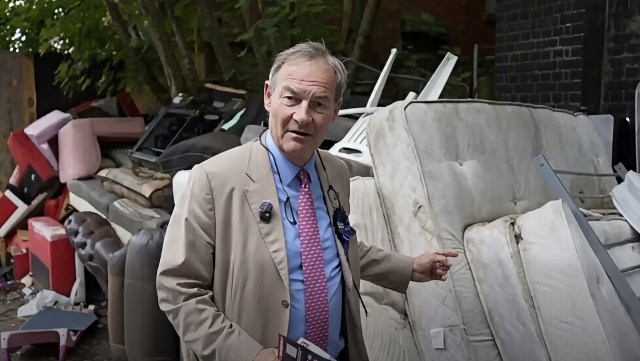
The Restore leader has encouraged his supporters to clean up Britain. (Rupert Lowe via Facebook)





“Found a massive great big dildo the other week in a lay-by,” my litter-picking companion Scott says matter-of-factly. “Quite a few people find knives. One found a sawn-off shotgun. Someone found an eighteenth century bayonet once.”
He isn’t remotely squeamish about the detritus of his fellow citizens: the sodden nappies; the greasy boxes of half-gnawed chicken bones; the “driver Tizer” (litter-picker slang for discarded bottles of truck driver’s piss). Scott is 57, ex-Army, works full time at a car storage facility and devotes hours a week to picking up other people’s rubbish near his home in Leicester. “You just can’t stop yourself,” he says. “It’s addictive… When I go to Tesco to do a shop, I’ll quickly litter pick outside.” He even went litter picking after his mother’s funeral, “still suited and booted”.
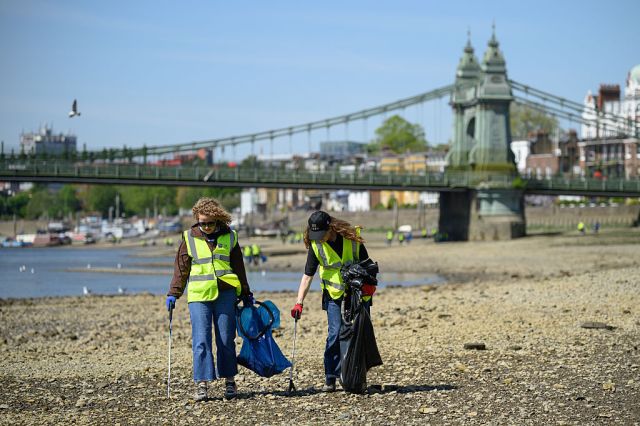
According to Keep Britain Tidy, two million pieces of litter are dropped every day. In the absence of adequate infrastructure, someone has to pick it up, and that’s mostly volunteers. Facebook is home to many bands of litter pickers. The Wombles Community Charity now boasts 200 groups with a total of 40,000 members across Britain, and provides free branded merchandise and equipment, although Scott says his gear was provided by the local council. He opens the back of his car to reveal his arsenal: grabbers, hoops for bags, green bin-liners, gloves. “There are two types of grabber; this one has a handle like a gun,” he says, handing it over to my delight. I begin to snatch at crisp packets and soon enter a flow state, wombling freely.
Once you cure yourself of “litter blindness” — as Scott calls it — you start seeing it everywhere: the bottles rolling across the pavement, the plastic bags sauntering in the breeze, the cans blooming in hedgerows, the wrappers nestling in wheel arches. The abundance of litter may then come to seem like a visual metaphor for a Britain that is itself in the gutter — a nation out of place, lacking the infrastructure to clean up its own mess, populated by people who don’t even notice what a mess they’re in. All of which helps to explain the growing political salience of litter.
One of Andy Burnham’s first acts as Prime Minister was to increase maximum fines for waste offences from £300 to £5,000 and to crack down on illegal waste dumps, having encountered a particularly noxious example in his constituency Makerfield. However, the issue is a particular favourite of the Right. Reform held a Cleaning Up Britain conference earlier this year, while Restore’s Rupert Lowe, not to be outdone, has organised a series of litter picks. “All over the country decent patriots are coming together to push for real change and restoration. It is wonderful to see,” Lowe wrote on Facebook. The motive is transparent. Not only is litter picking tangibly useful (it’s much harder to object to volunteers in high-vis tabards removing Red Bull cans from a playground than it is to people sharing Right-wing memes online), but it broadcasts a curated message to the masses. Restore-branded litter pickers present themselves as the frontline against a nation assailed by filth and left at the mercy of apathetic authorities.
It’s useful political ammunition, because everyone hates to see litter. A 2025 YouGov poll claims 96% of Brits find litter irritating. It’s the second most condemned anti-social annoyance — just behind dog poo. And yet people do it anyway: Keep Britain Tidy claims that 49% of British adults litter. But what little breakdown of that statistic I could find suggests that most of the admitted litter is food waste like sandwich crusts or apple cores, under the mistaken belief it will quickly biodegrade (an orange peel can take six months). Still, as I survey the littered landscape, it’s the battered beer cans, plastic bottles of pop, McDonald’s meal wrappers, and crushed crisp packets that sag my bin liner.
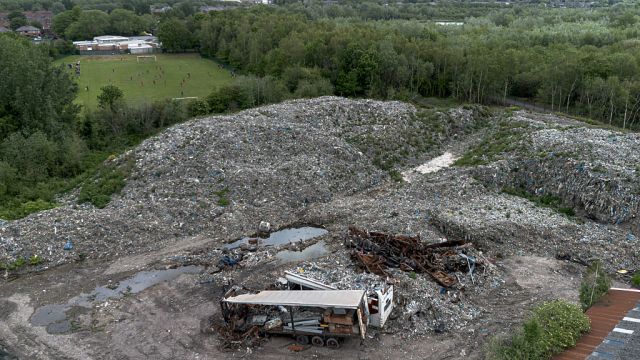
Scott and I litterpick our way past the skeleton of a bench, venture down a graffitied alley, and emerge into a small arena of long-shuttered shops, where we find a a carpet of wind-blown rubbish. We begin to clear it but stop when I hoist aloft a used needle. Scott freezes, as if I’ve just picked up a venomous snake. “I’ve been caught on one of these before,” he says — it required several doses of the hepatitis B vaccine. He takes it from me with a Steve Irwin swagger and drops it into a sealed container. While in theory he should report the needle and leave it alone instead of removing it, he tells me he worries about animals being hurt. Estimates vary, but up to three million animals reportedly die each year after becoming trapped in, or consuming, litter.
Green rubbish bag full, Scott ties it off, places it on the pavement, and uploads a photo and location pin to the third-party Love Clean Streets app to be collected by the local council within 48 hours. While, superficially, this volunteer system is efficient, it does nothing to tackle the root cause of litter. As such, it raises a bigger question: who is responsible for keeping the country tidy?
The most littered areas in the UK are also the most impoverished due to multiple confounding factors: infrastructure challenges like council funding shortages or inefficiencies in street cleaning and waste collection; higher concentrations of fast-food outlets; more smokers and vapers; communal bins stretched further and filling faster, and subsequently — on the basis of there already being more litter — a higher likelihood of more being dropped. A formative (and since replicated) study from 1990 found that people are more likely to litter in already littered environments; rubbish begets rubbish. It’s this latter issue that creates much of the political discourse around litter, with many arguing that the problem is not infrastructural or systems-based, but cultural — and linked to ethnicity and immigration status. It’s a convenient story, and a familiar one.
I ask Scott about this. We’ve moved on to a different estate and I notice that while there is not noticeably more litter than the previous area, the packaging brands are obviously imports catering to an ethnically diverse market. “This area is, how we say, multicultural. Which is part of it,” he says. As we scour the streets, I notice a lot of clear plastic bottles containing rust-tinted liquid which at first I assume is driver Tizer. “That’s called paan,” Scott says, spelling it out:“P-A-A-N.”
Paan is a traditional, chewable stimulant made from ingredients including nuts, herbs, and tobacco wrapped in a betel leaf. It provides a psychoactive effect when chewed before being spat out on the ground or in a receptacle. It’s purportedly popular in South and South East Asian communities. In 2025, Brent Council revealed it spends more than £30,000 a year removing the red spit stains from public places, although it is yet to publish costs for the much larger, racially neutral cigarette butt and vape clean-up.
Scott, who moderates a litter-picking Facebook group, says he frequently spends time reporting racism, as some members blame ethnic minorities for the perceived increase in rubbish on the streets. He says a common argument is that “[ethnic minorities] don’t feel they belong here therefore they don’t respect it”.
This theory is nothing new. In 2018, former Tory MP for Gloucester, Richard Graham, when writing to constituents about new measures to deal with waste in the area, said immigrants were “not used to urban recycling”. In 2008, Gordon Brown’s Labour Government issued plans for town halls to develop information packs, instructing migrants about things like spitting and littering (bad) and queueing in an orderly fashion (good). But while there is room for debate on cultural differences like paan, deprivation, not race, is the primary factor in which areas have the most litter — and in a UK context, people from ethnic minority backgrounds are simply more likely to be in poverty.
Moreover, the war on litterbugs predates the immigration boom by some decades. Harold Macmillan’s Conservative government passed the first anti-littering law in 1958, after pressure from Keep Britain Tidy – an organisation proposed by the Women’s Institute and launched three years earlier. The act made littering illegal for the first time and introduced fines of up to £10 (equivalent to over £200 today). Parliament legislated again in 1971 and 1983, raising penalties, but the laws remained vague until Thatcher’s 1990 Environmental Protection Act cleared up the legislative mess. This clarified that dropping any item of waste is a criminal offence, and allowed local councils to issue on-the-spot penalty notices. It doesn’t appear to have worked. Littering is a phenomenon linked to modern convenience culture which has only become more entrenched with each new innovation. A 2025 survey across England showed that 77% believe the country’s litter problem has got worse in recent years.
Most litterers are never caught, let alone fined. Nationally, littering fines totalled less than £48 million in 2025 from roughly 200,000 fixed penalty notices, less than five percent of the annual £1 billion cleanup cost. Littering is hard — and therefore expensive — to penalise. The crime either has to be witnessed by an enforcement officer, or caught on CCTV in such a way that the perpetrator can be easily (cheaply) identified.
As part of its War on Waste Crime initiative, the Government intends to increase fines by 50% to £750, should councils wish to apply it. Scott thinks this won’t help. “That horse has already bolted,” he says, and offers his own suggestion on how to identify litterers. “It’s not that there’s a lack of evidence,” he says over the click of his picker. “There’s dashcams, cameras outside your house. People are catching people. But we need the police to then enforce it”.
Most parties endorse more police to tackle anti-social behaviour like littering. Labour’s manifesto contained a section entitled Take Back Our Streets which promises to “crack down on antisocial behaviour with more neighbourhood police”. The Tories, meanwhile, recently launched a proposal bafflingly also called Take Back Our Streets which pledges to tackle anti-social behaviour, including littering, through a combination of more police, hotspot patrols, and community-service street-cleaning. It also includes a proposal to roll out the highly controversial Live Facial Recognition (LFR) in the 100 areas with the highest crime rates.
Even Reform UK has long expressed caution about LFR being used to tackle crime — after all, they can empathise with the embarrassment of being caught doing something illegal on camera. Despite having a manifesto you could fit on the back of a crisp packet, they’ve decided to launch a litter policy, perhaps coincidentally because it’s an anti-immigration talking point. I was surprised to learn that their partner in this endeavour is Clean Up Britain, the self-declared politically-neutral lobby group that boasts diver Tom Daley, host Lorraine Kelly, and crisp-salesman Gary Lineker amongst its supporters.
Clean Up Britain was started in 2010 by John Read. John is 65 and, alongside his anti-littering campaigning, owns and manages the British Football Academy in KwaZulu Natal, South Africa. We speak on the phone shortly after he’s touched down at Heathrow. While Clean Up Britain remains committed to “joined-up, effective action,” John is quick to blame the “very large number of selfish, lazy and ignorant people in Britain” for the litter crisis.
“The great thing about running this campaign is we just tell the truth,” he says. “And the truth is immigration is a factor and no doubt some migrants from different cultures treat the country like shit.” He is careful to add that this only applies to “a minority overall,” and that he “wouldn’t want to excuse the indigenous population.” But he reserves his fiercest ire for Keep Britain Tidy — which he describes as “an impotent failed part of the Quangocracy”. “If I was the chief executive of Keep Britain Tidy I’d die a million deaths”.
Keep Britain Tidy is the main source of most data on littering in the UK. It isn’t possible to determine whether the litter problem is because they are rubbish or whether it would be far worse without them. Read, however, believes they exist less to solve the litter problem than to provide “handy greenwashing for corporates”. One example is the fried chicken chain KFC, which has donated £50,000 to Keep Britain Tidy over the last five years. According to Keep Britain Tidy’s own figures, fast food accounts for 22% of litter in the UK.
Criticising the beloved friendly stick-figure-and-bin logo feels akin to kicking Great Uncle Bulgaria in the bin bags, but in April the Times reported that Keep Britain Tidy had received a £10 million donation from the tobacco industry, conveniently hidden behind a middleman, Clean Streets CIC. This led to a public statement from Action on Smoking and Health distancing themselves from — and condemning — the donation. Nonetheless, Keep Britain Tidy has a platinum rating on CharityScore, and a YouGov poll ranks it the 20th most trusted charity, just below the Royal British Legion.
John Read’s rival organisation, Clean Up Britain, also wants to partner with politicians and influence policy. In June, they invited every major political party to collaborate on the issue of litter. The obvious respondent would be Greens, but the party seems to have tossed the issue aside; their 2024 manifesto does not mention litter once. When I ask him why he’s working with Reform UK, Read says that it was simply the only party to respond. He theorises that “maybe a lot of their support base are very patriotic and, you know, care about the country.”
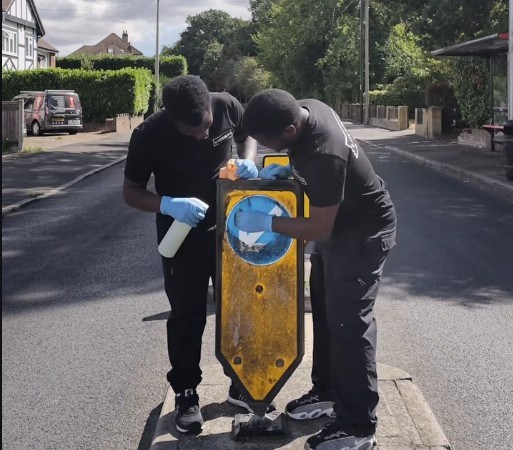
While the UK debates these varying methods of enforcement, countries like Japan prove that cultural intervention in schools and prioritising civic pride can transform litter culture. While the UK has non-mandatory education schemes (such as Keep Britain Tidy’s eco schools programme), it lacks a national effort to foster personal responsibility for clean streets. In the absence of state-led cultural change, social media is beginning to pick up the slack. Anti-litter influencers such as James and John Makanjuola, better known as The Maka Twins, have stepped up to inspire accountability. Now both 25 and living in London, they set up a commercial cleaning company after university and have since made their name on social media as the pair who will “clean the places nobody asked us to clean”.
“Our mission is to make cleaning fun, change lives through cleaning, and help the community,” James tells me. Through their content, they want to inspire a “culture, mind, and perspective change”. Their philosophy echoes that of the successful government interventions in Japan. “What we do is mainly targeted towards kids and the younger generation,” John says. “By the time they grow, cleaning will be instilled in them.” As part of their campaign, they workshop games for young people to create positive associations with binning rubbish. The pair talk about bringing pride back to cleaning, and believe that the issue of untidy streets “boils down to the individual.”
And in the absence of a more broadly shared sense of personal responsibility, it falls on a few individuals more than others. Litter is the most visible symptom of a country that has stopped caring: the overflowing bins, the verges strewn with takeaway wrappers, and grubby high streets. If the answer lies in civic pride, litter presents a grimly circular problem: the more deprived the area, the more litter there will be, which in turn reduces civic pride.
I catch up with Womble Scott. He’s amiable but seems more frustrated than when we were picking litter. “Although there’s thousands of us doing it,” he says defeatedly, “I honestly think if we don’t see light at the end of the tunnel, I shall think ‘I’ve been doing it for seven years, I want to go fishing’.”
***
Additional reporting by Tracy King